What Is Flatpay?
Flatpay is the European payment terminal provider with transparent flat-rate pricing for SMBs. Founded in Denmark in 2022, Flatpay challenges traditional card processors that charge variable percentages depending on card type, transaction size, and unclear fee structures. Flatpay charges one flat rate regardless of card type.
The pitch is predictability. Most European SMBs sign with payment processors that quote a "starting" rate but actual statements show different effective rates after interchange, scheme fees, premium card surcharges, and other variables. Flatpay's flat rate eliminates these surprises.
The product covers physical card terminals for retail, restaurants, salons, and service businesses, plus mobile readers for businesses on the move. Settlement happens in 1-2 business days. Most onboarding completes within a week.
Get Flatpay Get started →How Flatpay Works
Sign up online with business information and bank details. Compliance verification typically completes within 3-5 business days. Once approved, Flatpay ships your terminal hardware.
Terminals come pre-configured for your account. Plug in, connect to internet (wired or 4G), and start accepting cards. Standard EMV chip-and-PIN, contactless (NFC including Apple Pay and Google Pay), and traditional magstripe all supported.
Pricing is flat per transaction: typically 0.99% to 1.49% depending on tier and transaction volume. No per-transaction fixed fee on most plans. No surcharges for premium cards, corporate cards, or American Express. The rate you sign on is the rate you pay.
Settlements transfer to your bank account in 1-2 business days. Statements show every transaction with the same flat rate applied. No reconciling effective rates against quoted rates.
Reporting dashboards show daily revenue, transaction counts, and reconciliation views. Integration with major POS systems (Square, Lightspeed, Vend) and accounting platforms (QuickBooks, Xero) feeds data into existing workflows.
Flatpay Pricing in 2026
Terminal rental: €19-€29/month per terminal depending on model.
Transaction rate: Flat 0.99% to 1.49% based on monthly volume tier. Higher volume tiers earn lower rates.
No setup fees, no PCI compliance fees, no statement fees: the rate is the rate.
Compared to traditional processors quoting 1.6%+0.10 + variable fees, Flatpay typically saves 0.3-0.6% on effective rates. For a business processing €100,000/month, this translates to €300-€600/month in savings.
See Flatpay Pricing See plans →Where Flatpay Wins
- Transparent pricing: one rate, predictable bills.
- No surprise fees: no per-transaction, no premium card surcharges, no scheme fee passthrough.
- Fast onboarding: account live within a week.
- Modern terminals: contactless, mobile wallets, EMV all supported.
- European focus: tuned for Nordic and Western Europe regulations.
Where It Falls Short
- Limited geographic coverage: Denmark, Netherlands, Germany, expanding to other markets.
- No US offering: not for businesses outside Europe.
- Smaller brand than SumUp or Stripe Terminal: less recognition in procurement.
- Online-only model: physical terminals only, no native e-commerce gateway (use Stripe online).
Flatpay vs SumUp vs Stripe Terminal vs iZettle
Finance tools, published pricing
| Tool | Pricing | Model |
|---|---|---|
| Xero | $15/mo (Early), $42/mo (Growing), $78/mo (Established) | Subscription |
| Aplos | $59/mo (Lite), $99/mo (Core), $189/mo (Advanced) | Subscription |
| Heard | $149/mo (lowest published recurring price) | Subscription |
| Aspire | $200/mo (lowest published recurring price) | Subscription |
| Compliancely | $200/mo (lowest published recurring price) | Subscription |
SumUp is the European card reader category leader with similar SMB focus. Comparable pricing.
Stripe Terminal targets developers wanting custom integrations. More flexible, more technical setup.
Zettle by PayPal (formerly iZettle) has wide European presence with similar pricing model.
Adyen targets enterprise European businesses with broad omnichannel payments.
Who Should Use Flatpay
European SMBs tired of variable card processing fees: predictability is the main value.
Retail and restaurant businesses: physical card payments at counter.
Service businesses with mobile teams: trades, beauty professionals, food trucks.
Skip it if: you operate primarily online (use Stripe), outside Flatpay's coverage areas, or need enterprise omnichannel.
How Flatpay works
Flatpay is a European merchant payments provider aimed at small physical businesses. It sells three things: a standalone card terminal, full POS kits, and an online payments gateway. The commercial pitch is a single flat percentage per transaction with no monthly subscription and no fixed per-transaction fee, whatever card the customer presents. On the UK site that is 1.49% for the terminal-only product and 1.69% for POS, falling to around 0.99% (or a custom rate) once annual turnover passes £200,000. Flatpay says it serves over 70,000 merchants across Europe, and its online product runs on the Frisbii platform.
There is no self-serve signup. The flow is a consultation with a Flatpay rep, then a custom quote, then an on-site installation where a technician sets up the hardware and trains your staff. Terminal-only merchants get a PAX A920 Pro Android card reader at no setup cost: you plug it in and connect it to WiFi. POS Pro (£1,495) ships a Lenovo Tab K11 tablet, a terminal, an external printer, a cash drawer, stands and a receipt roll. POS Premium (£2,495) swaps the tablet for a CPOS X5 15.6in touchscreen with a built-in printer.
The POS software covers products and inventory, table management, split bills, dine-in versus takeaway, kitchen printing, barcode scanning, discounts, refunds, email receipts and sales reporting, all administered from a merchant portal. Online payments plug into Shopify, WooCommerce, Magento, PrestaShop, OpenCart, Drupal, Shopware, Dynamicweb, Ucommerce, VirtueMart and Ideal Shop, with an API key route for anything not on that list. Settlement is a daily weekday payout.
Where Flatpay wins
- One flat rate across all card types, with no monthly subscription and no fixed per-transaction fee, so your effective cost is predictable without decoding an interchange++ statement.
- On-site installation and staff training are included rather than billed as a professional-services line, which matters for a cafe or salon with no IT person.
- Zero setup cost and zero hardware outlay on the terminal product: the PAX A920 Pro is provided and only needs WiFi.
- Daily weekday payouts instead of the multi-day rolling settlement common with legacy acquirers.
- The POS software handles hospitality specifics out of the box: table plans, split billing, kitchen printing, dine-in and takeaway modes.
- The online gateway ships prebuilt plugins for eleven named ecommerce platforms, plus an API-key fallback for custom stacks.
Where it falls short
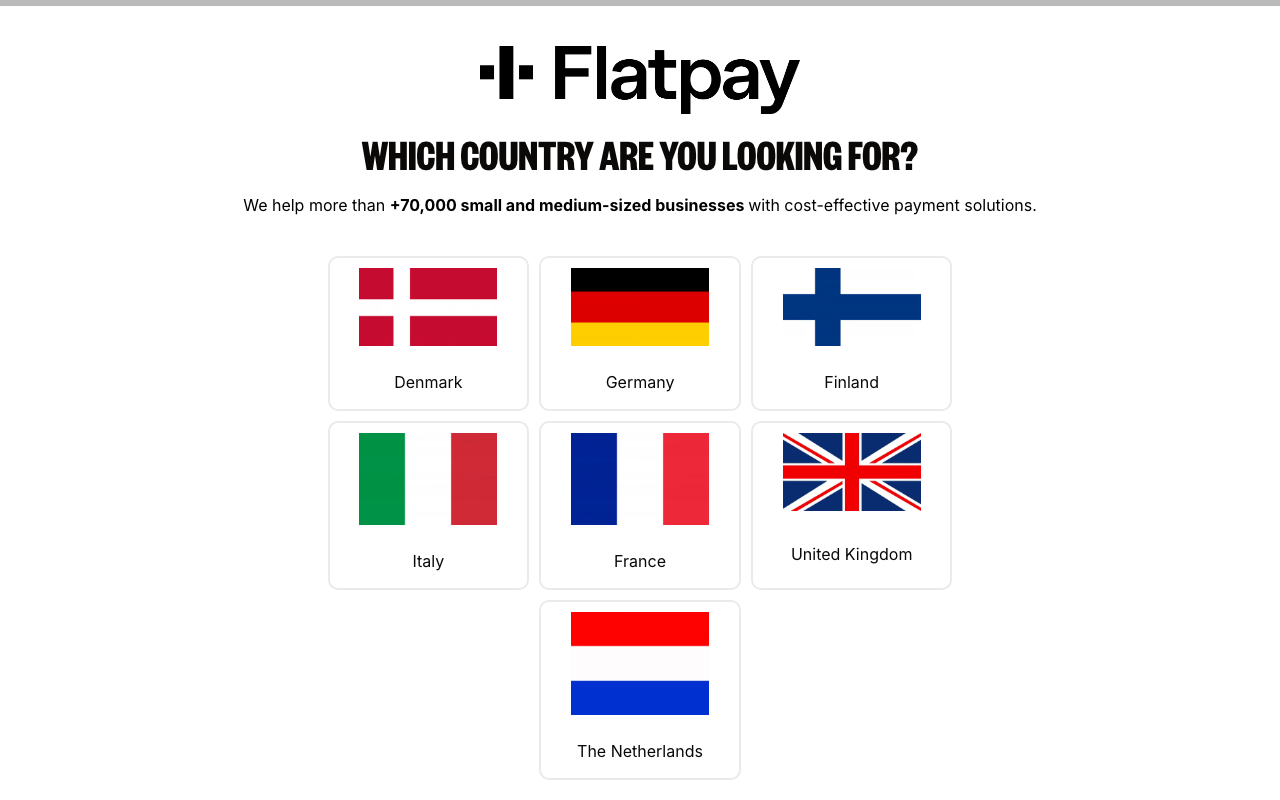
- Europe only. The site lists Denmark, Germany, Finland, Italy, France, the UK and the Netherlands, with pricing and product mix varying by market. No North America, no APAC.
- POS hardware is a real upfront cost (£995 mPOS, £1,495 Pro, £2,495 Premium) and the POS rate of 1.69% is higher than the 1.49% terminal rate, so the all-in-one option costs more on both axes.
- The 0.99% headline rate is gated behind £200,000+ annual turnover. Below that you pay 1.49% to 1.69%, which is uncompetitive for a high-volume merchant who could negotiate interchange++.
- Online payments charge 1.99% for non-EU and corporate cards, roughly double the EU card rate, so international or B2B ecommerce revenue costs materially more than the advertised number.
- No self-serve signup and no public pricing calculator. You go through a sales consultation and a custom quote, which slows evaluation and keeps rates opaque until you talk to someone.
- Thin developer documentation. Beyond plugins and an API key, the marketing pages publish no API reference, SDK list or webhook spec for the online product.
Who should use Flatpay
Flatpay fits small and mid-size European brick-and-mortar merchants: restaurants, cafes, bars, salons, barbershops, small retail and food trucks. If you are doing under a few hundred thousand a year, want a fixed and readable rate, and would rather have someone physically come and install the kit and train the staff than work it out yourself, this is a sensible option. The daily weekday payout and the included training are the practical reasons to pick it over a self-serve competitor.
Skip it if you are outside Flatpay's seven European markets, since there is no coverage elsewhere. Skip it if you are a high-volume merchant who can get better economics on interchange++, because 1.49% to 1.69% will cost you more than a negotiated rate. Skip it if most of your online card volume is non-EU or corporate, where the 1.99% rate applies. And skip it if you want to sign up and be live within the hour without a sales call, because that path does not exist here.
Frequently Asked Questions
Which countries are covered?
Denmark, Netherlands, Germany primarily; expanding to other European markets.
How fast is settlement?
Typically 1-2 business days.
Are American Express cards accepted?
Yes at the same flat rate as other cards.
Does it support Apple Pay and Google Pay?
Yes natively via NFC contactless.
Are there any hidden fees?
The promise is no hidden fees: no per-transaction, no setup, no PCI fees, no statement fees.