
What Is Evolve?
Evolve is the AI-powered enterprise platform that helps mid-market and enterprise companies build, train, and deploy custom AI agents for specific business workflows. The product positions itself between general-purpose AI assistants (ChatGPT, Claude) and full enterprise platforms (Microsoft Copilot Studio, Salesforce Einstein), offering workflow-specific automation without the complexity of full enterprise rollout.
The pitch is operationalizing AI beyond chat. Most companies have ChatGPT subscriptions but few have automated meaningful workflows with AI. Evolve identifies repetitive business processes (customer onboarding, contract review, support triage, IT ticket categorization, sales research) and helps you build AI agents that execute those workflows autonomously with appropriate human oversight.
The product targets companies in the 200-5,000 employee range with established processes ripe for automation. Smaller organizations may not have enough volume to justify the platform; larger enterprises may use Microsoft, Salesforce, or Google AI tools depending on their existing ecosystem.
Request Evolve Demo Get started →How Evolve Works
Engagement starts with workflow identification. Evolve's team works with you to map current business processes, identify automation candidates, and prioritize based on impact and complexity. Output is a roadmap of agents to build over 3-12 months.
For each agent, define the workflow: trigger events, data sources, decision logic, output actions, and human oversight points. The visual workflow builder makes this configurable by business users rather than requiring developer involvement.
Connect data sources and tools through native integrations or APIs. Common connections include Salesforce, HubSpot, Slack, Microsoft Teams, Google Workspace, ServiceNow, Jira, and custom databases. The agent reads from and writes to these systems as part of its workflow.
Choose the underlying LLM. Evolve supports OpenAI, Anthropic, Google, Microsoft Azure OpenAI, and on-premise models. The multi-model approach means companies can pick based on cost, performance, or compliance requirements per agent.
Governance and monitoring run continuously. Audit logs capture every agent action; approval gates pause for human review on high-stakes decisions; content filtering prevents inappropriate outputs; and bias monitoring tracks output patterns by demographic data when applicable.
Evolve Pricing in 2026
Enterprise pricing model. Annual contracts typically start at $50,000-$100,000/year with custom pricing based on agent count, integration depth, and feature mix. Larger deployments reach $500K+/year.
Sales engagement required. Procurement processes typically take 3-6 months from initial conversation to contract signing.
Get Evolve Pricing See plans →Where Evolve Wins
- Workflow-first approach: targets real business processes rather than generic chat.
- Governance built in: audit logs, approval gates, content filtering for enterprise compliance.
- Multi-model support: not locked to one LLM provider.
- Visual workflow builder: business users build agents without engineering.
- Enterprise integrations: native connectors to major business tools.
Where It Falls Short
- Enterprise pricing: out of reach for SMBs.
- Long sales cycle: months from first call to deployment.
- Less brand recognition: Microsoft Copilot Studio and Salesforce Einstein have larger ecosystems.
- Setup investment: meaningful onboarding effort before agents deliver value.
Evolve vs Microsoft Copilot Studio vs Salesforce Einstein vs Dify
Microsoft Copilot Studio is the default for Microsoft 365 shops with strong Teams and Office integration. Pick Copilot if you already live in Microsoft.
Salesforce Einstein is built into Salesforce with native CRM integration. Pick if you already use Salesforce extensively.
Dify is the open-source alternative. Lower cost, requires more technical capability, less governance.
n8n handles general workflow automation with AI capability added; weaker enterprise governance.
Who Should Use Evolve
Mid-market and enterprise companies operationalizing AI: workflow-focused approach fits.
Companies needing AI governance: audit logs and approval gates matter for regulated industries.
Multi-tool environments: integrations across Salesforce, ServiceNow, Microsoft, custom databases.
Skip it if: you are a small team (use ChatGPT Team or Dify), you already have Microsoft or Salesforce footprint, or you cannot commit to enterprise procurement process.
How Evolve works
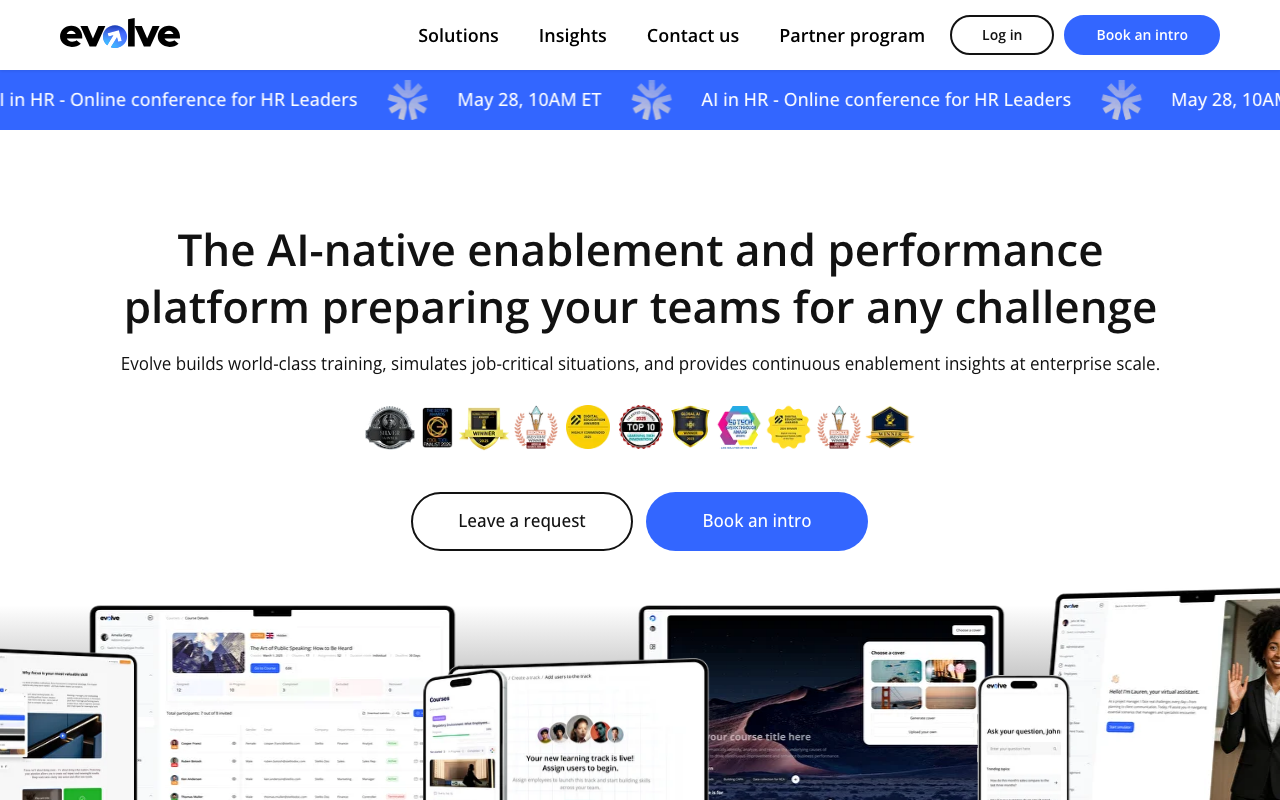
Evolve (evolveplatform.ai) is an AI-native corporate learning and enablement platform aimed at enterprise L&D teams. It is sold as six modular but connected products: Evolve LMS (learning paths, roles, audiences, branded academies, analytics), Evolve Course Generate, a file-to-course engine that turns raw internal documents into practice-first training, Evolve Studio for manual authoring, Simulations where learners practice job-critical conversations against AI counterparts, a Knowledge Base that turns internal files into an instant-answer engine, and an Assessment Center for AI-assisted skill and behavior evaluation.
You can adopt the whole lifecycle or a single module. The typical setup is to upload existing materials (decks, PDFs, policy docs) into Course Generate to produce structured courses, refine them in Studio, then deliver through Evolve LMS with role-based auto-assignment rules, reminders and learning paths that mix courses, assessments and events. Content can instead be exported as SCORM packages into an LMS you already own, or Evolve features can be wired into your stack via API. The vendor explicitly positions three deployment modes: standalone, API into existing systems, or SCORM export.
On the plumbing side, authentication supports SAML and OpenID SSO, and the platform maintains a live org structure with roles and permissions. Named integrations include Microsoft Office and Entra, Google Drive, Salesforce, HubSpot, SAP, Jira, Confluence, Zoom, BambooHR, HiBob, Notion and Slack. Both the web platform and the iOS and Android apps are fully white-labelable. Compliance is stated as SOC 2 and GDPR, with a public Trust Center. The entry point is "Book an intro" or a request form. The vendor claims 100+ enterprises and 2.9M+ learners, naming Danone, Carlsberg, Schneider Electric and PostFinance as customers.
Where Evolve wins
- The file-to-course generator is the concrete differentiator, and it comes with named customer detail: Schneider Electric "built 50+ courses from mixed content", and a customer quote cites 58 courses created or debugged, including faster SCORM package production.
- You are not locked in. SCORM export means content you generate can run in your existing LMS, and API-only adoption is offered instead of a full platform migration.
- Evaluation goes past completion tracking. AI simulations and the Assessment Center handle behavioral evaluation and benchmarking, and Danone reports 3x faster medical rep assessments.
- Full white-labeling of the web platform and the native iOS and Android apps, plus branded academies and role-based audiences.
- Enterprise plumbing is present rather than promised: SAML and OpenID SSO, HRIS, HCM, CRM and ERP connectors, SOC 2 and GDPR, and a public Trust Center.
Where it falls short
- No published pricing. The /pricing/ URL exists but renders the homepage content with only "Book an intro" and "Leave a request" CTAs. There is no tier table, no per-seat rate and no stated minimum, and figures circulating in third-party listicles are not confirmed on the vendor site.
- No self-serve signup and no advertised free trial. The closest offer is a sales-qualified "leave a request and get your free course built from your own materials".
- Integration claims are inconsistent. The integrations page says 100+ enterprise systems while the LMS page says "50+ tools", only about a dozen are actually named (as logos), and there is no public API reference or connector catalog.
- Small-vendor signals. The site footer directs questions to the founder's personal email ([email protected]) and lists a Delaware registered-agent-style address. Fine for a partnership, worth diligence if you need vendor stability guarantees.
- Effort is front-loaded on you. Value depends on feeding it good source material and defining roles, org structure and assignment rules. This is not a drop-in tool.
Who should use Evolve
Evolve suits enterprise and upper-mid-market L&D teams sitting on a large backlog of existing documents that need converting into training, particularly those with distributed or regulated workforces where role-based delivery and behavioral assessment both matter. If your problem is that the knowledge already exists inside decks and policy docs and nobody has time to turn it into courses, that is the exact problem Course Generate is built for, and the SCORM export route means you can test that without replacing your LMS.
Skip it if you are an SMB wanting to swipe a card and start today, if you need public pricing to build an internal business case, or if a course marketplace and off-the-shelf library matter more to you than generating training from your own content.
Frequently Asked Questions
Does Evolve support custom LLMs?
Yes. Multi-model support including OpenAI, Anthropic, Google, and on-premise deployments.
What deployment options exist?
SaaS and on-premise available depending on contract.
How long does deployment take?
3-12 months for full deployment of first set of agents depending on complexity.
Can business users build agents?
Yes through the visual workflow builder. Complex agents may need developer assistance.
What governance features are included?
Audit logs, approval gates, content filtering, bias monitoring, role-based access control.