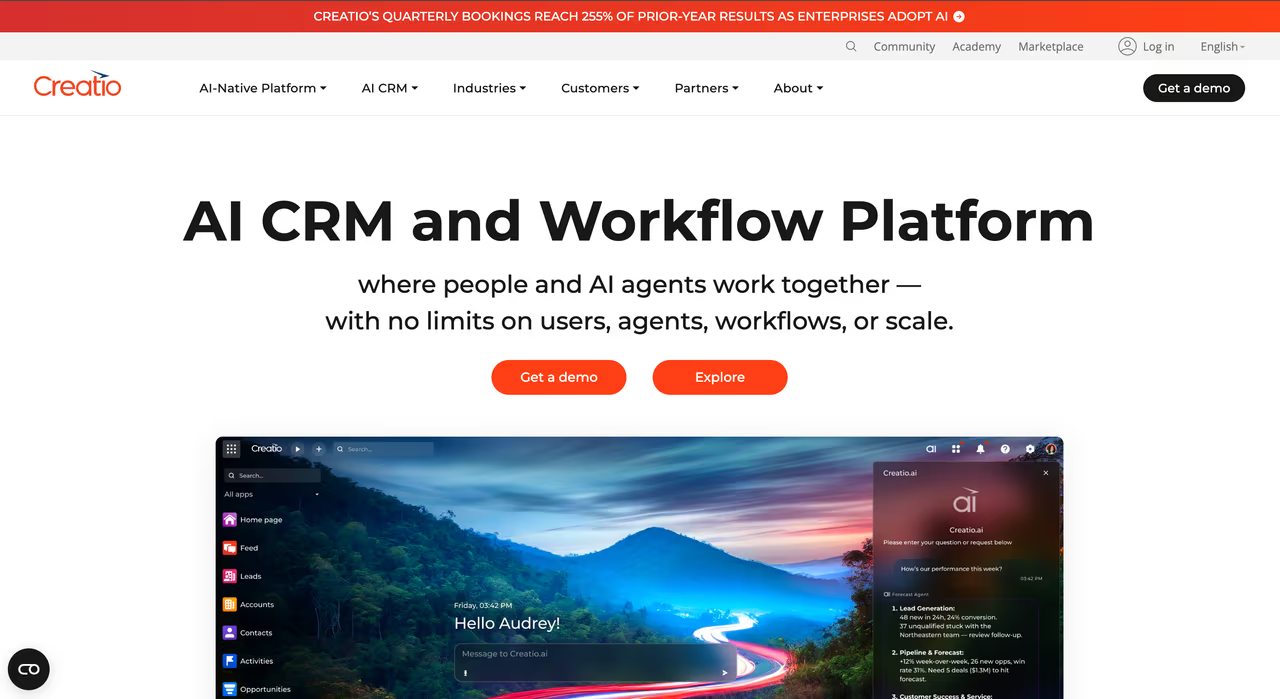
What is Creatio?
AI CRM and workflow platform where teams and AI agents run sales, marketing, and service on one system.
Creatio handles the process behind the record, not just the record. If your sales cycle involves approvals, quotes, and handoffs that currently live in email, that's the gap it targets.
How We Evaluated Creatio
We scored Creatio on five things: workflow automation depth, AI capability, how far you can customize without a developer, integration coverage, and pricing transparency. Same rubric we apply to every CRM in the directory, so the scores line up.
That meant working in the product, testing the features that matter most for revenue teams, reading the docs, and checking whether pricing sits in the open or behind a sales call. We also weighed it against Salesforce and Microsoft Dynamics 365 to place it.
Key Features
What Creatio actually gives you:
- AI agents across the lifecycle: Ready-to-use agents enrich records, score leads, prep meetings, and triage cases, and because the AI reads your CRM objects and workflows directly, they act on business context instead of a text prompt
- No-code automation: Business users build and change workflows through configuration and natural-language prompts, not developer tickets
- Full CRM coverage: Sales, Marketing, and Service run on one data model and one automation engine
- Build your own agents: AI Studio lets you create, deploy, and govern custom agents in natural language, and AI Twin lets any employee spin up a personal agent that inherits their exact permissions
- Composable licensing: Start with one product, add the others as you need them
Pricing
Creatio follows a composable subscription model. The platform (Creatio Business & AI Studio) starts at $40 per user/month (Growth), with an Enterprise tier at $75 per user/month. Each CRM product (Sales, Marketing, or Service) adds $15 per user/month, and all plans include the core platform and built-in AI.
For organizations rolling out AI across the business, the Unlimited Enterprise plan drops per-seat counting altogether. It covers unlimited users, AI agents, workflows, applications, custom objects, and API calls, and Creatio quotes it per deal rather than publishing a rate.
There's no free tier and no trial. Evaluation starts with a guided demo, which means you can't kick the tires before you talk to someone, plan for that in your timeline.
Pros and Cons
What we like
- Business teams change the system themselves. You configure data models, business rules, and end-to-end processes without filing a ticket with IT, the difference between adapting a CRM quarterly and adapting it once a year. Nucleus Research put implementation at 70% faster and total cost of ownership at 37% lower than legacy CRM systems, measured on companies that moved off Salesforce and Microsoft
- AI is native, not bolted on. Creatio.ai reads CRM objects, workflows, and the relationships between them, so agents act with business context instead of guessing from a prompt. Every app ships with agents you can use on day one, and AI Studio lets you build more without code
- Automation doesn't stop at the customer. Approvals, onboarding, procurement, and compliance run on the same engine and the same data, so you're not stitching a CRM to a separate workflow tool
- Scale isn't a licensing negotiation. The Unlimited Enterprise plan lifts caps on users, agents, workflows, apps, and API calls, so adding AI agents doesn't trigger a renegotiation, and the platform is LLM-agnostic, running on OpenAI, Anthropic Claude, or Google Gemini
What could be better
- No trial and no free tier. Every evaluation starts with a guided demo, and hands-on teams who prefer to test first will find that friction
- The Unlimited Enterprise plan is quote-based, so the number that matters most for a large rollout isn't public
- Depth cuts both ways. A platform that models your processes rewards teams who know their processes, and punishes teams hoping to unbox something and start selling on Monday
Creatio Alternatives
If Creatio isn't the right fit, here are the closest platforms worth looking at:
| Tool | What it does | Pricing |
|---|---|---|
| Salesforce | Enterprise CRM with the largest third-party app ecosystem | From $25/user/mo |
| Microsoft Dynamics 365 | Enterprise CRM and ERP suite tied into the Microsoft stack | From $65/user/mo |
| Zoho CRM | Broad, low-cost business suite aimed at small and mid-sized teams | From $14/user/mo |
| Pegasystems | Process automation and decisioning platform for complex enterprise workflows | Quote-based |
We track hundreds of CRM tools in our tools directory. Worth browsing if none of these match what you need.
Who It's For (and Who It's Not)
Good fit: Creatio makes the most sense for mid-market and enterprise teams whose customer processes cross departments and change often, regulated industries, distribution networks, member-facing financial services, public sector casework. Creatio covers more than 20 verticals with prebuilt workflows, so you start from something closer to your business than a blank pipeline.
Skip it if: you want a CRM you can sign up for tonight and use tomorrow, or your process is a single pipeline with five stages and no approvals. At that size, the platform's flexibility is overhead you pay for and never spend.
Bottom Line
We gave Creatio 4.7/5. There's no trial, so the demo is the evaluation, go in with your actual workflows, not a feature checklist.
In short: Creatio suits mid-market and enterprise teams that need customer processes and internal workflows running on one platform, and that expect to keep rebuilding those processes as the business changes. Teams wanting a simple pipeline they can self-serve into should look elsewhere.
How Creatio works
Creatio sits on one AI-native platform, Creatio Business & AI Studio, and layers products on top of it. Creatio Sales covers Customer 360, lead and opportunity management, forecasting and revenue intelligence, sales engagement, order and contract management, and sales productivity. Creatio Marketing covers Customer 360, campaign management, digital ads, lead generation, email marketing, and event management. Creatio Service covers Customer 360, case management, an omnichannel agent workspace, knowledge management, and productivity. Bank.AI adds an industry build for banks and credit unions, with agents for onboarding, loan origination, servicing, and account management. You can license one product or all three, and they share the same data model either way.
Setup starts with your data and your processes rather than a template you accept as-is. You define the objects, configure the business rules, then automate the flow end to end, and business users do that work through configuration and natural-language prompts instead of code. Creatio AI Studio handles the agent side: you build, deploy, govern, and monitor AI agents from one place, connect them to enterprise systems, and set how much autonomy each one gets. Creatio.ai combines generative, predictive, and agentic AI, and because it understands CRM objects and workflows natively, agents work from business context rather than a prompt window.
Every application ships with agents you can use immediately. Sales gets data enrichment, account awareness, lead and opportunity insights, meeting preparation, next best action, and productivity agents. Marketing gets segmentation, campaign generation, email creation, asset generation, campaign optimization, and conversion insights. Service gets case understanding, resolution guidance, knowledge creation, next best action, performance insights, root cause analysis, and productivity agents. You can build more in natural language when the prebuilt set doesn't cover a process, and AI Twin lets individual employees create personal agents that inherit their own roles and permissions.
Connecting Creatio to the rest of your stack runs through the Creatio Marketplace, which carries applications, AI agents, connectors, templates, and industry accelerators from Creatio, its partners, and third-party vendors. Prebuilt connectors and APIs handle ERP, cloud platforms, communication tools, and databases. Agents reach users where they already work (email, SMS, web chat, Microsoft Teams, Slack, and social channels) and surface inside Outlook, Teams, and Zoom. AI Studio stays LLM-agnostic, supporting OpenAI, Anthropic Claude, and Google Gemini.
Where Creatio wins
- Business users own the changes. Configuration and natural-language building replace developer queues, which shortens both the first implementation and every change after it.
- AI comes native, not bolted on. Creatio.ai understands CRM objects, workflows, and relationships across the platform, so agents operate with context instead of a text window, and AI Studio and AI Twin let both IT and individual employees build governed agents without code.
- Automation reaches past the customer. Approvals, onboarding, procurement, and compliance run on the same engine, same data, and same logic as the customer-facing work.
- Scale stops being a licensing question. The Unlimited Enterprise plan lifts caps on users, AI agents, workflows, applications, custom objects, and API calls, so adding agents doesn't trigger a renegotiation.
- Deployments land fast in practice. City of Boston launched a 311 service across 700 users in four months. Howdens went live in 12 weeks. Novem covered its five largest branches in six weeks. Nucleus Research put implementation at 70% faster and total cost of ownership at 37% lower than legacy CRM systems.
- Vertical depth is real. More than 20 industries get prebuilt workflows, which matters most in regulated environments where the process is the product.
Where it falls short
- No trial, no free tier. The demo is the front door, so self-serve evaluation isn't an option.
- The Unlimited Enterprise price isn't public. Creatio quotes it, which makes budgeting an enterprise rollout a conversation rather than a calculation.
- Complexity needs owners. The platform pays back teams who can describe their processes precisely, and stalls where nobody owns process design.
- Ecosystem breadth trails the largest incumbents. The Marketplace covers the common integrations, but you won't find the long tail of niche apps that the biggest CRM ecosystems carry.
- Small teams overbuy. Below roughly 20 seats, most of what makes Creatio strong sits unused.
Who should use Creatio
Two groups get the most out of it. First, mid-market companies that want CRM, workflow automation, and AI on one platform without carrying the implementation overhead of legacy enterprise software, Dunapack Packaging standardized 15 sales organizations across 10 countries and passed 70% user adoption within three months. Second, enterprises and regulated organizations orchestrating cross-functional customer journeys, where the same platform has to handle compliance-aware processes and internal approvals. Everwise Credit Union connected 27 departments on a single member view and cut process inefficiency by 40%.
Skip it if you need one capability cheaply, such as a standalone email tool or a lightweight pipeline tracker, because you'd pay for a platform and use a corner of it. Skip it too if your evaluation process requires hands-on testing before any vendor conversation, since Creatio starts everyone with a guided demo.