What Is Bar Codes Talk?
Bar Codes Talk sells UPC and EAN barcodes for sellers on Amazon, retail marketplaces, and ecommerce platforms. The company provides legitimate GS1-derived barcodes at prices significantly below buying directly from GS1, the official issuer.
The pitch is cost savings on legitimate barcodes. GS1 charges $250+ for initial UPC company prefix registration plus annual fees of $50-$2,000+ depending on number of codes needed. Bar Codes Talk sells individual barcodes from prefixes purchased before 2002 when GS1's exclusivity restrictions changed, allowing legal resale.
The product targets Amazon FBA sellers, small ecommerce brands, and businesses launching products that need barcodes for retail or marketplace listings but cannot justify GS1's enterprise pricing.
Buy Barcodes Get started →How Bar Codes Talk Works
Browse the barcode catalog. Buy individual codes or bulk packages. Receive UPC (12-digit, US) and EAN (13-digit, international) codes via email within minutes of purchase. Each code comes with PNG and EPS graphics ready for product packaging.
Use the barcodes on Amazon listings, retail packaging, scanner systems, and marketplace product registrations. The codes function identically to GS1-issued codes for scanning, lookups, and marketplace acceptance.
Each purchase includes a certificate of ownership documenting the GS1 derivation chain. Amazon and most marketplaces accept this documentation for product registration. Major retailers (Walmart, Target) have stricter requirements that may demand GS1-direct codes for their specific supplier programs.
One-time purchase model means no annual renewal fees. You own the codes permanently. Compare to GS1 where annual fees continue regardless of how many codes you actively use.
Bar Codes Talk Pricing in 2026
One-time purchase, volume-based pricing:
- 1 UPC: $10
- 10 UPCs: $50 ($5 each)
- 100 UPCs: $200 ($2 each)
- 1,000 UPCs: $750 ($0.75 each)
- 10,000+ UPCs: Volume pricing
Compared to GS1's company prefix at $250 + annual fees, savings are dramatic for small sellers needing under 100 codes.
See Barcode Pricing See plans →Where Bar Codes Talk Wins
- Cost savings vs GS1: $10 per code vs $250+ company prefix.
- No annual fees: one-time purchase, codes are yours permanently.
- Fast delivery: codes available within minutes.
- Marketplace acceptance: Amazon, eBay, Walmart Marketplace accept these codes.
- Includes graphics: PNG and EPS ready for packaging design.
Where It Falls Short
- Not technically a "your company" prefix: codes derive from a single corporate prefix purchased pre-2002.
- Some major retailers require GS1 codes: Walmart direct supply, Target direct supply, and certain regulated industries.
- Cannot register a company prefix: for businesses needing thousands of codes, GS1 may be cheaper long-term.
- Pharma and food regulations: some regulated industries require GS1-direct codes.
Bar Codes Talk vs GS1 vs Other Resellers
Operations tools, published pricing
| Tool | Pricing | Model |
|---|---|---|
| Shippo | $19/mo (lowest published recurring price) | Subscription |
| Stamped | $23/mo (lowest published recurring price) | Subscription |
| Housecall Pro | $69/mo (lowest published recurring price) | Subscription |
| SimplePractice | $39/mo (lowest published recurring price) | Subscription |
| Foursixty | $50/mo (lowest published recurring price) | Subscription |
GS1 is the official issuer. Required for direct supplier relationships with major retailers and regulated industries. Expensive but necessary in some contexts.
SnapUPC, Speedy Barcodes, InstantUPCCodes are similar resellers with comparable pricing. Bar Codes Talk has stronger Amazon track record per customer reviews.
NationalBarcode targets businesses needing larger volumes with bulk-focused pricing.
Who Should Use Bar Codes Talk
Amazon FBA sellers: codes accepted, dramatic cost savings.
Small ecommerce brands launching first products: cheap way to test retail.
Sellers needing 1-100 codes: where GS1's enterprise pricing makes no sense.
Multi-marketplace sellers: same codes work on Amazon, eBay, Etsy, Shopify, others.
Skip it if: you sell direct to Walmart, Target, or major chain retailers (need GS1), operate in pharmaceutical or regulated food categories, or need a company prefix for thousands of products.
How Bar Codes Talk works
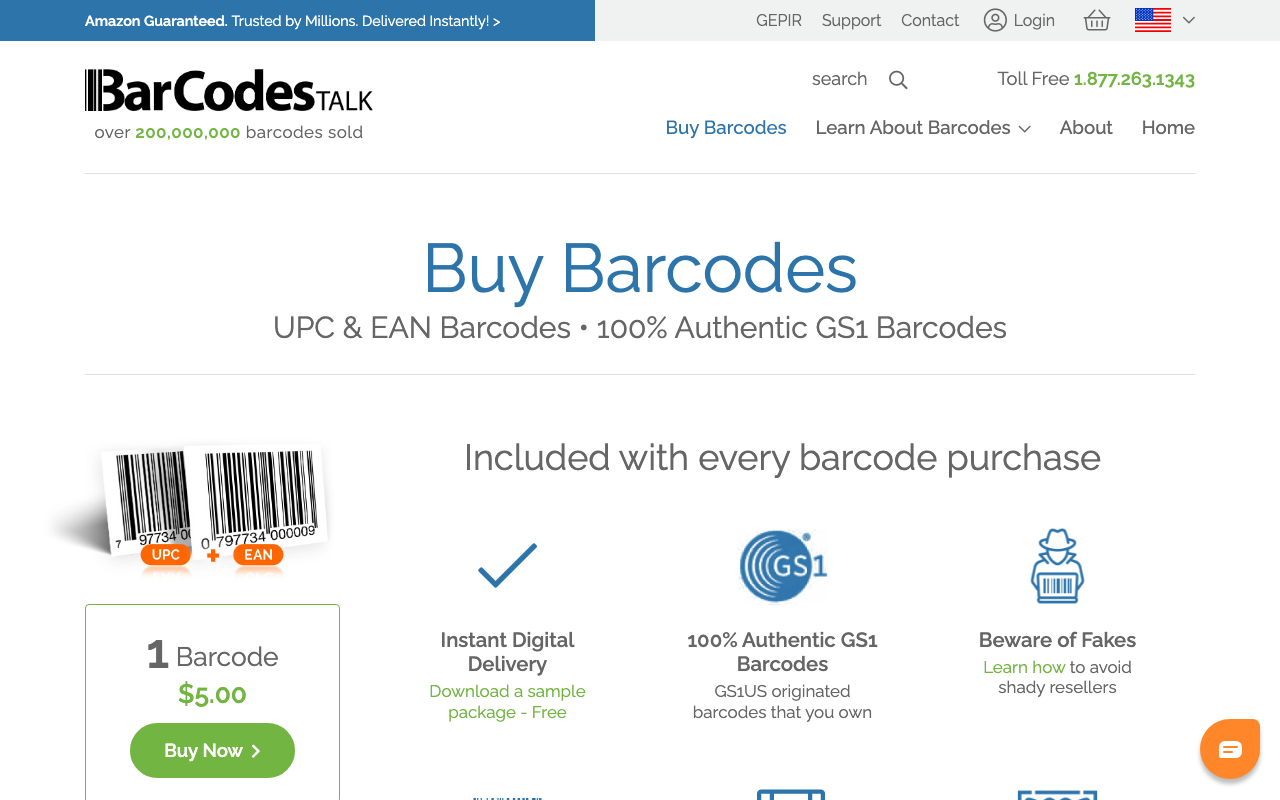
Bar Codes Talk sells UPC and EAN barcode numbers (GTINs) outright to sellers who need product identifiers for retail and marketplace listings. It is worth being clear about what that means, because the category name misleads people: this is not barcode-printing software, and it is not an inventory system. You buy a quantity of numbers, you pay once, and you own them. The company is based in Brooksville, Florida, has been family-run since 1996, and says it has delivered over 200 million barcodes.
There is nothing to install and nothing to configure. You pick a pack size on the buy-barcodes page, pay, and the codes download in seconds. Each purchase includes both UPC-A and EAN-13 artwork at no extra cost, supplied as EPS and JPEG files, alongside Excel and PDF lists of the numbers themselves and a Certificate of GTIN Assignment. The spreadsheets are what you actually use day to day: you upload them into Amazon, Walmart or Shopify listings.
The important mechanical detail is where the numbers come from. Codes are registered in the company's own BCT GEPIR database rather than in GS1's registry. The vendor is upfront that its inventory consists of resold prefixes: companies that bought 6-digit prefixes before the UCC-to-GS1 change and never used them. Ownership is permanent, with no renewals. In the vendor's words, "Once your barcodes are issued they are yours for life."
Around the paid product sits a large set of free browser tools: a bulk barcode generator, an Amazon FNSKU label generator, an FBA fee calculator, a UPC-to-ASIN converter, a SKU generator, a UPC-E converter, and a QR generator and scanner. These are standalone web utilities. They do not require an account and they do not connect to your store.
Where Bar Codes Talk wins
- Pricing is transparent and drops steeply with volume: $5 for 1, $15 for 10, $45 for 100, $180 for 1,000, $650 for 10,000 and $3,500 for 100,000, with no subscription and no annual renewal.
- Delivery is immediate and complete. Every purchase includes UPC and EAN artwork in EPS and JPEG, Excel and PDF number lists, and a Certificate of GTIN Assignment.
- There is a stated "Works for Amazon Guarantee", plus an explicit position from the vendor that Walmart.com accepts its codes.
- The education section is unusually candid for a reseller: one page names the exact retailers that require GS1-issued codes, and another covers how to spot shady barcode resellers.
- The free tools are genuinely useful, particularly the FNSKU label generator in Avery 5160 format and the FBA fee calculator, and there is phone support on a US toll-free line.
Where it falls short
- These are resold prefixes, not GS1-issued numbers. GS1 refuses to enter third-party-sold barcodes into its database, so your brand will never appear as the owner in GS1's GEPIR. Only the original prefix holder does.
- Several major retailers will not accept them. The vendor's own page lists Walmart and Sam's Club, Kroger, Costco, Home Depot, Lowe's, Macy's, Nordstrom, Wegmans and Fred Meyer as requiring GS1-direct codes, with Target, Whole Foods, Walgreens and Publix flagged as "may require". Amazon Brand Registry members also need GS1-direct codes.
- It sells numbers, not a system. There is no inventory module, no catalogue, no label-print pipeline and no store integration. The free tools are separate one-off utilities.
- Codes are effectively single-product for life. The vendor itself discourages reusing a barcode on a different product, noting that most retailers and marketplaces do not allow it.
- Buying one code at a time is poor value at $5 per unit. The economics only work if you buy a pack sized well beyond your current need.
Who should use Bar Codes Talk
This fits Amazon FBA, Etsy, eBay and Shopify sellers, and small brands that need cheap, permanent GTINs quickly and are not enrolled in Brand Registry or sitting on a big-box retailer's shelf. If you are launching 40 SKUs and need identifiers this afternoon, the $45 hundred-pack solves the problem for good.
Skip it if you sell into Walmart stores, Kroger, Costco or Home Depot, if you plan to enrol in Amazon Brand Registry, or if you want your company listed as the brand owner in GS1's registry. In those cases the cheaper-looking option becomes the expensive one, and you should pay GS1 directly.
Frequently Asked Questions
Will Amazon accept these barcodes?
Generally yes. Amazon's branded product requirements changed in 2016 but reseller codes still work for most sellers with brand registry.
Are these legitimate barcodes?
Yes. Derived from a corporate prefix issued by GS1 prior to 2002 when exclusivity restrictions changed.
Do they work on EAN-13 internationally?
Yes. UPC-12 codes are subset of EAN-13; work in both US and international contexts.
Can I resell these codes?
No. Each code is licensed to one product/brand. Reuse on different products violates the terms.
What if Amazon rejects my code?
Bar Codes Talk offers documentation showing GS1 derivation. Most rejections resolve with this documentation.