
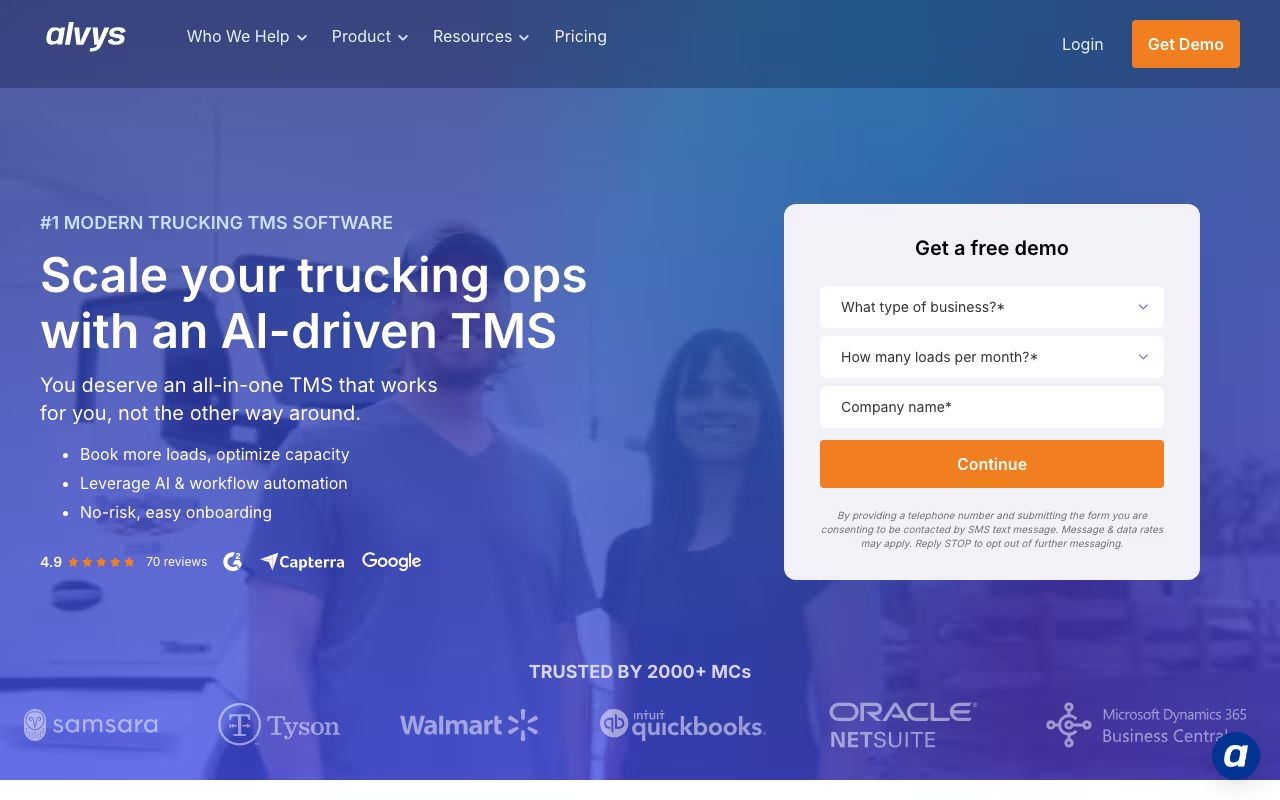
If you've used McLeod or TMW, you know the feeling: powerful software that looks like it was designed in 2005. Alvys is the opposite. Founded in 2020 and backed by $77M in funding (including a $40M Series B in September 2025), it's a cloud-native TMS that covers both carrier and brokerage operations in a single platform.
That hybrid angle is the real differentiator. Most TMS tools force you to pick a lane: carrier or broker. Alvys lets you toggle between both. If you're running a brokerage that also has assets, or a carrier that brokers overflow freight, that's a big deal.
See Alvys in Action Get started →What Makes Alvys Different
Carrier + broker in one system. Load management, dispatch, carrier sourcing, tracking, document handling, settlements, and accounting integration. All cloud-based, accessible from anywhere.
AI features that actually ship. AI rate confirmation reading extracts load details automatically (40%+ accuracy improvement in 2025). Dispatch Assist (in beta) recommends asset assignments. Agentic Reporting, coming in 2026, lets you query your data in plain language.
Native EDI with no third-party fees. 63% of customers pursuing contracted freight through Alvys EDI won new customers within their first year. That's a stat worth paying attention to.
120+ integrations included. ELDs, QuickBooks, DAT, Truckstop, and more. No extra per-integration fees.
Unlimited users. No per-seat pricing, which is unusual in TMS land.
Pricing
Alvys uses load-based pricing. No setup fees, no per-user charges, cancel anytime. The four tiers:
- Carrier: From ~$150/month. Dispatch, driver app, accounting, compliance.
- Broker: From ~$300/month. Load board integrations, carrier management, invoicing.
- Hybrid: Custom quote. Combined carrier + broker workflows.
- Enterprise: Custom quote. Advanced analytics, unlimited divisions, premium support.
Annual billing saves more. You'll need a demo for exact numbers since pricing scales with load volume.
Get Alvys Pricing See plans →Strengths
- Modern UX: 4.9/5 on G2 and Capterra. Users consistently cite the interface as the reason they switched.
- Fast onboarding: Implementation in days, not the weeks/months that legacy TMS vendors require.
- Active development: Driver Settlements, Marketplace, AI rate con reading all shipped in 2025.
- Native mobile driver app: Document scanning, status updates, communication. iOS and Android.
Limitations
- Reporting accuracy: Some users report data discrepancies between different report areas. Analytics is improving but not yet bulletproof.
- No built-in CRM: You'll still need a separate tool for sales pipeline management.
- Frequent updates can disrupt: Fast development means occasional workflow interruptions when features change.
- Young platform: 2,000+ trucking companies use it, but McLeod and TMW have decades of edge-case handling baked in.
Alvys vs. the Competition
Operations tools, published pricing
| Tool | Pricing | Model |
|---|---|---|
| Alvys | Transportation management, custom fleet-based pricing | Subscription |
| Shippo | $19/mo (lowest published recurring price) | Subscription |
| Stamped | $23/mo (lowest published recurring price) | Subscription |
| Housecall Pro | $69/mo (lowest published recurring price) | Subscription |
| SimplePractice | $39/mo (lowest published recurring price) | Subscription |
| Foursixty | $50/mo (lowest published recurring price) | Subscription |
McLeod/TMW: Deep enterprise features, legacy interfaces. If you need every niche feature imaginable, they've got it. If you want your team to actually enjoy using the software, look elsewhere.
AscendTMS: Free basic tier is compelling for startups. But you outgrow it fast, and the paid tiers don't match Alvys on modern features.
Tai TMS: Similar modern approach, competing for the same "replace your legacy TMS" market.
Alvys wins on the hybrid carrier/broker angle and the no-per-seat pricing. If either of those matter to your operation, it's hard to beat.
Start Your Free Alvys Demo Get started →How Alvys works
Alvys is a cloud transportation management system (TMS) for trucking, positioned as an operating system for the whole load lifecycle: creation and dispatch through tracking, delivery, invoicing and driver settlement. It serves asset-based carriers, freight brokers, hybrid asset plus brokerage operations, private fleets and multi-division enterprises. The company says 3,000+ trucking companies run on it. It was founded by an operator who built the first version to run his own freight, and it raised a $40M Series B led by RTP Global.
In practice you configure divisions, users, drivers, equipment, customers and carriers, then run loads through dispatch boards with real-time status and automated alerts on at-risk loads. AI handles document ingestion, load creation from rate confirmations, and dispatch and communication routing. Drivers work from an iOS/Android app to scan documents, send status updates, message dispatch and pull eChecks, with EFS and ComData supported.
Compliance tracking covers driver records, hours of service and FMCSA requirements. On the accounting side there is one-click invoicing and billing, customizable driver, agent and carrier settlement structures, and an IFTA calculator with fuel and mileage tracking. Connectivity comes from 120+ prebuilt integrations at no extra cost spanning ELDs, load boards, factoring and accounting systems, plus native EDI for shipper load tenders and status updates, and a public API for custom reporting.
Where Alvys wins
- Genuinely all-in-one: dispatch, driver app, compliance, accounting and settlements, and IFTA in one system, instead of a TMS plus three bolt-on tools stitched together.
- Unlimited users and unlimited business divisions included at no extra cost. That is unusual in TMS, where per-seat pricing normally punishes growth and makes carrier plus brokerage hybrids expensive.
- Native EDI is included rather than sold as an enterprise add-on, so shipper tenders and status updates sync automatically.
- 120+ integrations bundled at no extra cost (ELDs, load boards, factoring, accounting), plus a public API for reporting you build yourself.
- Fast implementation for the category: Alvys says carriers can be live in days and cites under two weeks on the accounting side, with onboarding delivered through webinars or one-on-one sessions.
- No long-term contract, and you can cancel at any time.
Where it falls short
- Pricing is not published. It is load-based (monthly or annual) and the pricing page returns a 401, so you cannot budget without talking to sales. There is no free tier and no self-serve signup.
- Load-based pricing scales cost directly with volume, which is the opposite of the unlimited-users pitch and a poor fit for high-load, low-margin operations unless you negotiate the per-load rate hard.
- The site names almost no integration partners specifically. The 120+ figure and the categories (ELDs, load boards, factoring, accounting) are stated categorically, so whether your particular ELD or accounting package is covered has to be confirmed with sales before you commit.
- Strongly North America-centric: FMCSA compliance, IFTA, and EFS/ComData checks. Nothing on the site suggests it serves non-US operations.
- Marketing leans on unverifiable outcome claims (2-4x more loads, 40-50% overhead reduction, 22% load volume growth in four months) with no methodology attached. Treat those as testimonials, not benchmarks you should expect to hit.
Who should use Alvys
Alvys makes the most sense for small to mid-size US carriers and brokers, and especially hybrid asset-based brokers, who have outgrown spreadsheets or a legacy on-premise TMS and want dispatch, compliance and settlements living in one place rather than reconciled across systems. The unlimited-users and unlimited-divisions model is particularly attractive if you run multiple entities or are adding back-office headcount, since seat count stops being a budgeting question.
It is a poor fit if you need published pricing before you will take a sales call, if you operate outside the US regulatory frame (FMCSA and IFTA are baked in), or if you run very high load counts on thin margins, where per-load pricing bites hardest. If your specific ELD, factoring provider or accounting package is non-negotiable, confirm that integration explicitly during the sales process rather than trusting the headline count.