What Is 800.com?
800.com is the toll-free phone number provider focused on giving small businesses a professional 800/888/877/866/855 number that forwards to their existing phone. The product strips down to the essentials: pick a number, configure forwarding, and answer calls on your existing phone.
The pitch is simpler than full VoIP systems. Most small businesses do not need a complete phone system; they need a toll-free number that makes them look like a national operation. 800.com provides exactly that without the complexity of RingCentral or even Grasshopper.
The company has been issuing toll-free numbers since the early days of the industry and maintains one of the deeper pools of available 800-prefix numbers, including vanity numbers (1-800-FLOWERS-style memorable numbers).
Get an 800 Number Get started →How 800.com Works
Browse available numbers by prefix (800, 888, 877, 866, 855) or search for vanity combinations. Vanity numbers cost extra; standard numbers are included in plan pricing. Once you select a number, configure where it forwards: your mobile phone, your office line, or a sequence of numbers that tries each in order.
The forwarding model is the core. Calls to your 800 number ring on your existing phone. Customers see your toll-free number; you answer on your normal device. No new hardware or apps required to start.
Optional features include an automated attendant ("Press 1 for sales, 2 for support"), voicemail with email delivery, call recording, business SMS through the toll-free number, and basic call analytics (call volume, peak times, missed calls).
The web portal lets you reconfigure forwarding, listen to voicemails, view call logs, and adjust settings. Mobile apps provide the same functionality on phones.
800.com Pricing in 2026
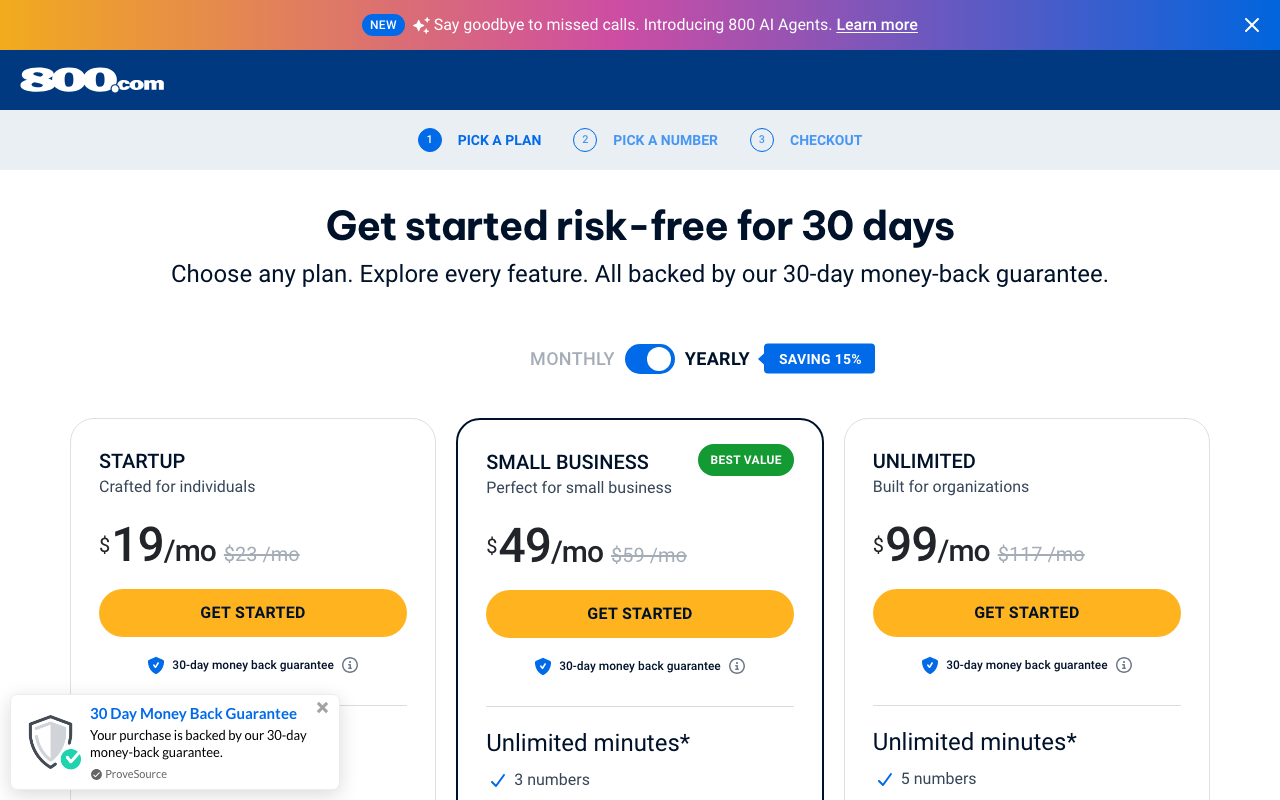
Startup: $19/month billed yearly, or $23 month to month. 250 minutes, 1 toll-free, local or vanity number, 1 user, 1 extension and 120 texts. Extra minutes cost $0.06 each.
Small Business: $49/month billed yearly, or $59 month to month. Unlimited minutes under a fair-usage policy, 3 numbers, unlimited users and extensions, and 500 texts. 800.com labels it the plan most businesses choose.
Enterprise: custom pricing, with scaled AI answering, advanced call tracking and white-glove migration.
Every plan includes call recording, call tracking and analytics, business texting, voicemail transcription, CRM integrations and API access. Extra numbers cost $15 each, there is no activation fee on toll-free or local numbers, and vanity numbers (1-800-LAW-FIRM type) are priced separately by desirability.
The constraint is the Startup plan's 250 minutes. A busy line burns through them fast, and at $0.06 a minute the overage adds up, so most teams with regular call volume land on Small Business.
See 800.com Plans See plans →Prices checked on the 800.com plans page in September 2026. Plans and limits change, so confirm before you buy.
Where 800.com Wins
- Vanity number inventory: deeper pool of memorable numbers than most competitors.
- Simple model: forward calls, done. No new phone system to learn.
- Low entry price: $19/month billed yearly for a toll-free number with call recording and CRM integrations included.
- Existing-device support: no app required for basic call forwarding.
- Toll-free SMS: customers can text your 800 number on every plan.
Where It Falls Short
- Minute cap on Startup: 250 minutes, then $0.06 a minute, so monthly costs vary with call volume.
- Limited features vs full VoIP: no contact center, no video, no advanced routing.
- Single-user entry plan: Startup covers one user and one extension, so teams need Small Business.
- UI is functional, not polished: web portal feels dated.
- Vanity numbers add up: premium vanity numbers are priced separately through a marketplace.
800.com vs Grasshopper vs Unitel Voice vs Just a Toll-Free Forward
Unitel Voice is the closest competitor offering full virtual phone service, and its Solo plan at $9.99 a month with unlimited calling now undercuts 800.com's entry price.
Grasshopper has more brand recognition and a polished mobile app. Comparable price.
Free toll-free forwarding services exist through some carriers as add-ons. Cheaper but lack vanity inventory and management features.
Phone.com targets similar SMB toll-free needs at competitive pricing.
Who Should Use 800.com
Solo professionals wanting a vanity number: 1-800-YOUR-NAME for personal branding.
Small businesses upgrading from a personal mobile: cheap way to present a professional toll-free presence.
Service businesses requiring memorable numbers: locksmiths, plumbers, lawyers benefit from vanity inventory.
Skip it if: you need a real phone system with extensions (use Unitel Voice or RingCentral), you have 5+ team members (per-user systems scale better), or you do not need a toll-free number specifically (a local number is cheaper).
How 800.com works
800.com sells business phone numbers and wraps them in a light cloud phone layer. You buy a toll-free (800, 888, 877), local, vanity, or Canadian number directly from the site, or you port an existing one in. From there the web dashboard is where you configure the actual behaviour: forwarding to any cell or landline, ring style (standard, sequential, or simultaneous), greetings, extensions, call screening, and voicemail boxes with transcription. Desktop and mobile apps let you place and receive calls over VoIP or WiFi rather than relying on forwarding alone, so work calls stay off your personal line.
The part that separates it from a plain forwarding service is call tracking. Tracking is configured per number, so inbound calls can be attributed to a specific campaign. That data pushes into Google Analytics and Looker Studio, and into Google Ads, Meta, and Microsoft Ads for conversion reporting. CRM integrations cover Salesforce, HubSpot, and GoHighLevel, with Zapier and Make covering everything else, plus a public API and webhooks. Slack notifications are supported. Calendar integrations (Calendly, Google Calendar, HubSpot Meetings) require AI Agents.
There is also an AI layer: 800 Intelligence produces call summaries and follow-up recommendations, Enhanced Caller ID adds context, and AI Agents can answer calls automatically. Business texting and SMS campaigns run off the same numbers, but outbound campaigns require passing business and toll-free number verification before you can send anything.
Where 800.com wins
- Self-serve and instant. Numbers are purchased straight from the site with no activation fee on toll-free or local numbers, and 800.com states there is no contract or long-term commitment.
- Attribution built in. Call tracking with Google Ads, Meta, Microsoft Ads, Google Analytics, and Looker Studio integrations is unusual at this price point, which makes it usable as a lead-source tool rather than just a phone line.
- Call recording and API access are on every plan rather than gated behind the top tier.
- Vanity and premium numbers are a first-class product, with a marketplace plus port-in, not an afterthought bolted onto a VoIP product.
- Entry pricing is genuinely low: Startup is $19/mo billed yearly ($23 month to month) with 250 minutes, and yearly billing saves 15%.
Where it falls short
- US and Canada only. Inventory is US toll-free and local plus Canadian numbers. There is no international number inventory, so this cannot serve as a global phone system.
- The entry plan is a single seat. Startup is 1 user and 1 extension with 250 minutes. Unlimited users, extensions and minutes start on Small Business at $49/mo billed yearly ($59 month to month).
- The AI layer is sold separately and metered. AI Agents require upgrading to 800.com's AI plan, and call transcription and 800 Intelligence meter at $0.10/min on Startup and $0.04/min on Small Business.
- SMS allowances are small: 120 texts on Startup and 500 on Small Business, then $0.06 or $0.04 a message, and outbound campaigns need business and toll-free verification first.
- "Unlimited minutes" on Small Business is qualified by a Fair Usage Policy, and extra numbers cost $15 each on both plans.
- Vanity and premium number costs are not disclosed on any pricing page. They are quoted through the marketplace separately from the plan fee.
Who should use 800.com
This fits small US or Canadian businesses, home-services and real-estate operators, and marketing agencies that want a memorable toll-free or vanity number with call forwarding and call-source attribution, and whether that is one user on Startup or a whole team on Small Business. If your reason for buying is a branded number plus knowing which campaign produced each call, the combination of instant purchase, no contract, and ad-platform integrations is hard to match at $19 to $23 a month.
Skip it if you need a real multi-seat PBX with international DIDs, if you operate outside North America, or if the AI answering feature is the reason you are shopping: that needs 800.com's separate AI plan on top of the subscription. Heavy SMS senders should also price the text allowances carefully before committing.
Frequently Asked Questions
Can I get a vanity number?
Yes. Browse the vanity inventory or search for specific letter combinations. Pricing varies by desirability.
Does the number forward to my mobile?
Yes. Forward to any US or Canadian number, including mobile phones.
What if I miss a call?
Voicemail captures the call. Transcripts and audio files arrive in your inbox.
Can multiple people answer the same 800 number?
Yes through sequential forwarding (rings number 1, then 2) or simultaneous ring (rings everyone at once).
Is there a contract?
Month-to-month available; annual prepay offers a 15% discount on most plans.