
The 8 Best Low-Code Development Platforms in 2026

Key facts8 tools compared: Retool, Bubble, OutSystems, Microsoft Power Apps, Mendix, FlutterFlow…
- 8 tools compared: Retool, Bubble, OutSystems, Microsoft Power Apps, Mendix, FlutterFlow, Budibase, Glide
- Retool (best for: Internal tools for devs): Free, then €9/builder/mo
- Bubble (best for: Full web apps, no backend team): Free, then $29/mo
- OutSystems (best for: Enterprise & regulated industries): From $36,300/yr
- Microsoft Power Apps (best for: Microsoft 365 shops): $20/user/mo
Every team I talk to has the same backlog problem: ten app ideas, two engineers, and a roadmap that never moves. Low-code is how a lot of them dig out. You drag, you connect a database, you ship an internal tool in an afternoon instead of a sprint.
The catch is that "low-code" now covers wildly different things. Some platforms build polished consumer web apps. Some build the boring admin panel your ops team has been begging for. Some are enterprise systems with six-figure contracts and a sales call before you can touch them. Picking wrong costs you months.
If you want the short version: Retool is the one I reach for when developers need to build internal tools fast, Bubble wins for full customer-facing web apps without a backend team, and OutSystems is the pick when you're a large org with compliance people in the room. Below is who each one is actually for, what it costs in 2026, and where it falls short.
Quick comparison
| Tool | Best for | Price | Standout |
|---|---|---|---|
| Retool | Internal tools for devs | Free, then €9/builder/mo | Connects to anything, JS everywhere |
| Bubble | Full web apps, no backend team | Free, then $29/mo | Real database + logic, not just CRUD |
| OutSystems | Enterprise & regulated industries | From $36,300/yr | DevSecOps and serious scale |
| Microsoft Power Apps | Microsoft 365 shops | $20/user/mo | Native Teams, Dynamics, SharePoint |
| Mendix | Collaborative enterprise teams | Free, then ~$75/mo | Business + dev co-building |
| FlutterFlow | Native mobile apps | Free, then $39/mo | Real Flutter code you can export |
| Budibase | Self-hosted internal tools | Free (open source) | Own your data, no vendor lock-in |
| Glide | Apps from spreadsheets | Free, then $25/mo | Fastest path from data to app |

Retool: the default for internal tools
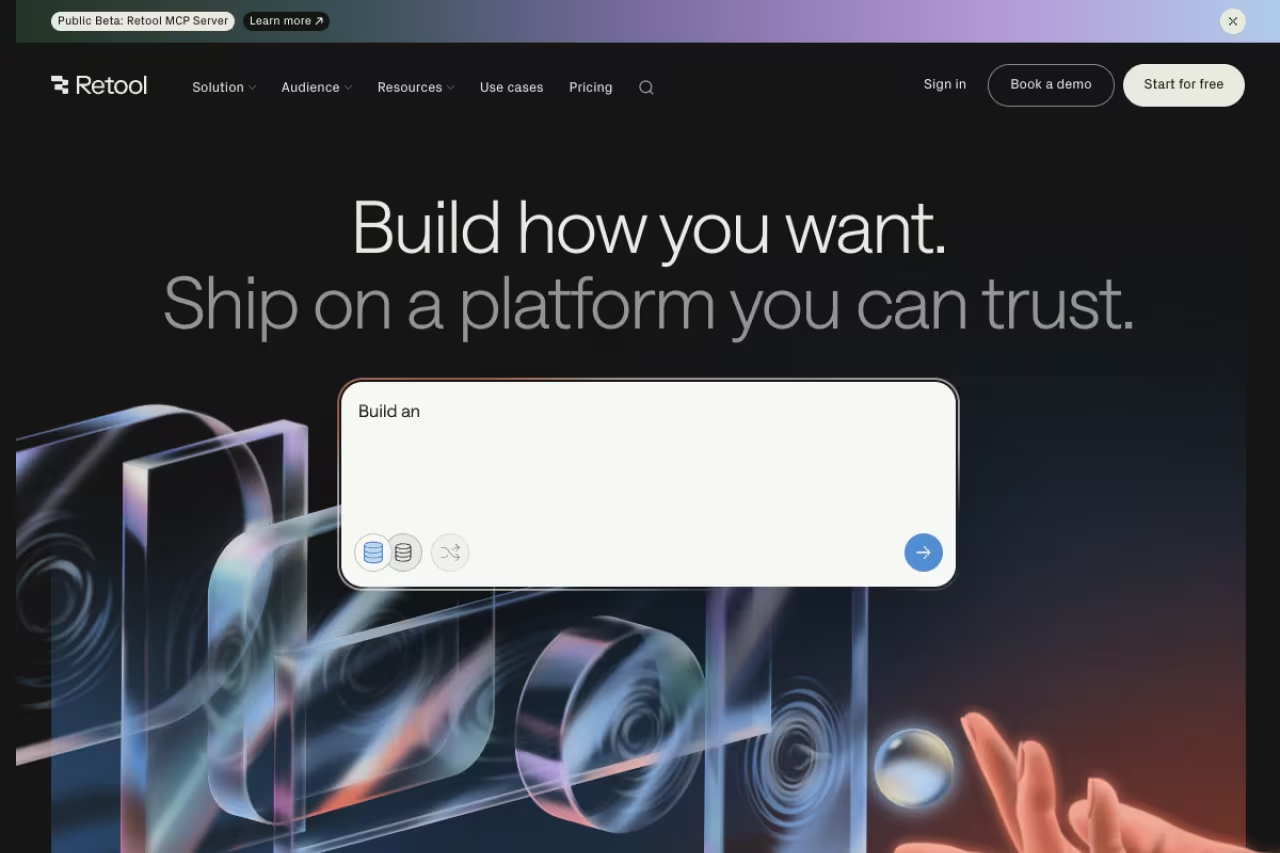
If your users are inside your own company and your builders are developers, start here. Retool is built for the admin panels, dashboards, and CRUD apps that every business needs but nobody wants to hand-code. You drag in tables, charts, and forms, wire them to a query, and drop into JavaScript anywhere the visual editor runs out of road.
What sells it for engineers is the data layer. Retool connects to Postgres, MySQL, MongoDB, REST and GraphQL APIs, plus tools like Stripe and Snowflake, and treats them all as first-class sources. You're not fighting the tool to talk to your existing stack.
The default for developers building internal admin panels, dashboards and CRUD apps, with strong connections to your existing data sources. The catch is that you pay per builder and per end user, so costs climb at scale.
Pricing is friendly to start. The Free plan covers up to 5 standard users and 5 end users with 500 workflow runs a month, enough to validate a real tool. After that, Retool's pricing runs €9/month per builder and €5 per internal user on Team, and €46 per builder on Business once you need audit logging, granular permissions, and source control.
The catch: it gets expensive at scale because you pay per builder and per end user, so a tool used by hundreds of staff adds up fast. And it's not the platform for a public-facing product. Retool wants to live behind your login, serving your team.

Bubble: full web apps without an engineering team
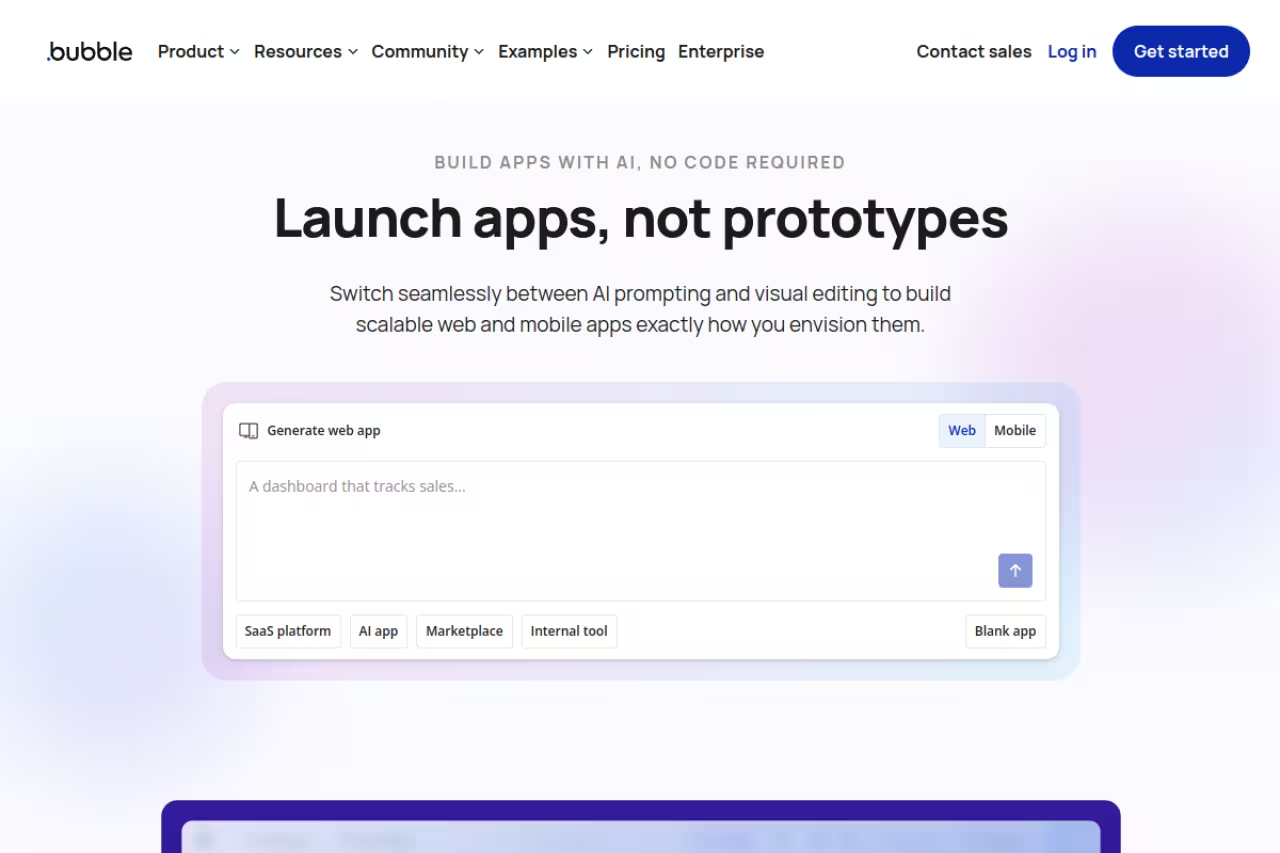
Bubble is the one founders use to build an actual product, not just an internal panel. You get a visual editor, a built-in database, a workflow engine for logic, and hosting, so a non-technical founder can ship a marketplace or SaaS MVP and charge money for it. I've seen two-person teams launch paying products on it.
The standout is how far the logic engine goes. Conditional workflows, user accounts, payments, API connections, and responsive design all live in one place. You're building something with real backend behavior, not a glorified form.
On price, Bubble's pricing starts free for learning, then Starter is $29/month, Growth is $119/month, and Team is $349/month. The thing to understand is Workload Units (WUs): every database query, workflow, and API call burns them, and heavy apps blow through the included quota. Starter includes 175K WUs, Growth 250K.
Where it falls short: that WU model makes costs hard to predict, and a popular app can cost far more than the sticker price suggests. Bubble apps can also feel sluggish under load, and you're locked into Bubble's hosting. If you outgrow it, there's no clean export.
The choice for non-technical founders who want to ship a real product such as a marketplace or SaaS MVP, with database, workflows and hosting in one place. Workload Units make costs hard to predict, and apps can feel sluggish under load.

OutSystems: the enterprise heavyweight
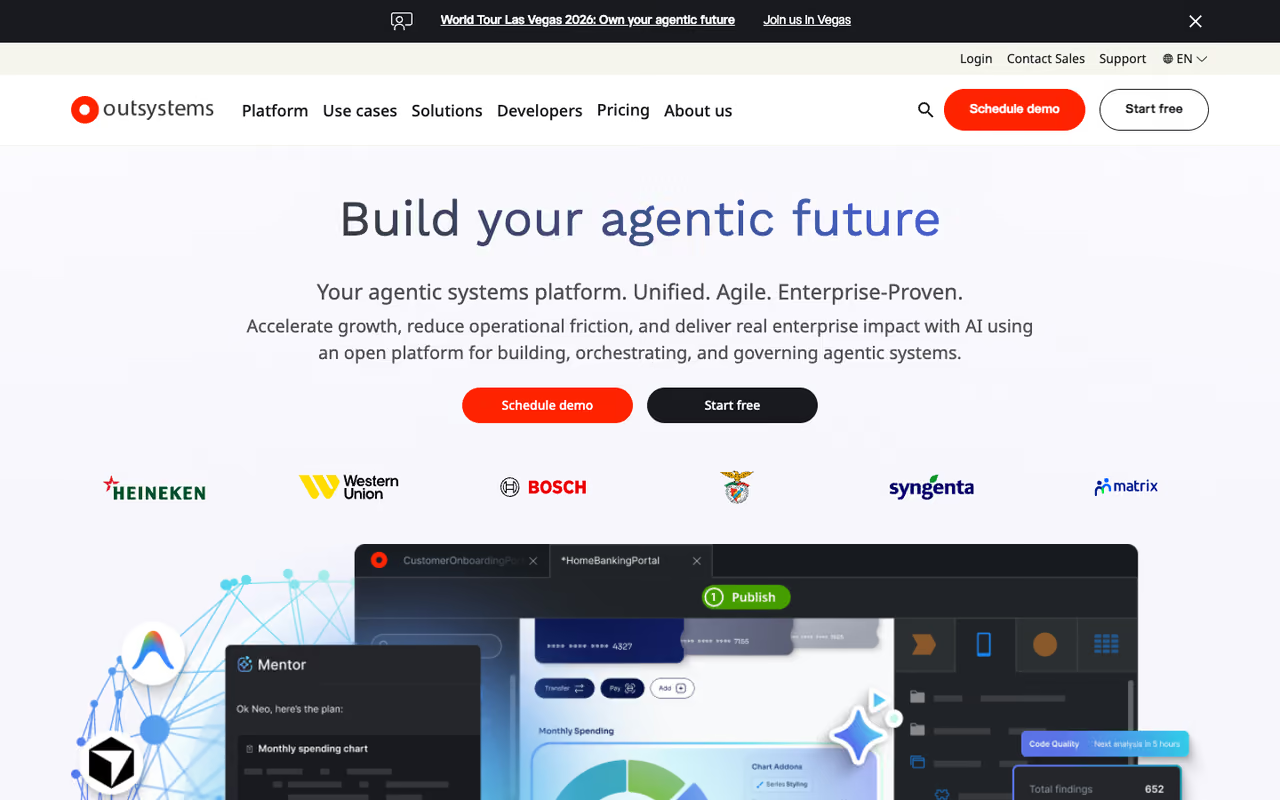
When the people in the room include a CISO and a compliance officer, OutSystems is the name that comes up. It's built for large organizations replacing legacy systems with applications that need to scale to thousands of users, pass security audits, and integrate with SAP and Oracle. Its Developer Cloud (ODC) product adds AI app generation and DevSecOps automation on top.
The standout is everything around the build: CI/CD pipelines, automated security scanning, performance monitoring, and architecture validation are baked in. This is low-code that satisfies an enterprise IT department, not just a citizen developer.
Built for large organizations that need security audits, scale and SAP and Oracle integration, with CI/CD and scanning baked in. The price tag and learning curve put it out of reach for small teams.
Pricing reflects that. OutSystems Developer Cloud starts at $36,300/year, which buys three runtimes, 100 internal users, and one medium production app. There's a free Personal Edition for learning, with full ODC Studio and AI generation, but you can't deploy production apps on it.
The catch: the price tag and the learning curve put it out of reach for small teams. You don't casually adopt OutSystems on a Tuesday. It's a strategic commitment with a sales process attached, and overkill for anything short of department-wide or company-wide systems.
If your team is wrestling with which AI-augmented dev tools to pair with a platform like this, our roundup of the best AI coding assistants and our top AI tools directory are good next reads.
Microsoft Power Apps: the Microsoft 365 obvious choice
If your company already lives in Microsoft 365, Power Apps is hard to argue against. It plugs straight into Teams, SharePoint, Dynamics 365, and the rest of the Power Platform, with an AI Copilot that drafts apps from a prompt. For internal apps in a Microsoft shop, the integration alone justifies it.
The obvious choice if your company already lives in Microsoft 365, thanks to tight integration with Teams, SharePoint and Dynamics 365. Licensing is confusing, connector costs sneak up, and the builder is less polished than Retool's or Bubble's.
Pricing changed in 2026, and it's worth knowing. The old Per App plan was pulled from Microsoft's licensing guide in January 2026, per Microsoft's licensing documentation. The main production path now is Power Apps Premium at $20/user/month (dropping to $12 at 2,000+ seats), plus a pay-as-you-go option at $10 per active user per app via Azure.
The catch: licensing is genuinely confusing, and the connector and Dataverse costs sneak up on you. The visual builder is also less polished than Retool's or Bubble's. If you're not already a Microsoft org, the gravity that makes it great mostly disappears.

Mendix: where business and developers build together
Mendix, owned by Siemens, is the enterprise platform built around collaboration between business users and professional developers. Two people working on the same model in shared environments, with AI-assisted sprint planning, is its whole pitch. For large teams where domain experts and engineers need to co-build, that matters.
It runs free for learning and small apps with up to two environments. Paid plans, per Mendix's pricing, start around $75/month for a single app covering up to 5 users, with the Standard tier jumping to roughly $900/month for department-wide use. Hosting and compute are billed on top.
Where it falls short: like OutSystems, it's a serious commitment with real cost once you scale, and the model-driven approach takes time to learn. The free tier is great for kicking the tires, but production use lands you in enterprise pricing fast.
A serious enterprise platform for large teams where business users and developers co-build in shared environments. It is free to learn on, but production use lands you in enterprise pricing fast and the model-driven approach takes time to learn.

FlutterFlow: low-code that ships native mobile
Most platforms on this list build web apps. FlutterFlow builds genuine native mobile apps for iOS and Android, because it generates real Flutter code under the hood. The killer feature is that you can export that code and walk away. No other tool here gives you a clean exit like that.
The 2026 lineup, per FlutterFlow's pricing docs, is Free, Basic at $39/month (adds code and APK download, custom domains, app store deployment), Growth from $80/month (GitHub, real-time collaboration, branching), and Business from $150/month. Pricing is per seat, and all paid plans include unlimited projects.
The catch: it's mobile-first, so it's the wrong tool for an internal dashboard or a content-heavy web app. There's also a real learning curve if you've never touched Flutter concepts like widgets and state, and complex apps still benefit from a developer who can read the generated code.
The one for native iOS and Android apps, and it lets you export real Flutter code and walk away. It is mobile-first, so it is the wrong tool for an internal dashboard, and complex apps still benefit from a developer.

Budibase: open source, self-hosted, your data
Budibase is the pick when data ownership is non-negotiable. It's open source, you can self-host it on your own infrastructure, and the self-hosted edition is free with unlimited apps, automations, and users. For teams in regulated industries or anyone allergic to vendor lock-in, that's a strong starting position.
It can auto-generate CRUD apps straight from your SQL schema and ships with a built-in database, so you don't need an external source to get going. On the cloud side, Budibase's pricing runs Pro at $19/month, Premium at $49/month, and Business at $299/month, with extra creators at $50/month and end users at $5/month.
Where it falls short: self-hosting means you own the maintenance, updates, and uptime. The component library is smaller than Retool's, and deep customization can hit walls faster. It's best for straightforward internal apps, not sprawling, highly custom products.
The pick when data ownership is non-negotiable, with a free self-hosted edition and no vendor lock-in. You own maintenance and uptime, and it suits straightforward internal apps better than sprawling, highly custom products.

Glide: the fastest path from spreadsheet to app
Glide is the quickest way to turn data you already have into a usable app. Point it at a Google Sheet, Excel file, or its built-in tables, and you get a working mobile or web app in minutes. For non-technical teams who think in spreadsheets, nothing gets you to "it works" faster.
The free tier covers 3 editors, 10 users, and 500 rows, enough for a small internal tool. Paid plans, per Glide's pricing, are Maker at $25/month and Business at $199/month for unlimited apps and 30 users, with extra users at around $5/month.
The catch: the spreadsheet foundation that makes it fast also caps how complex your app can get. Row limits and the data model become a ceiling for anything ambitious. Glide is brilliant for simple, structured apps and the wrong choice for a complex product with heavy custom logic.
The quickest route from a Google Sheet or Excel file to a working app, ideal for non-technical teams who think in spreadsheets. That same foundation caps complexity, so it is the wrong choice for a product with heavy custom logic.
If you're still mapping out your stack, our guide to the best no-code tools and the best AI app builders cover adjacent ground worth a look.
How to choose
Skip the feature checklists and answer three questions instead.
Who uses the app? Internal team with developers on staff: Retool or Budibase. Customers paying you money: Bubble or FlutterFlow. Either way, but inside Microsoft 365: Power Apps.
How big is the org? Startup or SMB: stick with transparent per-seat tools (Retool, Bubble, Glide, Budibase). Enterprise with compliance and scale needs: OutSystems or Mendix, and budget for a sales process.
Where does the app run? Web internal tool: Retool, Budibase, Power Apps. Public web product: Bubble. Native mobile: FlutterFlow. Spreadsheet-backed simple app: Glide.
Most teams should start with the cheapest tool that fits all three answers and only graduate to enterprise platforms when governance forces the move. If you're building an AI-native product on top of one of these, our Dupple X program covers the tooling and workflows that make it stick.
FAQ
What is the difference between low-code and no-code?
No-code tools (like Glide) are built so non-technical people can ship apps with zero programming. Low-code tools (like Retool or OutSystems) still let you drop into real code when the visual editor runs out of room, which gives developers more power and ceiling. In practice the line is blurry, and most platforms here sit somewhere on the spectrum rather than purely at one end.
Which low-code platform is best for internal tools?
Retool is the most popular choice for internal tools when you have developers, because it connects to almost any database or API and lets you script anything in JavaScript. If self-hosting and data ownership matter more than polish, Budibase is the open-source alternative. For Microsoft 365 shops, Power Apps is the natural pick.
Are low-code platforms actually cheaper than hiring developers?
For internal tools and MVPs, usually yes, because you ship in days instead of months and need fewer engineers. The savings shrink at scale: per-seat and usage-based pricing (Bubble's Workload Units, Retool's per-user model) can climb past what a small dev team costs once an app serves hundreds of users. Run the math on your real user count before committing.
Can you export your app if you outgrow a low-code platform?
Mostly no, and this is the biggest hidden risk. Bubble, Retool, and Power Apps lock you into their hosting with no clean export. FlutterFlow is the notable exception: it generates real Flutter code you can download and own. Budibase, being open source and self-hosted, also avoids true lock-in. Factor this in before you build something business-critical.
Do low-code platforms have AI features in 2026?
Yes, almost all of them added AI app generation by 2026. OutSystems, Mendix, and Power Apps ship agentic features that can draft, test, and iterate on apps from a prompt. Budibase and Glide include AI app builders too. The quality varies, and AI gets you a rough first draft rather than a finished product, but it meaningfully speeds up the starting point.
Ready to put the right platform to work? Start your Dupple X trial and build with the AI tooling that fits your stack.
Related guides
Some offers on this page may be paid placements or contain affiliate links.
