
The 8 Best Internal Developer Portals in 2026

Key facts8 tools compared: Port, Backstage, Cortex, OpsLevel, Roadie, Spotify Portal, Atlassian…
- 8 tools compared: Port, Backstage, Cortex, OpsLevel, Roadie, Spotify Portal, Atlassian Compass, Humanitec
- Port (best for: Most teams, fast time-to-value): Free up to 15 seats, then $30/seat/mo
- Backstage (best for: Large orgs with a platform team): Free (open source)
- Cortex (best for: Driving standards and service maturity): ~$65/user/mo (custom)
- OpsLevel (best for: Auto-cataloging an existing stack): Custom (sales-led)
Every engineering org past about 30 people hits the same wall. Nobody knows who owns the payments service. The new hire spends a week figuring out how to spin up a staging environment. Three teams have built three slightly different ways to deploy. An internal developer portal (IDP) is the fix: one place where every service, owner, doc, runbook, and self-service action lives.
The problem is that "developer portal" now means six different things depending on who's selling it. Some are open-source frameworks you assemble yourself. Some are turnkey SaaS you switch on in a week. Some are really orchestrators that provision infrastructure with a portal bolted on top. I spent the past month digging through pricing pages, docs, and product screenshots to sort out what each one actually does.
If you want the short version: Port is the best starting point for most teams in 2026, because it gives you a production portal in days without a platform team babysitting it. If you have 500+ engineers and a dedicated platform crew, self-hosted Backstage is still the most flexible thing on the market. And if your real goal is enforcing engineering standards rather than self-service, Cortex is built for exactly that. Here's the full breakdown.
Quick comparison
| Tool | Best for | Price | Standout |
|---|---|---|---|
| Port | Most teams, fast time-to-value | Free up to 15 seats, then $30/seat/mo | No-code blueprint data model |
| Backstage | Large orgs with a platform team | Free (open source) | Total customization, huge plugin ecosystem |
| Cortex | Driving standards and service maturity | ~$65/user/mo (custom) | Scorecards and engineering intelligence |
| OpsLevel | Auto-cataloging an existing stack | Custom (sales-led) | Automatic service discovery |
| Roadie | Backstage power without the ops | From $24/dev/mo | Managed, upgraded Backstage |
| Spotify Portal | Backstage in a box, no-code setup | Free trial, then custom | Setup wizard, Soundcheck |
| Atlassian Compass | Atlassian shops on a budget | Free up to 3 users, then $7.67/user/mo | Cheapest paid tier, Jira integration |
| Humanitec | Self-service infra provisioning | Custom (sales-led) | Platform Orchestrator + Score |
Port
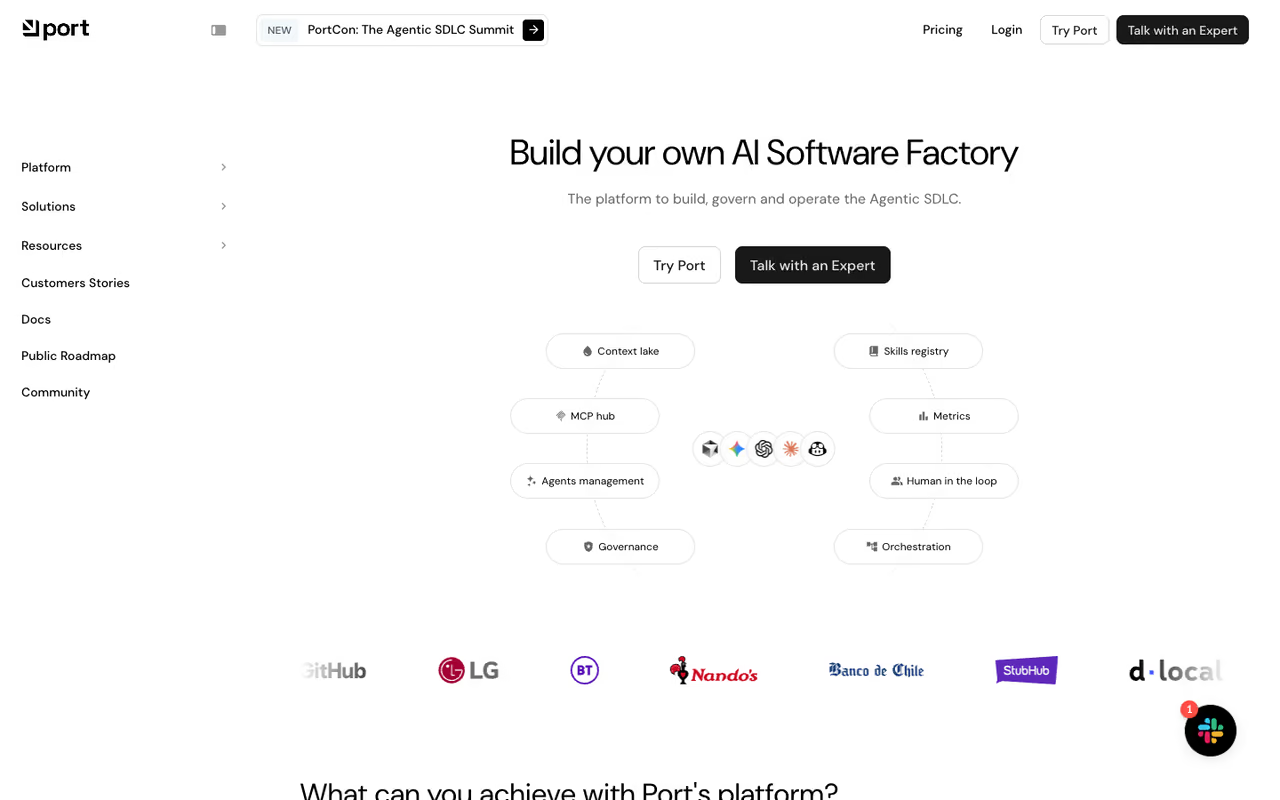
Port is the SaaS portal I'd hand to most teams today. Its whole pitch is that you can stand up a real portal this week instead of next quarter, and based on its documentation and public reviews, that mostly holds.
The thing that sets Port apart is its data model. Instead of a fixed "service catalog," you define blueprints: any entity type you want (services, environments, clusters, teams, even Jira epics) and the relationships between them. It's effectively a no-code way to model your whole engineering org. That flexibility means it adapts to weird internal setups instead of forcing yours into a template.
Who it's best for: teams of roughly 50 to 500 developers who want fast time-to-value and strong self-service actions without hiring a platform team.
The SaaS portal to hand most teams of roughly 50 to 500 developers who want fast time-to-value and self-service without a platform team. The blueprint data model is flexible but can turn into a tangled mess without a day or two of upfront schema design.
Pricing is refreshingly public. The free plan covers up to 15 seats and 10k entities, which is enough to genuinely evaluate it. Basic starts at $30/seat/month (annual) for up to 50 seats, Standard at $40/seat/month adds SSO and dynamic permissions, and Enterprise is custom. All tiers include the AI agents and workflow orchestration.
The catch: the blueprint flexibility is a double-edged sword. If you don't think carefully about your data model up front, you can build a tangled mess that's annoying to refactor later. Budget a day or two for schema design before you ingest everything.
Backstage
Backstage is the open-source framework from Spotify that created this entire category, and it's now a graduated CNCF project. If you've seen any other portal on this list, it was probably built to be "Backstage but easier."
The core is a software catalog, plus TechDocs (docs-as-code rendered in the portal), software templates for scaffolding new services, and a plugin ecosystem that's bigger than anything else here. There are hundreds of plugins covering CI/CD, cloud cost, security scanning, and observability. If a tool exists in your stack, someone has probably written a Backstage plugin for it.
Who it's best for: large orgs (think 500+ engineers) with a dedicated platform team, strict data-residency needs, or requirements so specific that no SaaS will ever cover them.
It's free in the sense that the software costs nothing. It is very much not free in engineering time. The honest number floating around the build-vs-buy analyses is two or more full-time engineers just to run and upgrade it.
The catch: Backstage out of the box is a blank canvas, not a product. You're responsible for hosting, auth, upgrades, GitHub rate limits, and database management. Teams routinely underestimate this and end up with a half-finished portal nobody trusts. If you don't have platform engineers to spare, buy instead of build.
The ecosystem king for large orgs (500+ engineers) with a dedicated platform team or strict data-residency needs. The software is free, but expect two or more full-time engineers to run it, and out of the box it is a blank canvas, not a product.
Cortex
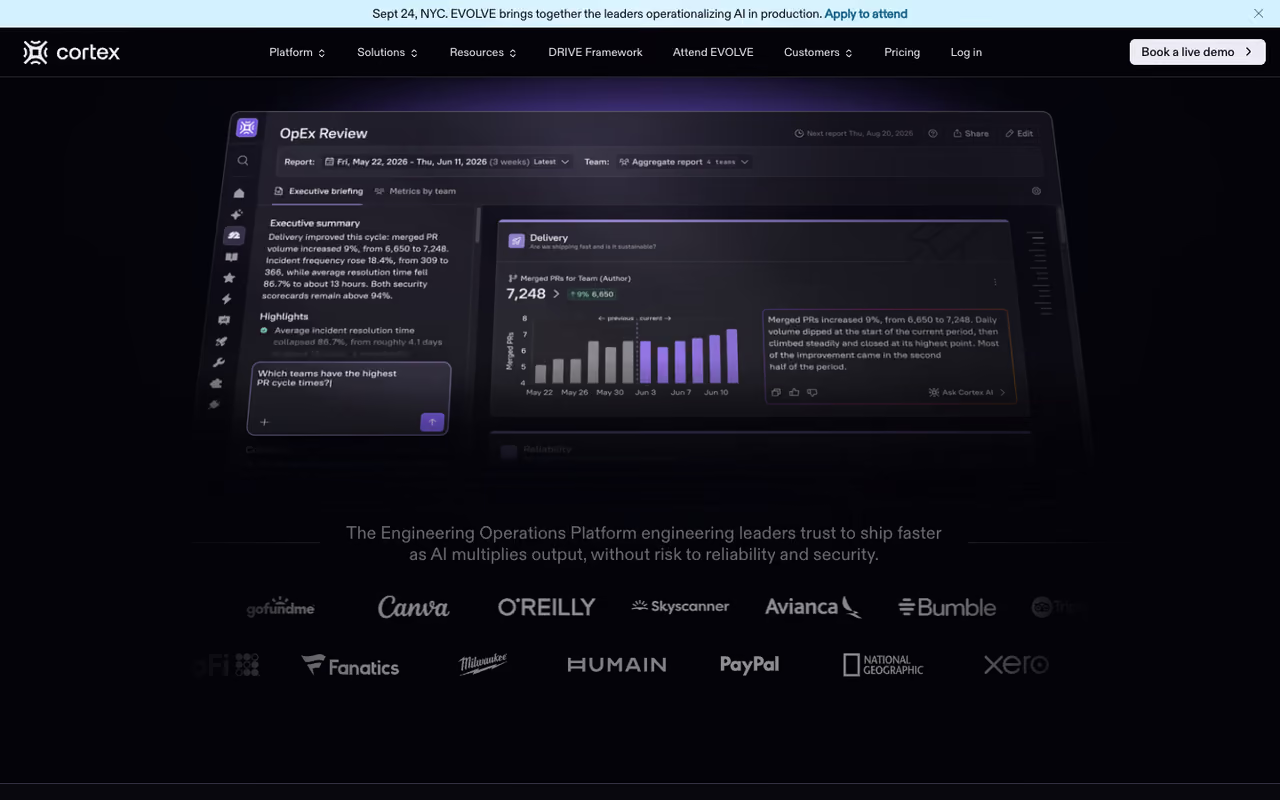
Cortex is the one to pick when your actual problem isn't "developers can't find things," it's "our services don't meet our own standards." It's a managed, proprietary portal built around Scorecards from day one.
Scorecards let you codify rules (every service must have an on-call owner, a runbook, vulnerability scanning, a passing test suite) and then grade every service against them automatically. Engineering leadership gets a live view of which teams are meeting the bar and which aren't. On top of that, Cortex bundles Engineering Intelligence: out-of-the-box dashboards for DORA metrics, deployment frequency, and incident data, plus an AI engine (Magellan) that helps auto-import and audit your catalog.
Who it's best for: growing-to-enterprise teams whose priority is driving service maturity, reliability standards, and compliance across many services.
Pick it when your problem is services missing your own standards, since Scorecards grade every service automatically. At around $65 to $69 per user per month it is the priciest here, and the value evaporates if nobody acts on a scorecard.
Pricing is sales-led and not published, but multiple third-party comparisons put it around $65 to $69 per user per month, the priciest tier in this roundup. For a 50-engineer team that lands near $40k a year.
The catch: it's overkill if all you need is a catalog and a few self-service buttons. You're paying for the standards-enforcement and analytics layer, so if nobody's going to act on a scorecard, the value evaporates. It's a leadership tool as much as a developer one.

OpsLevel
OpsLevel competes head-on with Cortex but leans harder into one promise: it'll catalog your existing stack for you, automatically, instead of making you fill in a hundred YAML files.
It connects to your git repos, Kubernetes clusters, and cloud accounts and detects services on its own. The Kubernetes Syncer pulls tagged information straight from your clusters and keeps the catalog current as things change. That auto-discovery is the biggest time-saver here, because the number-one reason portals die is a stale catalog nobody maintains. Like Cortex, it has Checks (its version of scorecards), self-service actions, and service templates.
Who it's best for: teams with a large existing service estate, especially Kubernetes-heavy ones, who don't want to manually onboard everything.
The strongest choice for large, Kubernetes-heavy estates that do not want to hand-fill YAML, because auto-discovery keeps the catalog current. Pricing is sales-led with no real free tier, so evaluation is slower than with Port.
Pricing is custom and sales-led, with volume discounts for larger teams. Reported figures put it around $39/user/month at the entry level, cheaper than Cortex but you'll need a sales call for a real quote.
The catch: no published pricing and no real free tier means a slower evaluation than Port. You can't just sign up on a Friday and have a portal by Monday without talking to someone first.
If you're still mapping out the wider tooling stack around your portal, our guide to the best AI DevOps tools pairs well with this one.

Roadie
Roadie solves a specific, painful problem: you want Backstage, but you don't want to run Backstage. It's a fully managed, hosted Backstage that handles the upgrades, the hosting, and the GitHub rate-limit headaches that bite self-hosters.
You get the real Backstage catalog, TechDocs, API specs, self-service templates, and 75+ supported plugins, minus the two engineers it normally takes to keep the lights on. Single sign-on, RAG-based AI search, and an MCP server come included on the main plan. It's the established independent option and has been doing managed Backstage longer than almost anyone.
Who it's best for: teams that specifically want Backstage's ecosystem and data model but can't justify a platform team to operate it.
Roadie's Teams plan runs $24 per developer per month for 50 to 150 developers with unlimited entities. Growth and the Context enterprise tier are custom. Worth noting: the public page lists Teams and Growth as "existing subscribers only," so newer buyers may get pointed to a different track.
The catch: you're still adopting Backstage's mental model and YAML-heavy catalog conventions. If you found Backstage confusing in concept, hosting it for you doesn't change that. And you're tied to the pace of upstream Backstage for some features.
The answer if you want Backstage's ecosystem without running it, with hosting, upgrades and 75+ plugins handled for you. You still inherit Backstage's YAML-heavy mental model, and the Teams plan is listed as existing subscribers only.
Spotify Portal for Backstage
Confusingly, Spotify now sells its own managed Backstage too. Spotify Portal for Backstage went generally available in October 2025 as a no-code SaaS version of Backstage, run by the team that built Backstage in the first place.
The hook is the setup experience. A setup wizard and catalog wizard connect to GitHub and auto-import your services, replacing the configuration work that used to eat your first quarter. It ships with Soundcheck (Spotify's scorecard/quality plugin) and a plugin installer so you can add third-party Backstage plugins through a UI instead of code. Capital One, PagerDuty, 2K Games, and the Linux Foundation are listed customers.
Who it's best for: teams that trust the Backstage roadmap and want it managed by the source, with the least possible setup friction.
There's free access to try it, but full pricing is sales-led and not published.
The catch: it's newer to GA than Roadie, so the independent-vendor track record is shorter, and you'll need a sales conversation to find out what it costs at scale. You're also betting on a single vendor for both the framework and the hosting.
A fit for teams that trust the Backstage roadmap and want it managed by its creators, with wizards that auto-import services. It is newer to GA than Roadie, pricing is sales-led, and you bet on one vendor for both framework and hosting.
Atlassian Compass
If your company already lives in Jira and Confluence, Atlassian Compass deserves a look purely on price and integration. It's a software component catalog with health scorecards that plugs naturally into the rest of the Atlassian stack.
You get a component catalog, scorecards, and operations management, all wired into Jira issues and Confluence docs your teams already use. The integration story is the main reason to choose it over a standalone portal.
Who it's best for: Atlassian-native shops and budget-conscious teams who want a real catalog without five-figure spend.
This is the cheapest paid option here. The free plan covers up to 3 full users (plus unlimited basic users), Standard is $7.67 per user/month, and Premium is $23.96 per user/month with a 99.9% SLA and 24/7 critical support. Compare that to Cortex's ~$65.
The catch: it's less of a true self-service platform than Port or Backstage. Self-service actions and deep customization are thinner, and Compass is cloud-only with no Data Center option. It's a strong catalog and scorecard tool, not a full internal developer platform.
The budget pick for Atlassian-native shops, with a real catalog and scorecards from $7.67 per user/month versus roughly $65 for Cortex. It is thinner on self-service and customization and cloud-only, so treat it as a catalog, not a full platform.

Humanitec
Humanitec is the odd one out, and that's the point. It isn't primarily a portal, it's a Platform Orchestrator. The portal is just the surface; underneath, it actually provisions and manages infrastructure.
The model has three parts: developers describe what they need with Score (a workload spec), the Platform Orchestrator turns that into real infrastructure while enforcing your standards, and the Portal gives one pane of glass over it all. So where Port or Cortex tell you about your services, Humanitec can stand up the environment behind them. It keeps a graph of all your infrastructure and the relationships between resources.
Who it's best for: platform teams that want true end-to-end developer self-service, where clicking a button in the portal genuinely spins up infrastructure.
Right tool if your developers currently file tickets to get a database, because its Platform Orchestrator genuinely provisions infrastructure. It is the heaviest lift on the list and the wrong choice if you just want to know who owns a service.
Pricing is subscription-based and sales-led, tiered by usage and managed resources, with no public numbers.
The catch: this is the heaviest lift on the list. You're adopting an opinionated provisioning model (Score, dynamic config) on top of a portal, which is a much bigger commitment than a read-only catalog. Wrong tool if you just want to know who owns the billing service. Right tool if your developers currently file tickets to get a database.
How to choose
Skip the feature checklists and answer one question first: what's the actual pain?
If the pain is discoverability ("nobody knows who owns what"), almost any catalog solves it. Pick on price and setup speed: Compass if you're in Atlassian, Port if you want self-service room to grow.
If the pain is standards and reliability ("our services don't meet our own bar"), go to Cortex or OpsLevel. They're built around scorecards, and that's where their money goes.
If the pain is self-service provisioning ("devs file tickets to get infrastructure"), you need an orchestrator like Humanitec, not just a portal.
Then layer in team size and resourcing. Under ~500 engineers with no platform team, buy a SaaS (Port, Cortex, OpsLevel, Roadie). Over 500 with a real platform team and unusual requirements, self-hosted Backstage earns its keep. And if you love Backstage's model but hate operating it, Roadie or Spotify Portal split the difference.
One more thing: whatever you pick is only as good as the data you feed it. A portal with a stale catalog is worse than no portal, because people stop trusting it. Auto-discovery (OpsLevel, Cortex's Magellan, Port's integrations) matters more than any individual feature, so weight it heavily.
If you're assembling the broader engineering toolchain, it's worth pairing your portal with the right AI coding agents and a solid observability setup. And if you want a faster way to stay on top of new developer tooling as it ships, Dupple X curates what's actually worth your attention so you're not the last to hear about it.
FAQ
What is an internal developer portal?
An internal developer portal is a central interface where engineers find every service, owner, doc, runbook, and self-service action in one place. It typically includes a software catalog, scorecards for standards, TechDocs, and templates to scaffold new projects. The goal is to cut cognitive load and stop developers from hunting across a dozen tools to ship.
Is Backstage free?
The Backstage software is free and open source, maintained as a graduated CNCF project. But "free" only covers the license. Running it in production usually takes two or more full-time engineers for hosting, auth, upgrades, and maintenance, so the real cost is in headcount. Managed options like Roadie or Spotify Portal trade that engineering time for a subscription.
What's the difference between an internal developer portal and a platform orchestrator?
A portal is mostly a read-and-act interface: it shows you services, ownership, and standards, and lets you trigger pre-built actions. An orchestrator like Humanitec goes a layer deeper and actually provisions and manages the infrastructure behind those actions. Many setups use both: an orchestrator under the hood with a portal as the front door.
How much does a developer portal cost in 2026?
It ranges widely. Atlassian Compass starts at $7.67/user/month and Port has a free tier up to 15 seats then $30/seat/month. Managed Backstage via Roadie runs about $24/developer/month, while Cortex sits near $65/user/month. For a 50-engineer team, annual costs span roughly $13k (Roadie) to $40k+ (Cortex).
Which internal developer portal is best for a small startup?
For a small team, start with a free tier and avoid the heavy options. Port's free plan (up to 15 seats) or Atlassian Compass's free plan (up to 3 full users) let you get a real catalog running at no cost. Skip Backstage unless you already have platform engineers, and skip orchestrators like Humanitec until self-service provisioning is an actual pain.
If you found this useful and want curated developer-tool intel without the doomscrolling, Dupple X sends the signal and skips the noise.
Related guides
Some offers on this page may be paid placements or contain affiliate links.
