
Best AI Fraud Detection Tools in 2026

Key facts8 tools compared: Stripe Radar, Sardine, SEON, Sift, Feedzai, DataVisor, Resistant AI, Hawk
- 8 tools compared: Stripe Radar, Sardine, SEON, Sift, Feedzai, DataVisor, Resistant AI, Hawk
- Stripe Radar (best for: Stripe-native businesses): Free on standard pricing; 5-7¢/screened txn otherwise
- Sardine (best for: Fintech, crypto, neobanks): Pay-per-transaction (custom)
- SEON (best for: Mid-market, fast-growing): From $699/mo, 30-day trial
- Sift (best for: Marketplaces, social platforms): ~$30k-50k/yr and up
Fraud got an upgrade. The same generative models that write your marketing emails now forge bank statements, spin up synthetic identities, and run account takeovers at a scale that breaks rule-based systems. DataVisor's 2026 executive report found that 74% of fraud leaders see AI-driven fraud as a top threat, but only 23% feel they have the infrastructure to fight it. That gap is the whole story.
If you're a founder shipping payments, a fintech operator, or a risk lead trying to keep chargebacks down without nuking conversion, the tool you pick matters more than it did two years ago. Static blocklists can't keep up with attacks that mutate every week. You need systems that learn.
I spent time digging into the platforms that actually run in production today, comparing pricing, integration effort, and what each one is genuinely good at. The short version: if you already process payments through Stripe, Stripe Radar is the fastest win and my default pick. But the right answer depends a lot on whether you're a startup, a fintech, or a bank. Here's the full breakdown.
Quick comparison
| Tool | Best for | Price | Standout |
|---|---|---|---|
| Stripe Radar | Stripe-native businesses | Free on standard pricing; 5-7¢/screened txn otherwise | Zero integration, learns from $1.9T in payments |
| Sardine | Fintech, crypto, neobanks | Pay-per-transaction (custom) | Device + behavior biometrics in one SDK |
| SEON | Mid-market, fast-growing | From $699/mo, 30-day trial | Digital footprint from email/phone/IP |
| Sift | Marketplaces, social platforms | ~$30k-50k/yr and up | 1T+ signals across 34k+ sites |
| Feedzai | Large banks, processors | Enterprise (custom) | GenAI scam agent (ScamAlert) |
| DataVisor | High-volume, fraud rings | Enterprise (custom) | Unsupervised ML, no labels needed |
| Resistant AI | Lenders, KYC/KYB onboarding | Custom | Document forgery detection |
| Hawk | Banks needing AML + fraud | Enterprise (custom) | Cuts AML false positives |
Stripe Radar: the easiest win if you're already on Stripe
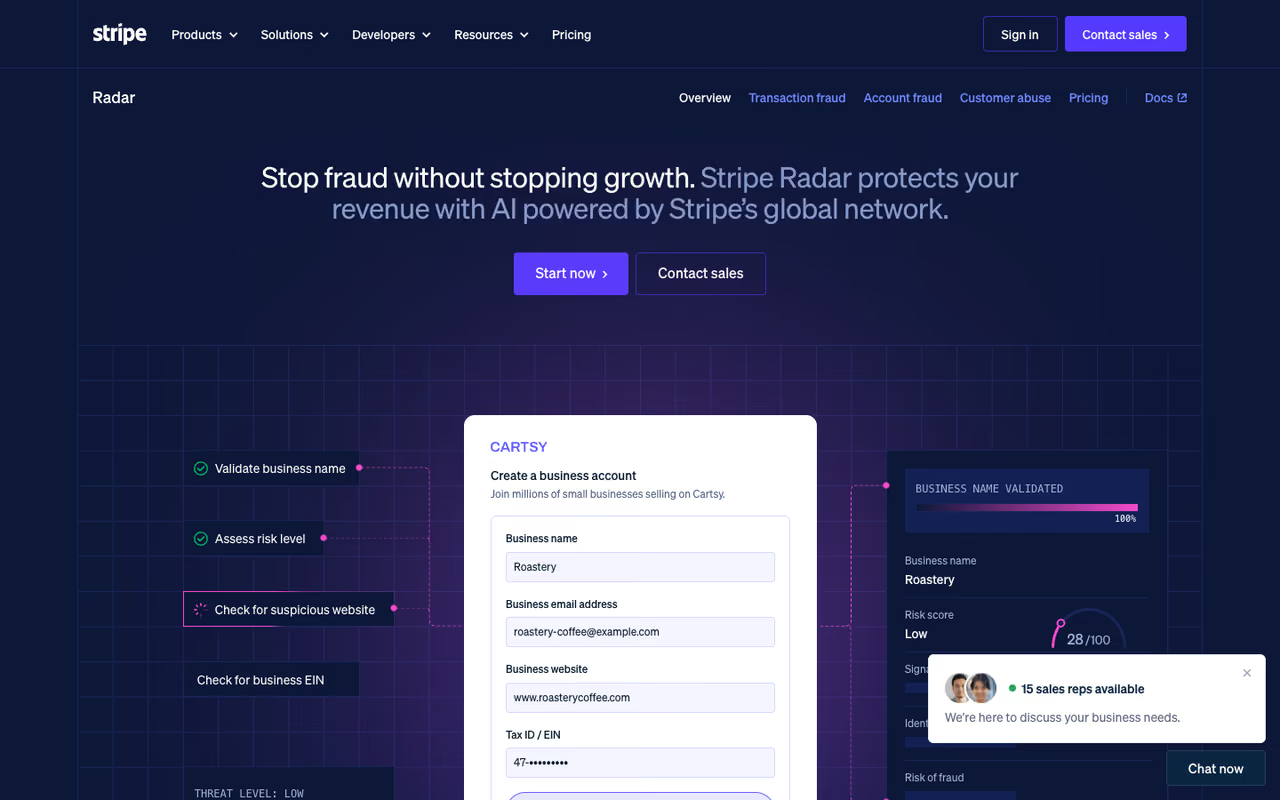
Stripe Radar is fraud detection that ships with your payment stack. If you process through Stripe, Radar is already scoring every transaction in the background, learning from a network that handles more than $1.9 trillion in payments a year. Stripe says it reduces fraud by 32% on average, and the basic version needs zero integration.
Who it's best for: any business already running payments on Stripe that wants strong baseline protection without hiring a risk team. Startups especially.
The easiest win for any business already processing on Stripe, especially startups wanting strong baseline protection without a risk team. It is locked to Stripe and weaker beyond card fraud, with no coverage of signups or logins.
The basic machine-learning layer is free for accounts on standard 2.9% + 30¢ pricing. If you're on custom interchange pricing, Radar runs 5¢ per screened transaction. Radar for Fraud Teams, which adds custom rules, review queues, and trend analytics, is 7¢ per screened transaction, or 2¢ if you're on standard pricing. I confirmed those numbers on Stripe's own pricing page.
The standout: the network effect. Because Stripe sees a huge slice of global card activity, Radar recognizes a card that committed fraud at another business hours ago. You can't replicate that from your own data alone.
The catch: it's locked to Stripe. The moment you add a second payment processor or want fraud signals across non-payment events like signups and logins, Radar's coverage stops at the checkout. It's excellent at card fraud and weaker at the broader account-abuse picture.
Sardine: built for fintech and crypto risk
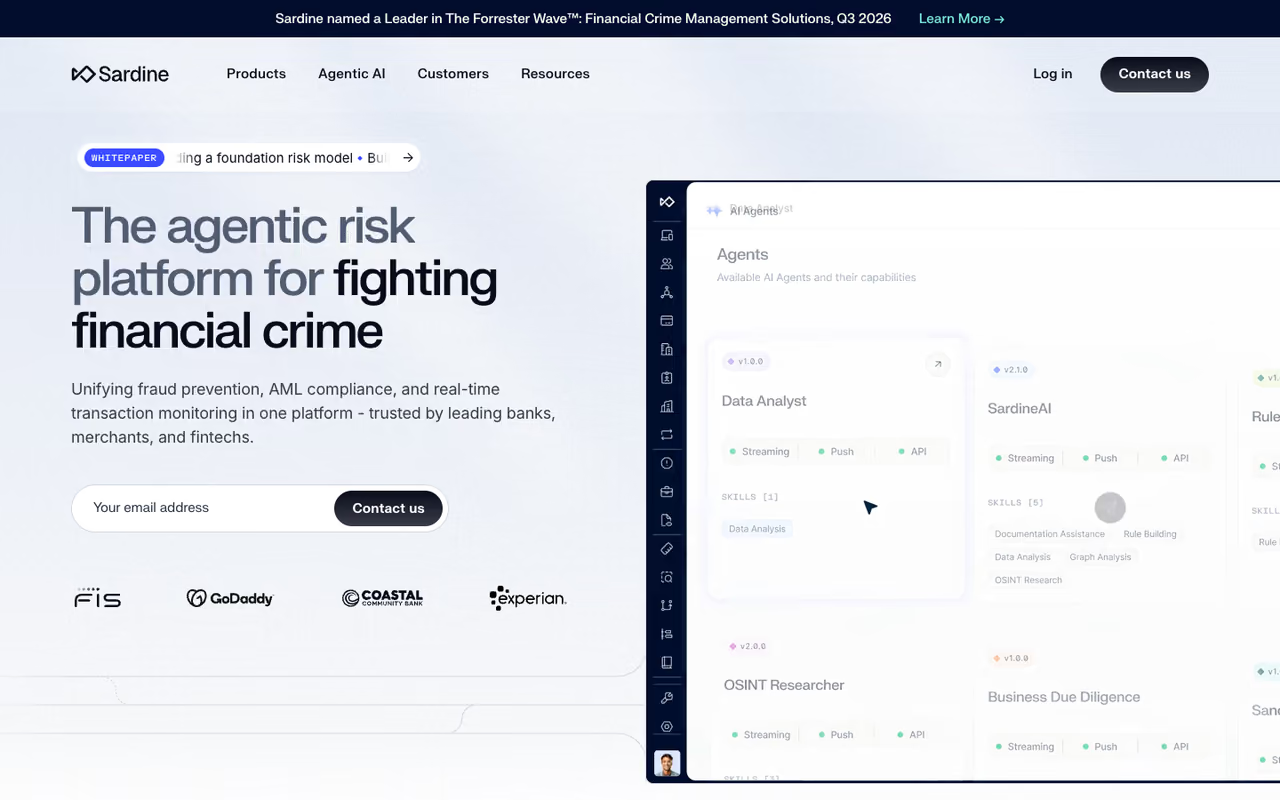
Sardine is what you reach for when payments are your whole business. It combines device intelligence and behavioral biometrics in a single SDK, watching things like typing rhythm, mouse movement, hesitation, and device fingerprints to flag a session that looks like a bot or a coached scam victim before money moves.
Who it's best for: fintechs, neobanks, crypto platforms, and anyone touching ACH or instant payments. Notably, Nacha's June 2026 rule requires banks receiving ACH credits to run fraud detection, and Sardine is positioned squarely for that deadline.
Built for fintechs, neobanks and crypto platforms, with behavioral biometrics that catch authorized push payment scams that card-level tools miss. Pricing isn't published, and it is overkill for a small e-commerce shop without real risk operations.
pay-per-transaction, quoted per use case. It's not published, so you'll talk to sales. Expect it to scale with volume rather than a flat platform fee.
The standout: behavioral biometrics that catch authorized push payment scams, where a real user approves a transaction under manipulation. Card-level fraud tools miss these entirely because the "right" person is clicking the button.
The catch: it's heavier than a startup needs. The SDK integration and the breadth of signals are overkill if you're a small e-commerce shop. This is a platform for teams with real risk operations.

SEON: the mid-market sweet spot
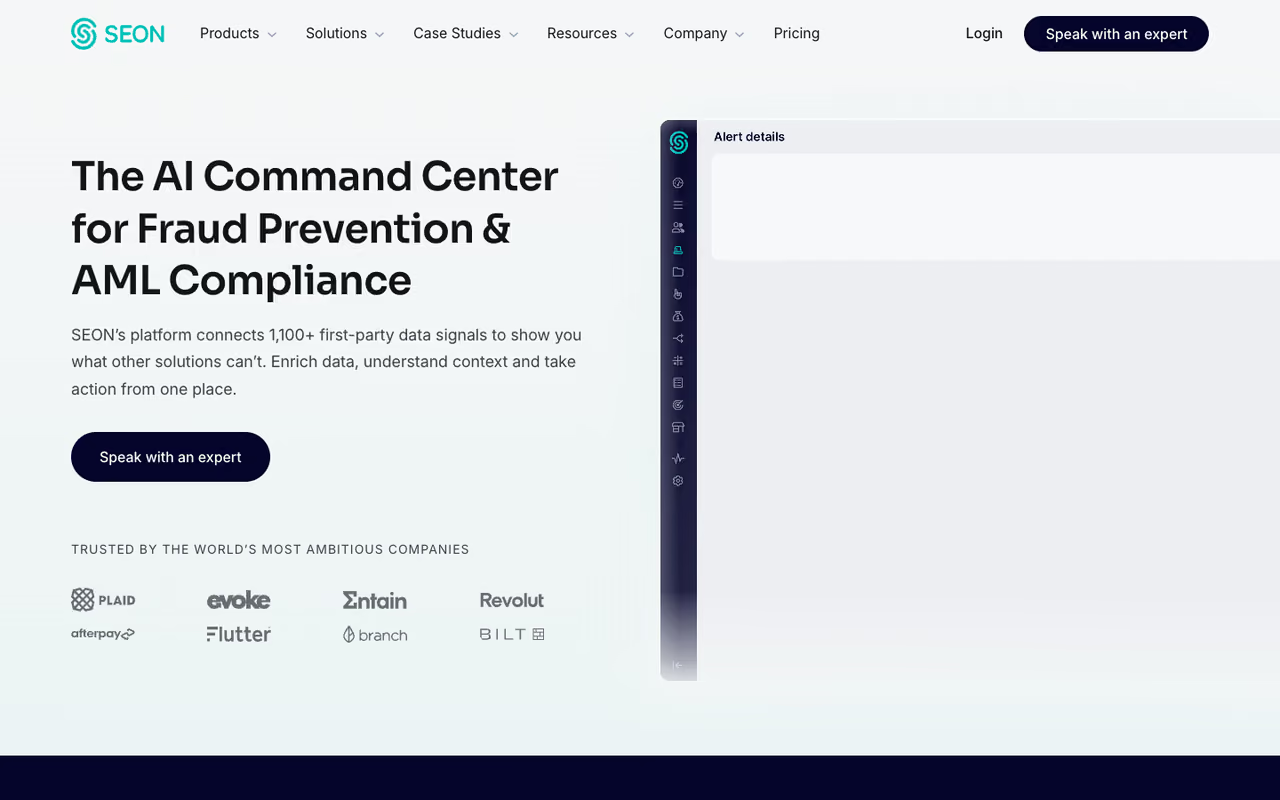
SEON earns its reputation by doing something clever: it enriches the tiny bit of data a user gives you. Feed it an email, phone number, or IP, and it builds a digital footprint from 300+ signals across social and online accounts. A real customer has a Gmail tied to LinkedIn, Spotify, and Amazon. A fraudster's throwaway address has nothing. That contrast is gold.
Who it's best for: fast-growing companies that want transparent, customizable rules without an enterprise contract. The company says it protects over 5,000 businesses and has prevented more than $300 billion in fraud losses.
starts around $699/month with a 30-day free trial, plus pay-as-you-go options. That trial and entry price make it one of the few serious platforms you can actually test-drive without a sales call.
The standout: the digital footprint enrichment. It catches synthetic and disposable identities at signup, before they ever cost you anything.
The catch: the rule transparency that makes SEON flexible also means you have to do the work. The defaults are a starting point, not a finished system. Teams that want a black box that "just decides" will find SEON asks more of them.
If you're sizing tools across your stack, our roundup of the top AI tools is a useful companion for the rest of your build.

Sift: for marketplaces and platforms
Sift thinks about fraud as a user-level problem, not a transaction-level one. Its platform draws on over 1 trillion data signals from more than 34,000 sites and apps, scoring the risk of an account or action in milliseconds. Brands like DoorDash, Yelp, and Poshmark run on it.
Who it's best for: marketplaces, social platforms, and any product where abuse goes beyond payments, fake reviews, spam, account takeover, promo abuse. Sift covers content integrity and account defense, not just checkout.
The strongest fit for marketplaces and platforms where abuse goes beyond payments, such as fake reviews, account takeover and promo abuse, all from one console. Contracts reportedly start around $30,000-50,000 per year with no self-serve tier, so it is a real commitment.
custom and enterprise-leaning. Typical contracts reportedly start around $30,000-50,000 per year and climb past $100,000 for high-volume deployments. There's no self-serve tier.
The standout: breadth. Sift scores the whole user journey, so a marketplace can fight payment fraud, content abuse, and ATO from one console.
The catch: the price and the commitment. For a small team with a single fraud vector, Sift is more platform than you need, and the annual contract makes it a real decision rather than a quick experiment.

Feedzai: enterprise banking and scam prevention
Feedzai is built for the institutions at the top of the food chain: large banks, payment processors, and major fintechs moving enormous volume. It's AI-native and covers fraud plus AML in one risk engine.
Who it's best for: enterprises that need a single platform spanning fraud, financial crime, and compliance across web, mobile, and payment channels.
An enterprise platform for large banks and major fintechs that want fraud, AML and compliance in one engine, plus ScamAlert, which turns customers into a detection layer. It is custom-quoted and far beyond what a startup or mid-market fintech can use.
enterprise only, custom-quoted. This is a procurement-and-RFP purchase, not a credit card signup.
The standout: ScamAlert, a generative-AI agent that lets a bank customer screenshot a suspicious ad or invoice inside their banking app and get an instant risk read. It turns customers into a detection layer, which is a genuinely fresh angle on scams that rely on manipulating real people.
The catch: it's for the enterprise tier and priced that way. A startup or even a mid-market fintech will find Feedzai's scope and cost far beyond what they can use. This is a tool for teams measuring fraud in basis points across billions of dollars.
DataVisor: catching fraud rings nobody labeled yet
DataVisor made its name on unsupervised machine learning. Most fraud models need labeled examples of past fraud to learn from. DataVisor's approach finds emerging fraud rings without labels or historical loss data, spotting correlated behavior across thousands of accounts that no human flagged yet.
Who it's best for: high-volume operations facing organized, coordinated attacks, mass account creation, coordinated cash-out, money mule networks.
The choice for high-volume operations facing organized attacks such as mass account creation and mule networks, since its unsupervised approach finds fraud rings without labels. The trade-off is interpretability, as the models can be noisier and harder to explain to compliance.
enterprise, custom. Aimed at large financial operations.
The standout: zero-day detection. Because it doesn't depend on known fraud patterns, DataVisor catches new attack types the first time they appear instead of after they've already cost you. In 2026 it also launched conversational AI agents for financial crime investigation.
The catch: unsupervised models can be noisier and harder to explain to a compliance team that wants a clear reason for every block. You trade interpretability for early detection.
Resistant AI: stopping fake documents
Resistant AI solves a narrow but painful problem: forged documents. When someone uploads a bank statement, payslip, or ID during onboarding, Resistant AI reads the file's hidden metadata and digital fingerprints to detect edits, AI generation, and tampering. It's trained on over 170 million documents.
Who it's best for: lenders, insurers, and any fintech with a KYC or KYB workflow where users submit documents. Loan underwriting, merchant onboarding, claims processing.
A specialist for lenders, insurers and fintechs with KYC or KYB workflows, catching edited or AI-generated documents via hidden metadata. It does nothing about transaction or behavioral fraud, so pair it with a broader platform.
custom, sold to small business through enterprise.
The standout: it catches what humans can't see. A reviewer can't spot that a PDF was edited in a specific tool, but the metadata gives it away. Customers report roughly 3x more document fraud caught and 90% fewer manual reviews.
The catch: it's a specialist, not a full fraud stack. Resistant AI handles document fraud beautifully and does nothing about transaction or behavioral fraud. You'd pair it with one of the platforms above, not replace them.
Hawk: unified AML and fraud for banks
Hawk (formerly HAWK:AI) focuses on the alert-fatigue problem that buries bank compliance teams. Its AI layer sits on top of existing rule-based systems to cut AML false positives while catching more real cases. Commerzbank deployed it in 2026 and reported more accurate alerts and fewer false positives.
Who it's best for: banks and regulated institutions that already have compliance infrastructure and need to make it smarter rather than rip it out.
A smart fit for regulated banks that want to make existing rule-based AML systems smarter instead of ripping them out. It augments rather than replaces, which regulators like, but a startup with no compliance stack has no problem for it to solve.
enterprise, custom-quoted.
The standout: it augments instead of replaces. Hawk's "extended risk model" layers AI over your existing rules, so you keep your audited compliance logic and add machine learning on top. Regulators like that.
The catch: it assumes you're already a regulated financial institution with rule-based monitoring in place. For a startup with no compliance stack yet, Hawk is solving a problem you don't have.
How to choose
Forget the feature checklists for a second. The decision comes down to three questions.
Where does your fraud actually happen? If it's card payments and you're on Stripe, start with Radar and stop reading. If it's account abuse on a marketplace, you need Sift. If it's forged documents at onboarding, that's Resistant AI. Match the tool to your real attack surface, not the longest feature list.
How regulated are you? Banks and licensed fintechs carrying AML obligations need Feedzai, Hawk, or DataVisor, platforms built for compliance and audit. A SaaS startup with chargebacks does not, and would drown in enterprise overhead.
Can you test before you commit? SEON's 30-day trial and Stripe Radar's free baseline let you prove value before signing anything. The enterprise platforms require a sales cycle. If you're early and moving fast, weight the tools you can actually try this week.
A practical sequence: most early-stage teams start with Radar or SEON, add Sardine or Resistant AI when a specific vector hurts, and graduate to Feedzai-class platforms only at real scale. Layer up as the fraud earns it.
While you're building your stack, Dupple X keeps you current on the AI tools reshaping every category, fraud included, in a few minutes a day. Start a yearly trial if you want the signal without the noise.
FAQ
What is the best AI fraud detection tool in 2026?
There's no single winner, it depends on your fraud type. For most businesses already on Stripe, Stripe Radar is the easiest high-value start because it needs zero integration and is free on standard pricing. Fintechs lean toward Sardine, mid-market companies toward SEON, and large banks toward Feedzai or Hawk.
How much does AI fraud detection software cost?
It ranges widely. Stripe Radar is free on standard pricing or 5-7¢ per screened transaction otherwise. SEON starts around $699 per month with a 30-day trial. Enterprise platforms like Sift run from roughly $30,000 per year into six figures, and Feedzai, DataVisor, and Hawk are custom enterprise quotes.
Can AI fraud detection stop scams where the customer approves the payment?
Yes, this is where behavioral tools shine. Authorized push payment scams trick a real user into sending money, so card-fraud tools miss them. Sardine's behavioral biometrics flag the hesitation and coercion patterns in a session, and Feedzai's ScamAlert lets users check suspicious requests before paying.
What's the difference between supervised and unsupervised fraud detection?
Supervised models learn from labeled examples of past fraud, so they're accurate on known patterns but slow to catch new ones. Unsupervised models, like DataVisor's, find suspicious correlations without labels, which catches brand-new fraud rings the first time they appear at the cost of being harder to explain.
Do I need fraud detection if I only use Stripe?
For card payments, Stripe Radar already covers you out of the box. You'd add a dedicated tool when fraud moves beyond checkout, fake accounts, document forgery at onboarding, or abuse across multiple payment processors, where Radar's coverage stops.
Which fraud detection tools offer a free trial?
SEON offers a 30-day free trial, which is rare among serious platforms. Stripe Radar's basic layer is free on standard pricing, so you can evaluate it with zero commitment. Most enterprise platforms (Feedzai, Sift, DataVisor, Hawk) require a sales conversation and a custom proof of concept instead.
Related guides
Some offers on this page may be paid placements or contain affiliate links.
