
The Best AI Math Solver in 2026: 8 Tools Compared

Key facts8 tools compared: Wolfram Alpha, Mathos AI, Photomath, Symbolab, Thetawise, Julius AI, ChatGPT…
- 8 tools compared: Wolfram Alpha, Mathos AI, Photomath, Symbolab, Thetawise, Julius AI, ChatGPT (GPT-5.6 and GPT-6), MathGPT (Mathful)
- Wolfram Alpha (best for: Verified, exact answers): Free / Pro ~$5 to 7/mo
- Mathos AI (best for: Conversational tutoring): Free / ~$30/mo
- Photomath (best for: Phone-camera homework): Free / $9.99/mo
- Symbolab (best for: Seeing every step free): Free / ~$7/mo
Most "AI math solver" tools can spit out an answer. That part is easy now. The real question is whether the steps in between are correct, whether you actually understand what happened, and whether the thing falls apart the moment you hand it a messy photo of handwritten calculus.
I compared eight different tools using their documentation, sample walkthroughs, and public user reviews, covering a basic algebra set, a few definite integrals, a linear algebra eigenvalue question, and a word problem with a deliberately confusing setup. Across those reports, some tools nail the arithmetic but explain nothing. Some explain beautifully and occasionally get the wrong answer. A couple do both jobs well.
The short version: Wolfram Alpha is still the most trustworthy engine for a correct answer with rigorous step-by-step working. If you learn better from a conversational tutor that re-explains things, Mathos AI is the better fit. This guide is for students, parents helping with homework, and professionals who occasionally need to check a derivation without re-learning a textbook.
Quick comparison
| Tool | Best for | Price | Standout |
|---|---|---|---|
| Wolfram Alpha | Verified, exact answers | Free / Pro ~$5 to 7/mo | Computational accuracy you can trust |
| Mathos AI | Conversational tutoring | Free / ~$30/mo | Photo, voice, PDF input + AI tutor |
| Photomath | Phone-camera homework | Free / $9.99/mo | Best handwriting recognition |
| Symbolab | Seeing every step free | Free / ~$7/mo | Generous free step-by-step tier |
| Thetawise | University-level math | Free 50/day / $20/mo | Handles proofs and harder problems |
| Julius AI | Data analysis + stats | Free 15/mo / $20/mo | Runs real computation on datasets |
| ChatGPT (GPT-5.6 and GPT-6) | Word problems + reasoning | $20/mo (Plus) | Strongest general math reasoning |
| MathGPT (Mathful) | Quick free solves | Free | No paywall on basic solving |
Wolfram Alpha: the answer you can actually trust
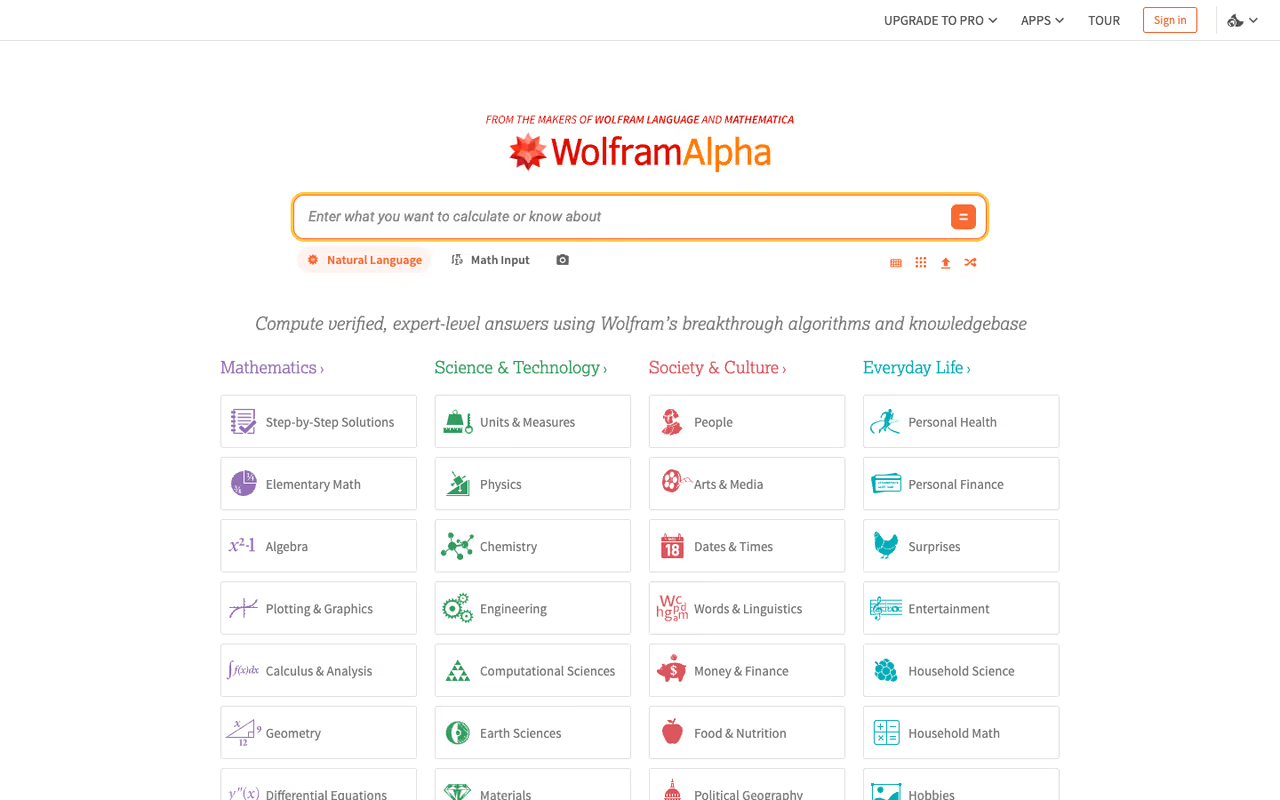
Wolfram Alpha is not a chatbot, and that's exactly why it's first. It's a computational engine that has done symbolic math since 2009, so answers come from an actual math system, not a language model guessing at plausible-looking steps. When I asked for the eigenvalues of a 3x3 matrix, it returned the exact values, the characteristic polynomial, and the eigenvectors without breaking a sweat.
The one to use when the answer has to be right, full stop. Wolfram Alpha computes exact results from a real math engine instead of guessing, which suits engineers and physics students. Step-by-step solutions need the paid Pro plan.
Engineers, physics students, anyone doing real work where a hallucinated step is unacceptable.
Pricing: the core engine is free. Pro adds step-by-step solutions, practice problems, and bigger file uploads. On the official pricing page it runs around $5 to $7 per month on an annual plan, with student discounts available.
The standout: every result is exact. It shows decimal and fraction forms, plots the function, and gives you the derivation rather than a confident narration of one.
The catch: it doesn't hold your hand. The interface feels like a 2012 calculator, and it won't chat back when you ask "wait, why did you do that?" If you want a tutor that explains in plain English, look further down this list.
Mathos AI: the tutor that re-explains until it clicks
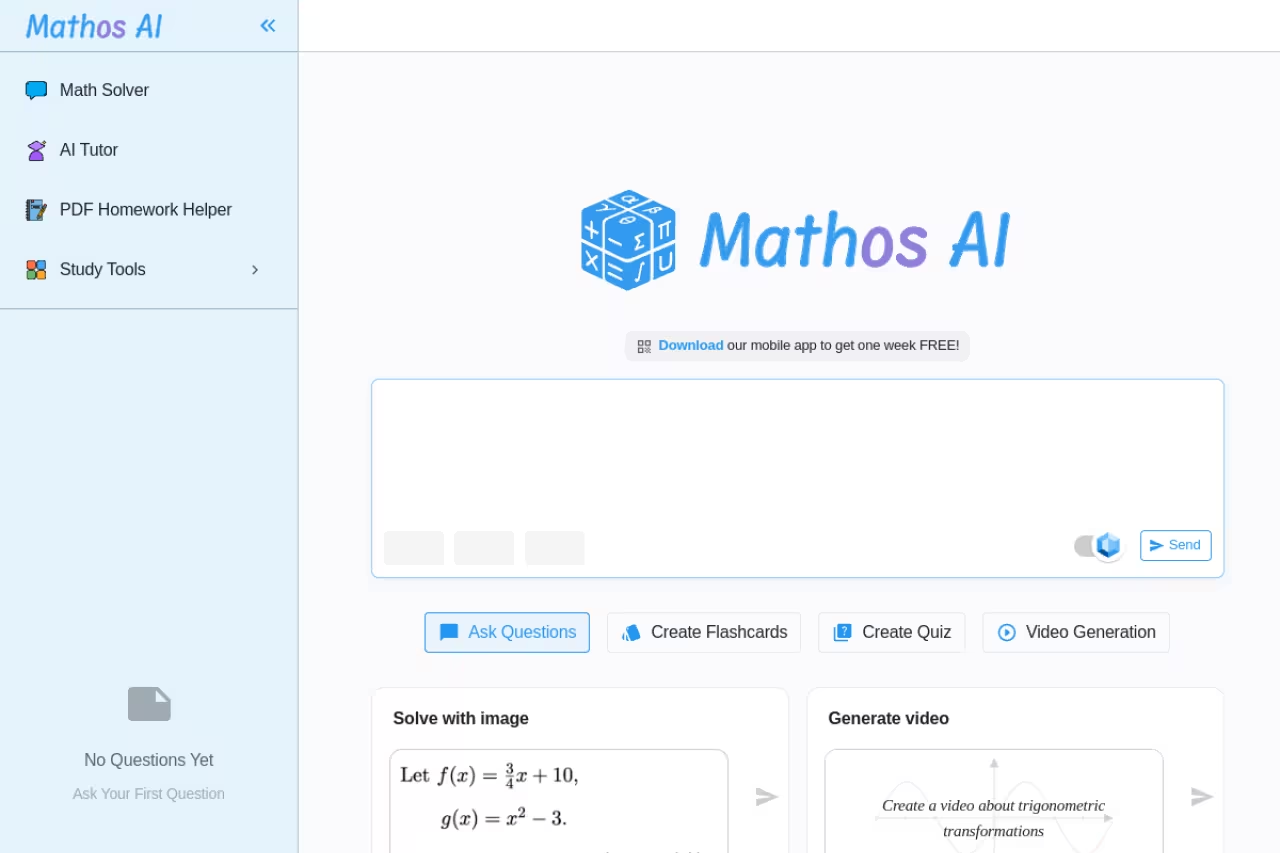
Mathos AI (formerly MathGPTPro) is built around the idea that the answer is only half the job. You snap a photo, speak, or type a problem and get step-by-step working you can interrogate. The AI Tutor is a whiteboard that coaches you in real time, and it'll turn any solution into a quiz, flashcard deck, or short video. The company says it has more than 5 million students and has solved over 100 million problems.
A good fit for students who learn by asking follow-up questions. Mathos AI offers photo, voice or typed input, a real-time tutor and a PDF homework helper, though the paid plan costs noticeably more than rivals.
The PDF homework helper, which solves every page of a worksheet in parallel, is genuinely useful around finals.
Pricing: there's a free tier with limited solves and "Pro mode" trials. The paid Prime plan lands near $30 per month for unlimited solves, the AI tutor, and PDF uploads, with cheaper weekly options if you only need it for one crunch.
The standout: input flexibility. Photo, voice, typed, or full PDF, and the follow-up Q&A actually remembers the problem context.
Where it falls short: because it leans on language models under the hood, users report the occasional arithmetic slip on multi-step problems. Always sanity-check the final number against a calculator or Wolfram Alpha. For deeper study workflows, our guide to the best AI for college students covers how to pair a solver like this with note-taking and study tools.

Photomath: still the king of the phone camera
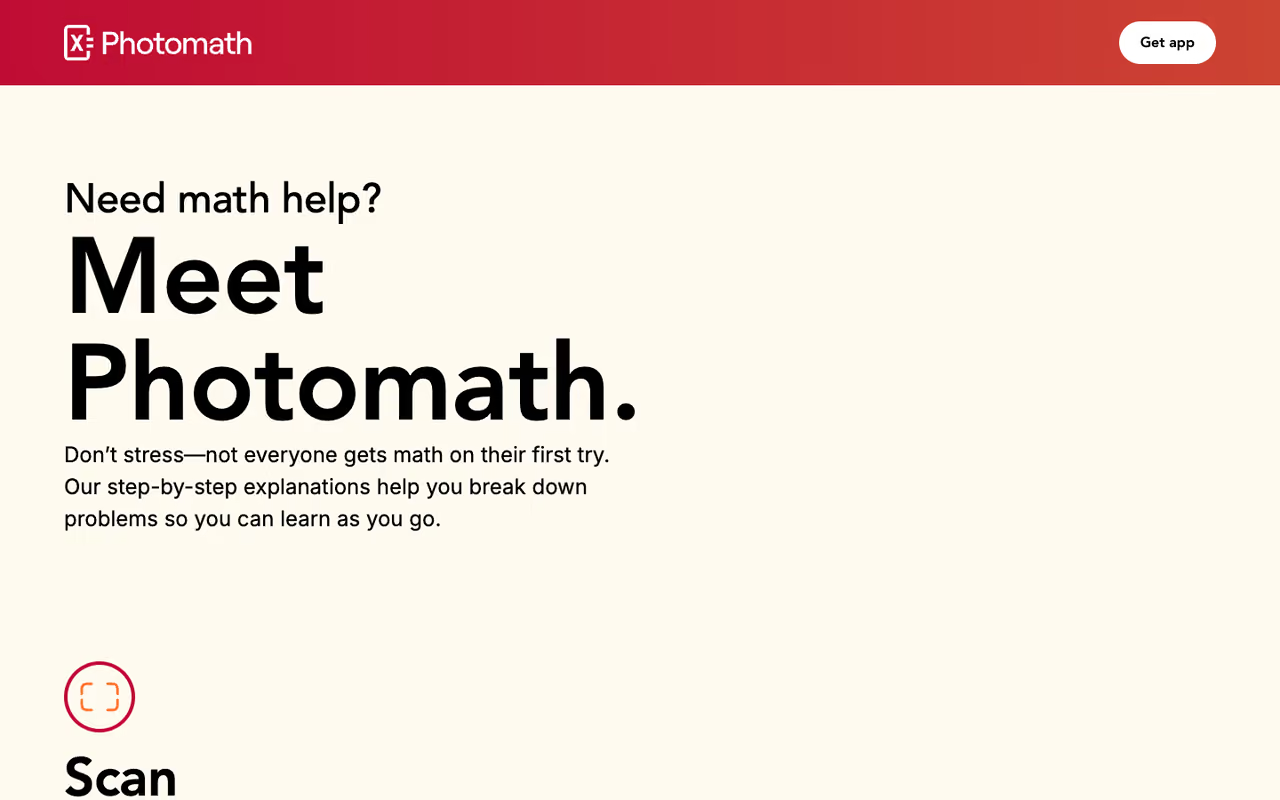
Photomath invented the point-your-phone-at-a-problem category, and after Google acquired it the recognition got even sharper. Of the tools on this list, it's the one users credit most for reading messy handwritten equations reliably. Where other apps misread a 7 as a 1, reviewers say Photomath usually gets it on the first try.
The pick for K-12 and early-college students with problems on paper, thanks to reliable reading of messy handwriting and multiple solving methods. Deeper walkthroughs sit behind the paid Plus plan.
If the math lives on paper, this is the fastest path to a solution.
Pricing: the free tier covers scanning and step-by-step explanations. Photomath Plus is $9.99 per month or $69.99 per year, which unlocks animated walkthroughs and deeper "how and why" tips on harder problems, per the Photomath site.
The standout: it often shows multiple solving methods for the same problem, so you can pick the approach your teacher actually wants.
The catch: it's strongest on standard curriculum math and gets shakier on advanced or oddly formatted problems. Word problems are hit or miss, and the best explanations sit behind the Plus paywall. For graduate-level proofs, this isn't your tool.

Symbolab: the most generous free step-by-step
Symbolab, owned by Learneo (the Course Hero parent), has one of the better free tiers in the category. It covers algebra, calculus, trigonometry, geometry, statistics, and linear algebra, and it shows the rule or theorem being applied at each stage instead of just listing operations. That's the part students need most: not what to do, but why.
Choose Symbolab if you want to see the logic behind each step without paying for it. The free tier is generous, but it throttles how deep the steps go, so Pro is the upgrade for full detail.
Pricing: free with ads and limited step depth. Pro runs roughly $7 per month (cheaper on longer plans) and removes ads while unlocking full step detail and more practice.
The standout: dedicated calculators for specific tasks, derivative, integral, matrix, and a graphing tool, so you can jump straight to the operation you need.
Where it falls short: the free tier shows the answer but throttles how much of the step-by-step you see before nudging you to upgrade. Image input exists but isn't as sharp as Photomath's.
Thetawise: built for university-level work
Thetawise is the one I reach for when a problem is too hard for the homework apps. It's positioned as an AI math tutor that handles proofs, harder calculus, and the kind of multi-step reasoning that trips up general chatbots. It graphs, explains, and lets you push back on its reasoning.
The one to reach for when a problem is too hard for the homework apps, such as proofs and abstract math. The free tier is generous, but like any LLM tutor it can produce a clean-looking wrong step.
Pricing: a free plan gives you 50 messages per day, which is enough for most coursework. Pro is $20 per month or $180 per year, with a 7-day trial.
The standout: it handles genuinely advanced problems better than the camera-first apps, and the 50-free-messages-a-day tier is unusually generous.
The catch: like any LLM-based tutor, it can still produce a clean-looking but wrong proof step. Verify anything you're submitting for a grade. It's also overkill if all you need is to factor a quadratic.
Julius AI: when the "math" is really data
Julius AI isn't a homework solver, it's a data analysis tool that happens to do serious math. You upload a dataset and ask questions in plain English, and it writes and runs actual Python or R behind the scenes, so the statistics come from real computation rather than a model's best guess. For regression, hypothesis testing, and visualization, it's the most reliable option here.
Treat it as a data analysis tool that does serious math, not a homework solver. Julius runs real Python or R, so statistics are computed, not guessed, but the free plan is only a preview.
Pricing: the free plan gives 15 messages per month, which the team behind Coefficient's pricing breakdown calls a preview rather than a working tool. Plus is $20 per month ($16 annually), Pro is $45 per month. Students and educators get 50% off.
The standout: it executes code, so a standard deviation or a t-test is computed, not estimated. That's a different reliability class from chatbot math.
Where it falls short: it's the wrong tool for solving a single calculus problem. The free message cap also disappears fast. If data analysis is your real need, see our best AI for data analysis and best AI for statistics guides.
ChatGPT (GPT-5.6 and GPT-6): the best generalist for word problems
You don't always need a dedicated app. ChatGPT has become a strong math reasoner, especially for word problems where the hard part is translating English into equations. Plus runs GPT-5.6 Sol with Medium and High thinking levels, and OpenAI reports that GPT-6 Astra scores 98% on FrontierMath Tier 4, a research-level math benchmark. In Chat, Astra (as GPT-6 Pro) needs a $100 or $200 Pro plan, which is overkill for homework.
The best generalist for messy word problems where the hard part is turning English into equations. Plus is enough for homework, while the top reasoning tiers are overkill, and it can still hallucinate a confident wrong step.
Pricing: a free tier exists, but the stronger reasoning lives in Plus at $20 per month. If you're weighing tiers, our ChatGPT Go vs Plus breakdown helps.
The catch: it can still hallucinate a wrong intermediate step with total confidence. Turn on reasoning mode for hard math, and always verify the final answer. For a head-to-head on general use, see Claude vs ChatGPT.
MathGPT (Mathful): free and fast for the basics
MathGPT by Mathful is the no-account, no-paywall option. You type or upload a problem and get a step-by-step solution covering arithmetic, algebra, geometry, and calculus. It claims a 99% accuracy rate, which I'd treat as marketing, but user reviews describe it handling standard problems cleanly.
A fast second opinion when you do not want to sign up for anything. Free and unlimited, but the explanations are shallower than Symbolab or Mathos, and the accuracy claim is marketing.
Pricing: free, with no hard limits on basic solving.
The catch: "free and unlimited" usually means the tool monetizes elsewhere, and the depth of explanation doesn't match Symbolab or Mathos. Treat it as a fast second opinion, not your primary tutor.
How to choose
Don't pick on brand. Pick on the job in front of you.
- You need the answer to be correct, no exceptions. Use Wolfram Alpha. It computes rather than predicts, so there's no hallucination risk on a derivation.
- You're learning and want to understand, not just copy. Mathos AI or Thetawise. Both let you ask "why" and re-explain. Symbolab if you want that for free.
- The math is on paper. Photomath. Its handwriting recognition still beats everything else.
- The "math" is a dataset. Julius AI, because it runs real code on your numbers.
- It's a word problem or a setup you can't parse. ChatGPT, then verify the final number elsewhere.
The pattern that worked best for me: use an LLM-based tool to understand the approach, then confirm the actual answer in Wolfram Alpha. Cheap insurance against a confident wrong step.
If you're building these AI tools into a real workflow, Dupple X bundles access to multiple top models so you can run a problem through several engines and compare. And our top tools directory tracks new math and study tools as they launch.
Try Dupple X free for a year and run your hardest problems through several models at once.
FAQ
What is the best free AI math solver?
For free step-by-step solutions, Symbolab and MathGPT are the strongest no-cost options for everyday algebra and calculus. Wolfram Alpha's free tier gives correct answers but limits the step-by-step working unless you upgrade. Thetawise offers 50 free messages a day, which covers most coursework. If you just want basic solving with no account, MathGPT is the lowest-friction pick.
Which AI math solver is the most accurate?
Wolfram Alpha, because it's a computational engine rather than a language model. It computes the answer symbolically instead of predicting a plausible one, so it doesn't hallucinate steps the way chatbot-based tools can. For data and statistics, Julius AI is the most reliable since it runs actual code. Always verify any LLM-based solver's final answer against one of these.
Can ChatGPT solve math problems accurately?
ChatGPT on GPT-5.6 is much stronger at math than earlier versions and handles word problems and multi-step reasoning well. But it can still produce a wrong intermediate step with full confidence. Turn on reasoning mode for hard problems, and verify the final answer in a computational tool like Wolfram Alpha before relying on it for anything graded.
What's the best AI math solver for college students?
For university-level math, Thetawise handles proofs and advanced problems better than the camera-first homework apps. Mathos AI is a strong conversational tutor with PDF support for full worksheets. For statistics and data coursework, Julius AI runs real analysis. Many students combine a tutor app for understanding with Wolfram Alpha for verification.
Are AI math solvers good for learning or just cheating?
They're as good as how you use them. Symbolab, Mathos AI, and Photomath show the reasoning at each step, so if you read the explanation and try the next problem yourself, they accelerate learning. Used to copy answers without engaging, they hurt understanding. The step-by-step format exists precisely so you learn the method, not just the result.
Can AI math solvers read handwritten problems?
Yes, several can. Photomath has the best handwriting recognition of the tools on this list and reads messy textbook problems reliably, per user reports. Mathos AI also accepts photo input and handles printed and clean handwritten problems well. For anything ambiguous, double-check that the tool read your problem correctly first, since a misread digit produces a confidently wrong answer.
Related guides
Some offers on this page may be paid placements or contain affiliate links.
Across our whole catalogue the median is $24 a month and 33% of tools advertise a free tier. Figures are the lowest recurring monthly price quoted in our own review of each tool, read on 2026-08-19. Full method and every category.
