
Best AI Language Learning Tools in 2026

Key facts8 tools compared: Speak, Langua, ELSA Speak, Duolingo Max, TalkPal, Babbel, Memrise, ChatGPT
- 8 tools compared: Speak, Langua, ELSA Speak, Duolingo Max, TalkPal, Babbel, Memrise, ChatGPT
- Speak (best for: Speaking fluency, all-around): ~$84/yr
- Langua (best for: Realistic open conversation): ~$160-200/yr
- ELSA Speak (best for: English pronunciation): ~$80/yr (50% off)
- Duolingo Max (best for: Habit + light AI roleplay): ~$168/yr
The single biggest reason adults stall out learning a language isn't grammar or vocabulary. It's that they never get enough speaking reps. A weekly tutor gives you maybe 50 minutes of talk time, a classroom splits attention across 20 people, and the moment you have to speak in front of a real person, the fear of sounding stupid shuts your mouth.
That's the gap AI fills, and in 2026 it fills it well. You can now have an unlimited, infinitely patient conversation partner that never sighs, never judges, and corrects your pronunciation at the phoneme level. I spent the last few weeks comparing pricing pages, documentation, and public user reviews for the major tools to see which ones actually move the needle versus which are gamified time-sinks.
If you want one answer: Speak is my top pick for most people because it forces you to talk out loud more than anything else, and its tutor gives feedback on why a phrase is off, not just that it's wrong. But the right tool depends on whether you want speaking practice, accent training, or a structured course. Here's the breakdown.
Quick comparison
| Tool | Best for | Price | Standout |
|---|---|---|---|
| Speak | Speaking fluency, all-around | ~$84/yr | AI tutor explains why a phrase is awkward |
| Langua | Realistic open conversation | ~$160-200/yr | Most natural AI call mode |
| ELSA Speak | English pronunciation | ~$80/yr (50% off) | Phoneme-level accent feedback |
| Duolingo Max | Habit + light AI roleplay | ~$168/yr | Gamification that keeps you back daily |
| TalkPal | Budget, many languages | ~$60/yr | 57+ languages, cheap |
| Babbel | Structured courses | ~$8/mo (12mo) | Expert-written lessons + AI Speak |
| Memrise | Vocab + casual chat | ~$90/yr | MemBot conversation in free tier |
| ChatGPT | DIY flexible tutor | Free or $20/mo | Voice mode, any language, zero structure |

Speak: the best all-around AI speaking coach
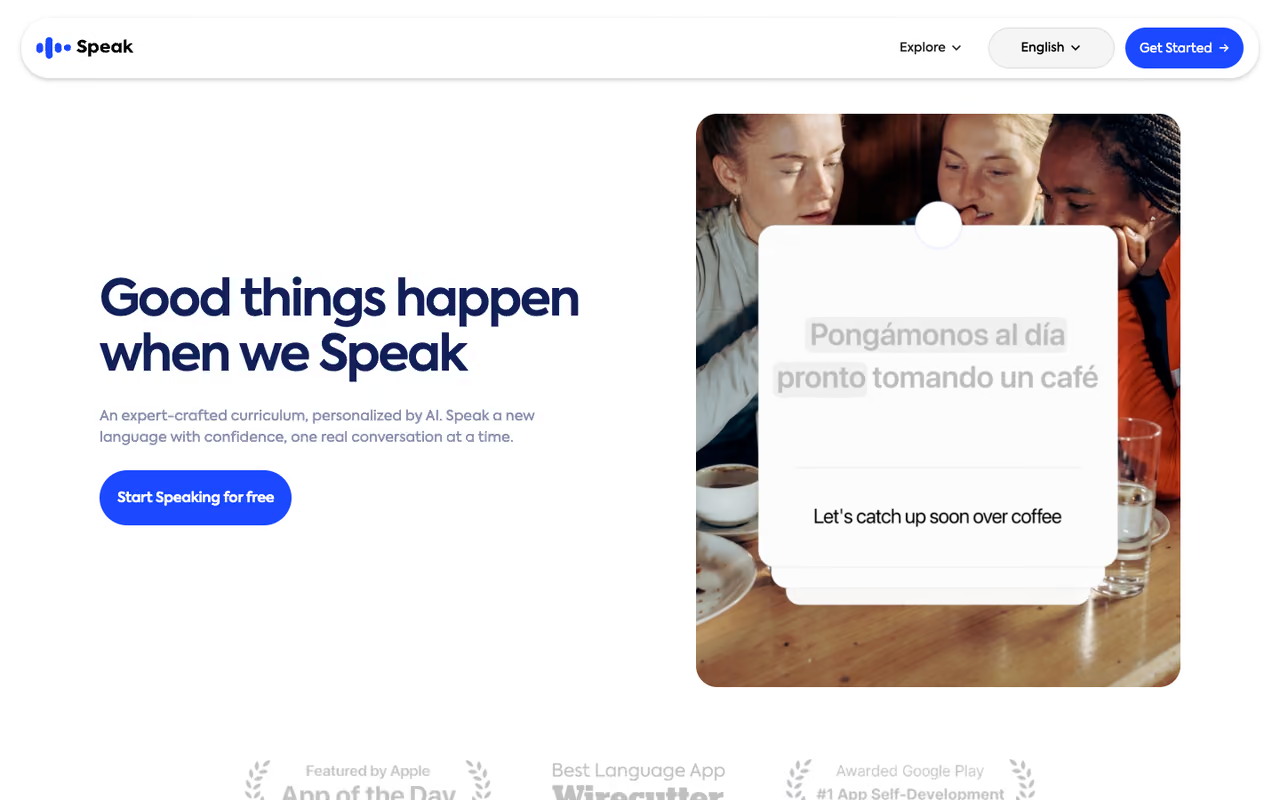
Speak is built around one idea: get you talking out loud as much as possible. Where most apps let you tap multiple-choice answers and feel productive, Speak makes you actually say the words. The core feature, Speak Tutor, designs a personalized curriculum then drops you into open conversation on any topic.
The feedback quality is what stands out. When a learner uses an awkward phrasing in Spanish, it doesn't just flag it. It explains that a native speaker would say it differently and why, which is the kind of correction you normally pay a human tutor for. Speak is backed by OpenAI's startup fund, and it shows in how naturally the conversations flow.
Who it's for: Anyone whose main bottleneck is speaking confidence. Best for English, Spanish, French, Korean, Italian, Japanese, and Chinese learners.
The pick if your main bottleneck is speaking confidence, with feedback that explains why a native speaker would phrase something differently. It covers only 7 languages and is weaker as a pure grammar reference.
A 7-day free trial, then Premium runs about $17.99/month or $83.99/year on iOS, with a higher Premium Plus tier. Prices shift by region and promo.
The catch: Only 7 languages. If you're learning something less common like Polish or Thai, Speak doesn't exist for you yet. The speaking-first design also means it's weaker as a pure grammar reference.
Langua: the most natural conversation partner
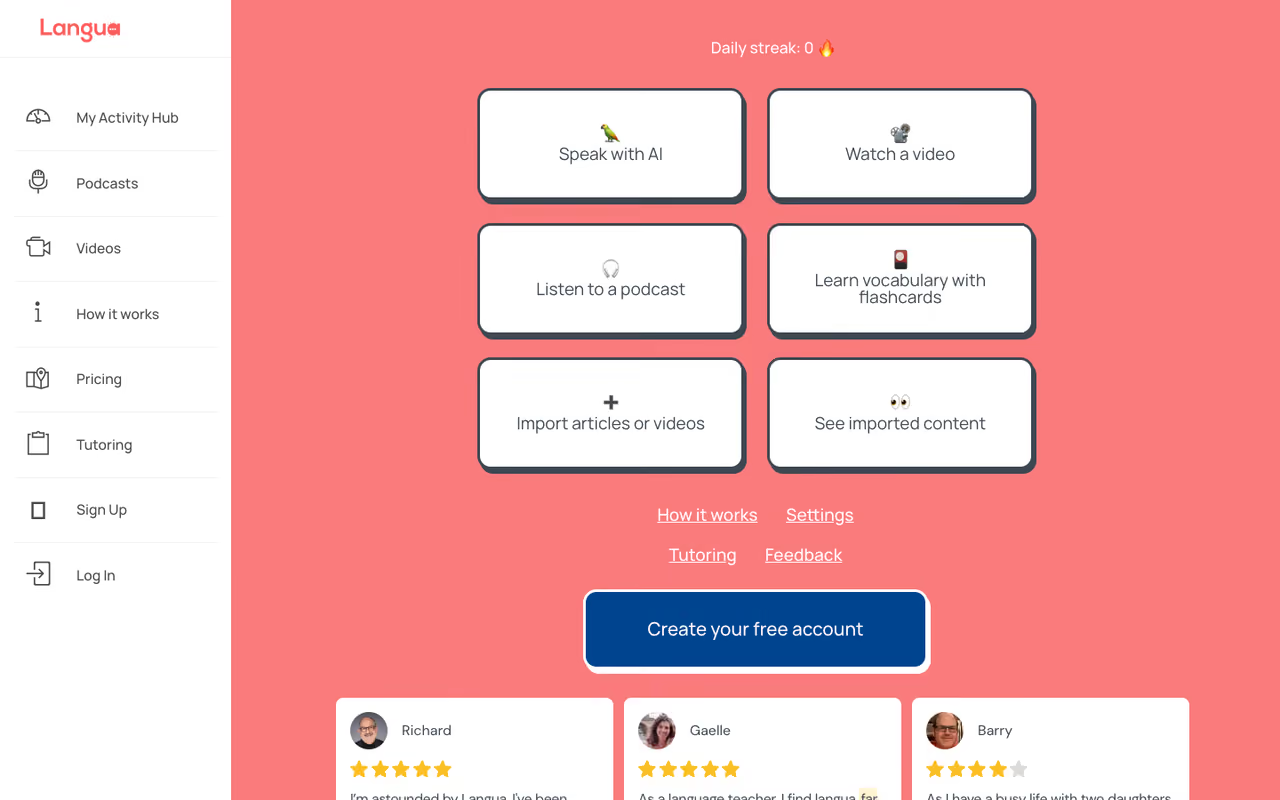
If you've tried older AI chat apps and found the voice robotic or laggy, Langua (from the LanguaTalk team) fixes that. Its call mode feels closer to talking with a real person than the alternatives on this list, with low latency and natural voices across 10+ languages including Spanish, French, German, Japanese, and Russian.
Langua leans into immersion. You can set the AI's personality, region, and accent, ask it to only correct you at the end so you don't break flow, and review a transcript afterward. For intermediate-to-advanced learners who know the basics and just need volume of real conversation, this is the closest thing to a daily speaking partner.
Who it's for: Intermediate learners who want unstructured, immersive talk rather than a course.
A strong daily speaking partner for intermediate learners who want immersion over a course, with low latency and natural voices across 10+ languages. Beginners will flounder without a curriculum, and the price sits at the upper end of this list.
No permanent free plan, but a free trial (5 days monthly, 7 days annual). The Annual Unlimited plan is around $200, or roughly $160 with a discount code, per LanguaTalk's pricing page.
Where it falls short: It assumes you already have a foundation. Complete beginners flounder because there's no hand-holding curriculum, and the price sits at the upper end of this list.
If you're putting together a full AI toolkit and want curated picks plus member deals on tools like these, Dupple X gives you a year of access for the price of a trial.

ELSA Speak: pronunciation, down to the phoneme
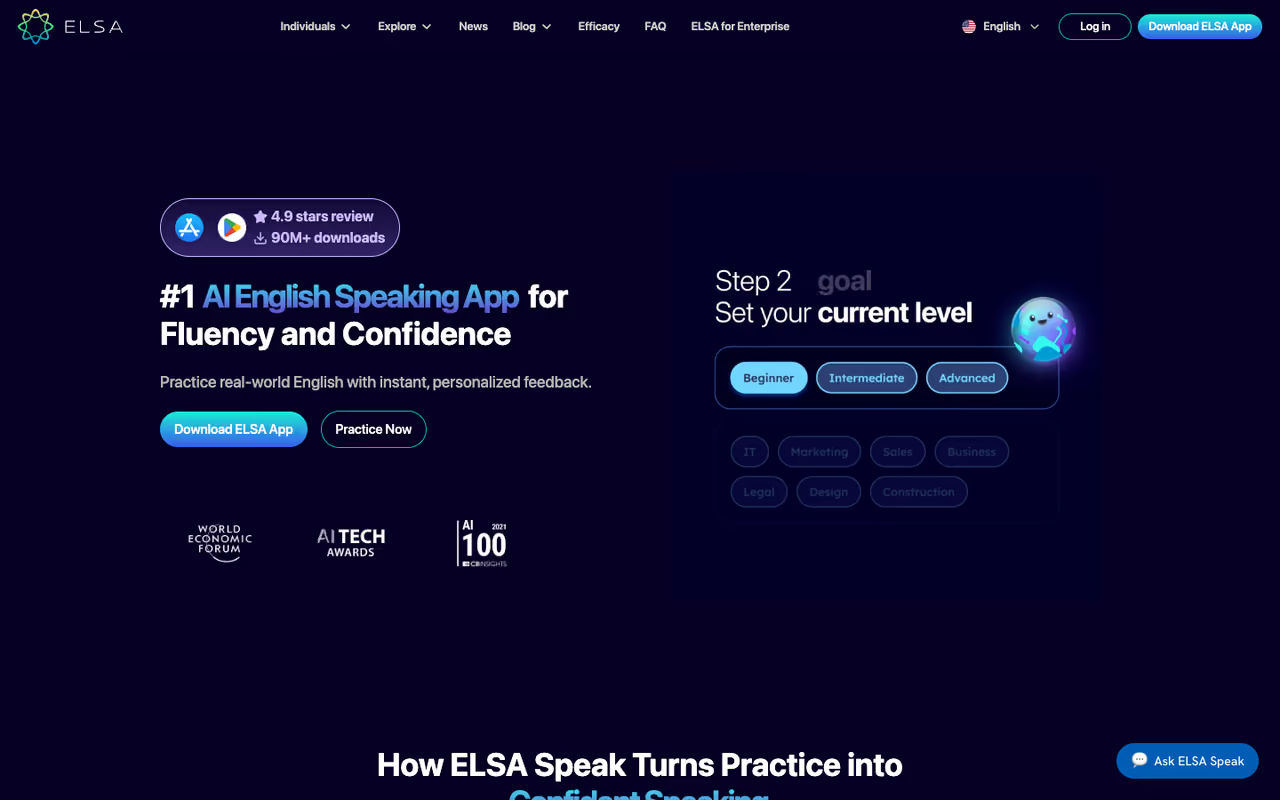
ELSA Speak (English Language Speech Assistant) does one job better than anyone: fixing your accent in English. It uses speech recognition trained on non-native speakers to tell you exactly which sound you're botching, then drills that phoneme. If you've ever been told "your English is great but your accent is hard to follow," this is the fix.
Reading drills produce a color-coded breakdown of every word, with problem sounds flagged in red and a target to hit. Over 2.5 million people use it, and it's the tool worth recommending to any non-native professional who needs to sound clearer on calls.
Who it's for: Non-native English speakers focused on accent and clarity, especially for work.
Pick ELSA if you're a non-native English speaker focused on accent and clarity, especially for work, since it pinpoints exactly which sound you're botching. It is English only and narrow by design, a pronunciation trainer rather than a full course.
Free tier exists. Premium is normally $159.99/year but is frequently 50% off at $79.99/year, working out to roughly $13/month on shorter plans. A lifetime option shows up periodically.
The catch: English only. ELSA won't help you learn French or Japanese. It's also narrow by design, so it's a pronunciation trainer, not a full course.

Duolingo Max: the habit machine with AI bolted on
Duolingo is still the king of keeping you coming back. The streaks, leaderboards, and guilt-tripping owl notifications work, and consistency beats intensity in language learning. The Max tier adds AI Roleplay (practicing real scenarios with a character) and more detailed AI feedback on top of the standard course.
One important 2026 update though: in January, Duolingo made Video Call and "Explain My Answer" free for all users, two of Max's headline AI features. So Max now mostly buys you scripted roleplays and deeper feedback, narrowing the gap with the free and Super tiers.
Who it's for: Beginners who need gamification to build a daily habit and don't mind a slower path to real speaking.
A good fit for beginners who need streaks and gamification to build a daily habit. At around $168/year, Max is hard to justify now that Video Call and Explain My Answer are free, and it gets you points more than fluency.
Max is around $168/year, per Duolingo's own pricing. Super is cheaper, and the free tier is generous now.
Where it falls short: Duolingo gets you points, not always conversational fluency. The AI features feel like add-ons rather than the core. Max is a lot to pay when the best AI bits are now free.
If you're building a broader AI toolkit beyond languages, our roundup of the best AI education tools and how to use AI to study pair well with any of these apps.

TalkPal: cheapest way to cover the most languages
TalkPal is the value pick: AI conversation practice across 57+ languages with modes like roleplays, debates, and photo descriptions. The breadth is the draw. If you want Vietnamese, Hungarian, or Swahili, TalkPal probably has it where the premium apps don't. I found the conversation quality a notch below Speak and Langua, but for the money it's hard to argue with, and the free tier lets you sample it properly.
Who it's for: Budget-conscious learners, or anyone studying a less common language.
The value pick for budget-conscious learners or anyone studying a less common language, with 57+ languages on offer. Conversation quality and AI feedback are a notch below Speak and Langua, but the free tier lets you sample it properly.
Free plan with a 10-minute daily limit. A 14-day premium trial, then $9.99/month, $4.99/month billed annually (about $60/year), or $6.25/month on a 2-year plan, per TalkPal's pricing page.
The catch: Jack of all trades. The AI feedback isn't as sharp or as explanatory as the premium specialists, and the polish isn't there.

Babbel: structured courses with AI speaking added
Babbel is the choice if you want a curriculum written by linguists, not an AI you have to steer yourself. The lessons are tight, practical, and aimed at real conversations. In September 2025, Babbel rolled out Babbel Speak, an AI speaking feature that walks you through expert-designed scenarios with prompts and live feedback. So you get both: a proven structured course for the fundamentals, plus AI conversation when you're ready to talk. For learners who tried free-form AI and felt lost, Babbel's structure is the antidote.
Who it's for: Learners who want a guided, lesson-based path with AI speaking as a complement.
Choose Babbel if you want a guided, lesson-based path written by linguists, with AI speaking as a complement. The speaking feature is newer and less open-ended than Speak or Langua, so you pay for course quality first and AI second.
Around $15/month for 3 months, $13/month for 6 months, or about $8/month on a 12-month plan. A lifetime subscription (all 14 languages) shows up periodically around $159.
Where it falls short: The AI speaking feature is newer and less open-ended than Speak or Langua. You're paying for the course quality first, AI second.

Memrise: vocab building with a chatty AI bot
Memrise pairs spaced-repetition vocabulary with MemBot, its AI conversation partner that asks questions and holds chats. The smart move Memrise made: MemBot isn't locked behind a premium wall, so everyone can practice talking, and it recently added voice input so you can speak instead of type. The vocab system uses video clips of native speakers, which helps words stick in real context. It's a nice middle ground between Duolingo's gamification and the pure-conversation apps.
Who it's for: Vocabulary-focused learners who want casual AI chat without a big spend.
A middle ground for vocabulary-focused learners who want casual AI chat without a big spend, with MemBot included free. It is lighter on structured grammar and serious speaking drills, so it won't be as demanding as a dedicated tutor like Speak.
Free tier includes MemBot. Pro is $8.49/month, $89.99/year, or $119.99 lifetime.
The catch: It's lighter on structured grammar and serious speaking drills. MemBot is fun but not as demanding as a dedicated tutor like Speak.

ChatGPT: the flexible DIY tutor
ChatGPT isn't sold as a language app, but it might be the most capable one if you're willing to drive. With Advanced Voice Mode you can have a real-time spoken conversation in 50+ languages, ask it to roleplay a job interview in German, explain a grammar rule, or correct your last paragraph. One tester wrote that voice mode replaced their $20/hour human tutor. The flexibility is unmatched: no other tool lets you say "be a strict French waiter and only correct me at the end" and have it just work. The downside is you build your own structure.
Who it's for: Self-directed intermediate-plus learners who want maximum control and already learn well on their own.
The flexible DIY option for self-directed intermediate-plus learners who want maximum control, with real-time voice conversation in 50+ languages. It has zero curriculum, no progress tracking, and no spaced repetition, so you build your own structure.
Free tier includes GPT-5.6 Luna with limited voice chats. Plus is $20/month and unlocks Advanced Voice Mode, which is the version you want for speaking practice.
Where it falls short: Zero curriculum, no progress tracking, no spaced repetition. It won't tell you what to study next or remember your weak spots across sessions the way a dedicated app does. For more on general-purpose chat tools, see our best AI chatbots and best AI assistant guides.
How to choose the right one
Forget the feature lists for a second and answer one question: what's actually stopping you?
- You freeze up when speaking → Speak or Langua. Both force conversation. Speak is friendlier to lower levels, Langua is better once you have a base.
- Your accent holds you back in English → ELSA Speak. Nothing else gets this granular.
- You can't stay consistent → Duolingo Max. The gamification is the product. Just know it's slow toward real fluency.
- You want a real course, not a free-for-all → Babbel.
- You're on a budget or learning a rare language → TalkPal.
- You learn well solo and want total control → ChatGPT Plus.
My honest recommendation for most people: pair a habit app (Duolingo free or Memrise) for daily vocab with one serious speaking tool (Speak for most, Langua if you're past beginner). That combo runs under $100/year and covers both consistency and the speaking reps that actually create fluency.
If you're assembling a wider stack of AI tools for work and learning, Dupple X members get curated picks and deals, and our top tools directory is a good place to compare what's out there.
FAQ
What is the best AI language learning tool in 2026?
For most people, Speak is the best all-around choice because it prioritizes speaking out loud and explains why your phrasing is off. Langua wins for natural open conversation at intermediate level, and ELSA Speak is best for English pronunciation. The "best" depends on whether your goal is speaking, accent, or structured study.
Can AI replace a human language tutor?
For raw conversation practice and pronunciation feedback, AI now comes close, and it's unlimited and cheaper. Several testers report swapping $20/hour tutors for ChatGPT voice mode or Speak. Humans still win on cultural nuance, accountability, and catching subtle errors AI misses. A good setup is daily AI practice plus an occasional human tutor for checkpoints.
Is ChatGPT good for learning a language?
Yes, especially with ChatGPT Plus and Advanced Voice Mode for real-time spoken practice in 50+ languages. It can roleplay scenarios, explain grammar, and correct your writing. The catch is no curriculum, progress tracking, or spaced repetition, so it works best for self-directed intermediate and advanced learners.
Are free AI language tools any good?
Some are. TalkPal's free tier (10 minutes daily), Memrise's MemBot, Duolingo's free tier (now including Video Call), and ChatGPT's free voice mode all let you practice without paying. They're great for sampling, but daily limits and reduced AI quality usually push serious learners to a paid plan.
How much should I expect to pay for an AI language app?
Most quality apps land between $60 and $170 per year. TalkPal is cheapest around $60/year, Speak runs about $84/year, ELSA is often $80/year on its 50%-off promo, and Duolingo Max and Langua sit at the top around $168-200/year. ChatGPT Plus is $20/month if you go the DIY route.
Which AI app is best for pronunciation?
ELSA Speak for English. It analyzes your speech at the phoneme level and tells you exactly which sounds to fix. For other languages, Speak and Langua give pronunciation feedback during conversation, though not as granular as ELSA's English drills.
Related guides
Some offers on this page may be paid placements or contain affiliate links.
