
Best AI Product Description Writers in 2026 (Compared)

Key facts8 tools compared: Describely, Jasper, Hypotenuse AI, Copy.ai, Shopify Magic, Rytr, Writesonic…
- 8 tools compared: Describely, Jasper, Hypotenuse AI, Copy.ai, Shopify Magic, Rytr, Writesonic, ChatGPT
- Describely (best for: Bulk catalogs, mid-market): Free (5 products), $0.75/SKU
- Jasper (best for: Brand voice, marketing teams): $59/mo per seat (annual)
- Hypotenuse AI (best for: Ecommerce SEO at scale): From ~$19/mo; ecommerce custom
- Copy.ai (best for: Workflow-driven content ops): $24/mo (annual, 5 seats)
Writing product descriptions is the job nobody on an ecommerce team wants. It's repetitive, it scales badly, and the moment your catalog passes a few hundred SKUs it turns into a backlog that quietly blocks every new launch. I've watched founders push back a product drop by two weeks because nobody had written the copy yet.
AI fixed most of that. But the tools are wildly different. Some are bulk machines that turn a spreadsheet of 5,000 SKUs into finished copy by lunch. Others are single-asset writers built for a marketer who wants one description to sound exactly right. Pick the wrong category and you'll either drown in a tool that's overkill for a 30-product store, or fight a chat box to do work it was never designed for.
I compared the main contenders on pricing, bulk output, and SEO features. If you need finished copy across hundreds or thousands of products, Describely is the one I'd start with. If you care more about brand voice on a smaller catalog, Jasper wins. Here's who each is for, what they cost, and where each one falls down.
Quick comparison
| Tool | Best for | Price | Standout |
|---|---|---|---|
| Describely | Bulk catalogs, mid-market | Free (5 products), $0.75/SKU | Generates titles, descriptions, meta tags for a whole catalog at once |
| Jasper | Brand voice, marketing teams | $59/mo per seat (annual) | Trained brand voices that stay consistent across thousands of items |
| Hypotenuse AI | Ecommerce SEO at scale | From ~$19/mo; ecommerce custom | Product data enrichment + SEO monitoring built in |
| Copy.ai | Workflow-driven content ops | $24/mo (annual, 5 seats) | Chains description writing into wider GTM workflows |
| Shopify Magic | Shopify stores on a budget | Free with any Shopify plan | Writes directly inside the product editor, zero setup |
| Rytr | Tiny catalogs, side projects | $9/mo unlimited | Cheapest paid option that still does the job |
| Writesonic | SEO-led long descriptions | From $10/mo | Built around keyword targeting and search ranking |
| ChatGPT | Full prompt control | Free; $20/mo Plus | The most flexible if you like steering the output yourself |

Describely: best for bulk catalogs
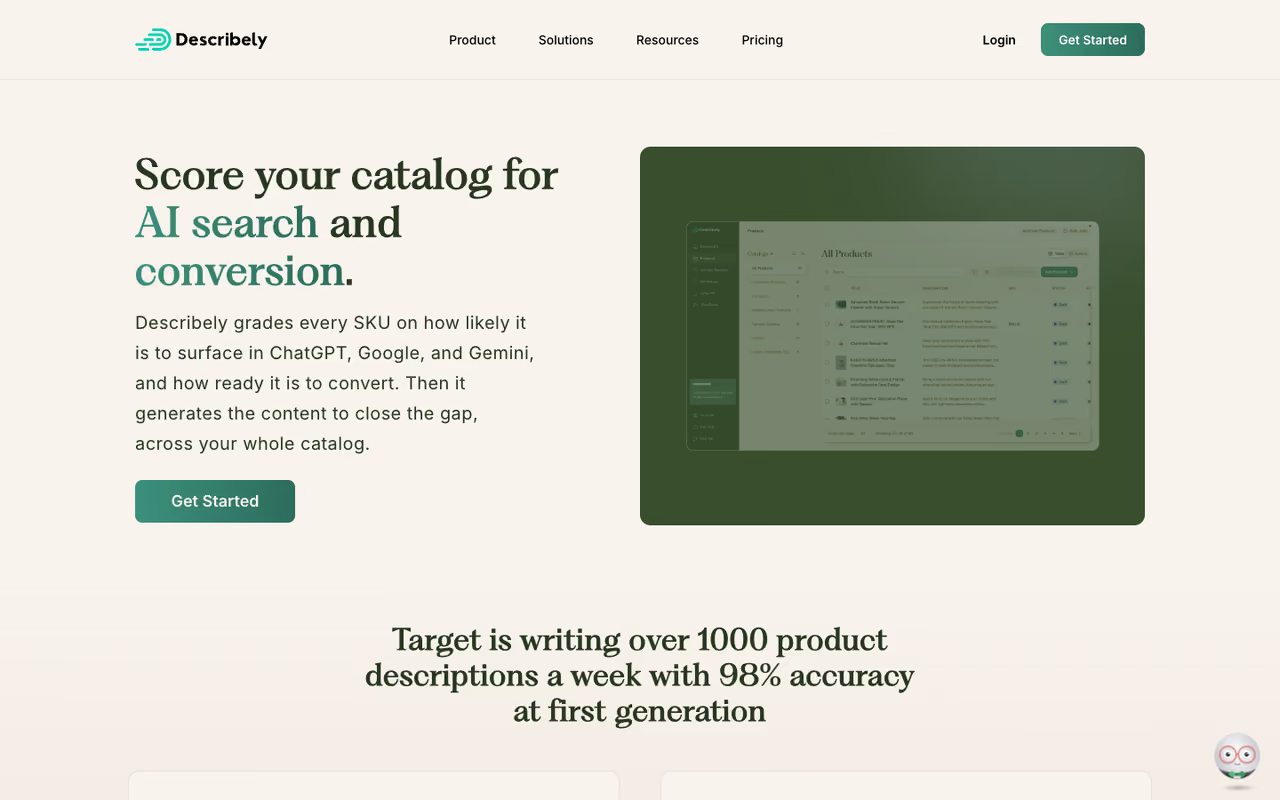
Describely is built for one job: turning a big catalog into finished product content fast. You import your SKUs, and it generates titles, descriptions, keywords and meta tags for the whole list at once, then syncs the results straight back to Shopify, WooCommerce or Wix without any copy-pasting.
Who it's best for: mid-market retailers with hundreds or thousands of products where manual copywriting has become the thing holding up new launches. Brands have reported finishing work that used to take two weeks in a single day, which tracks with what I saw running a few hundred SKUs through it.
The bulk choice for mid-market retailers with hundreds or thousands of products, generating content for the whole catalog and syncing it back to your store. It is narrow on purpose, and $0.75 per SKU adds up fast on a 10,000-product catalog.
there's a free plan covering 5 products with unlimited generations and a few enrichment credits, enough to judge output quality before you pay. Past that, pay-as-you-go charges $0.75 per product with unlimited regenerations on each. You can set Content Rules for tone, length and structure so every description follows your brand guidelines instead of drifting.
The standout: the bulk workflow is the real product. Most tools make you write one description at a time. Describely treats your catalog as the unit of work, the right mental model when you have a spreadsheet of SKUs and a deadline.
The catch: it's narrow on purpose. If you want one beautifully crafted hero-product description with a marketer's eye, you're better served elsewhere. And $0.75 per SKU adds up fast on a 10,000-product catalog, so do the math first.

Jasper: best for brand voice
Jasper is the marketing-team pick. Its strength is brand voice: you train it on how your company writes, and it holds that tone across product descriptions, ad copy and everything else. For a brand whose copy is part of the product, like apparel or beauty, that consistency matters more than raw speed.
Who it's best for: marketing teams that already own the brand voice and want AI to extend it, not invent it. It's a fuller marketing platform too, so product description work sits next to ad copy, email and campaign tools. It also shows up on most best AI tools for marketers shortlists for that reason.
The marketing-team pick for holding a trained brand voice across descriptions and ad copy, which matters for apparel or beauty. There is no bulk-catalog mode, and at $59 per seat per month it earns its price only if you use the whole suite.
the Pro plan runs $69/month per seat monthly, or $59/month per seat on annual billing, including 2 brand voices, image generation and the browser extension. The Business plan with unlimited seats and API access is custom-priced on a 12-month minimum. There's a 7-day free trial.
The standout: trained brand voices that genuinely stay consistent. I fed it our tone guidelines and the descriptions came back sounding like us, not generic AI filler. That's harder than it sounds and most tools don't nail it.
Where it falls short: there's no native bulk-catalog mode like Describely's, so it's not the tool for processing 5,000 SKUs unattended. And at $59 per seat per month, it's an expensive way to write product copy if that's all you need. Jasper earns its price when you use the whole suite.

Hypotenuse AI: best for ecommerce SEO at scale
Hypotenuse AI goes deeper on the ecommerce side than most. Beyond writing descriptions, it does product data enrichment, attribute tagging, categorization and SEO monitoring for your product pages. It connects directly to Shopify and handles bulk generation, so it competes with Describely on volume while leaning harder into search.
Who it's best for: stores where organic search is the main channel and the catalog is big enough that SEO has to be systematic. The enrichment features help when product data is messy or incomplete, which is common in catalogs imported from suppliers.
Pick Hypotenuse if organic search is your main channel and the catalog is big enough that SEO has to be systematic, with enrichment for messy product data. Custom-quote ecommerce pricing makes cost hard to compare for smaller stores.
the marketing and SEO plans start around $29/month monthly, or roughly $19/month billed annually, for 50,000 words and one seat. The ecommerce plans are a separate model requiring a custom quote, priced on features like bulk generation and SEO monitoring rather than word counts. There's a 7-day free trial.
The standout: SEO is baked in rather than bolted on. It handles keyword targeting and tracks how your pages perform, closing the loop most description writers leave open.
The catch: custom-quote pricing on ecommerce plans makes cost hard to compare without talking to sales, which rules it out for a lot of smaller stores. The two-tier model (marketing vs ecommerce) also confuses people who just want to know what they'll pay.

Copy.ai: best for content workflows
Copy.ai has shifted from a pure writing tool toward a workflow platform. You can still generate single descriptions, but the real pitch now is chaining that writing into larger go-to-market workflows: research a product, write the description, generate the ad, push it out. For ops-minded teams, that's the appeal.
Who it's best for: teams that think in workflows rather than one-off documents, and want product copy to be one step in a longer automated chain.
Suited to ops-minded teams that want product copy to be one step in a longer automated chain. Most stores need less platform than this, and the jump from $24 to $1,000 leaves no middle tier for a growing team.
the Chat plan is $24/month annual ($29 monthly), with 5 seats, unlimited chat words and access to OpenAI, Anthropic and Gemini models. The workflow-heavy plans jump sharply, with Growth at $1,000/month, so the gap between hobby and enterprise is wide. There is no free plan anymore.
The standout: multi-model access and the workflow builder. Routing a task to Claude or GPT depending on what writes better is genuinely useful, and 5 seats on the entry plan is generous.
Where it falls short: for plain product description writing, the workflow layer is more than most stores need. The jump from $24 to $1,000 leaves no middle tier for a growing team. If you just want descriptions, you're paying for a platform you'll barely touch.
Side note before the next two: if keeping track of which AI tools are actually worth adopting is the harder problem, Dupple X does that filtering for you so you're not testing ten tools to find one.
Shopify Magic: best free option for Shopify stores
If you're on Shopify, you already have a description writer and it costs nothing. Shopify Magic lives inside the product editor: click generate, give it a few details, and it writes the description right where you need it. No new account, no export, no integration.
Who it's best for: Shopify merchants on any plan who want decent copy with zero friction and zero added cost. For a store launching its first 50 products, this is often all you need.
The no-friction default for Shopify merchants on any plan, writing descriptions right in the product editor at no added cost. It has no real bulk mode and thinner brand voice control than Jasper, so it suits a first 50 products better than a big catalog.
free with every Shopify plan, no usage caps or premium tier. The 2026 version takes richer inputs like competitor links, customer personas and SEO keyword targets, which pushed output quality up noticeably from the early versions.
The standout: it's already there and it's free. The "open another tab, paste, copy back" friction is gone entirely, and that convenience wins for small catalogs more than people expect.
The catch: there's no real bulk mode, so it doesn't scale to thousands of SKUs like the dedicated tools. Brand voice control is thinner than Jasper's too. It's a great default, not a power tool. Our best AI tools for ecommerce guide puts it in context.

Rytr: best budget pick
Rytr is the cheapest paid tool here that still does the job properly. It has a product description template among its 40-plus use cases, supports 20-plus tones, and has a free tier to test before you spend anything.
Who it's best for: side projects, tiny catalogs, and anyone who wants a paid AI writer without a real monthly commitment.
The cheapest paid tool here that still does the job, with a free tier and unlimited writing at $9/month, good for side projects and tiny catalogs. It is a general writer with no catalog import or Shopify sync, so expect more editing.
the free plan gives you 10,000 characters a month (around 1,500 words), enough for a handful of short descriptions. The Unlimited plan is $9/month, or $7.50/month annual, and removes the character cap. Premium runs $29/month with more tones and 100 plagiarism checks.
The standout: $9/month for unlimited generation is hard to beat. For the price of two coffees you get a competent writer with no word anxiety.
Where it falls short: it's a general writer, not an ecommerce specialist, so there's no catalog import, no Shopify sync, no bulk processing. The output is solid but plainer than Jasper's, and you'll do more editing.

Writesonic: best for SEO-led descriptions
Writesonic is built around search visibility. Its product description tool is wrapped in a larger SEO suite with keyword targeting, article writing and an AI search visibility feature, so it suits stores that treat each product page as a piece of SEO real estate.
Who it's best for: sellers who want longer, keyword-optimized descriptions that are trying to rank, not just inform.
Go with Writesonic if your descriptions exist to rank, since keyword targeting and search tracking sit in one place. The credit system makes real costs harder to predict, and the description tool can feel like an afterthought.
plans start at $10/month for short-form, with longer-form tiers and an "unlimited" single-user plan around $20-25/month. There's a free trial with 10,000 words of credit and a free plan to start on. It runs on credits, so heavy use can move you up a tier faster than the headline price suggests.
The standout: the SEO framing. If your descriptions exist to rank, having keyword tools and search tracking in one place beats a plain writer.
The catch: the credit system makes real costs harder to predict, and the product sprawls across so many features that the description tool can feel like an afterthought. For pure bulk catalog work, Describely or Hypotenuse are cleaner fits.

ChatGPT: best for full control
ChatGPT belongs on this list because plenty of sellers still write their best descriptions by hand-steering a chat. With a good prompt and your brand context pasted in, it produces copy that rivals the dedicated tools, and you control every word.
Who it's best for: people who like prompting, have a small-to-medium catalog, and don't want another subscription. It's also the most flexible when products are unusual and templates don't fit.
The flexible option for people who like prompting, with small-to-medium catalogs and no wish for another subscription. With no catalog import or bulk mode, 500 products means 500 prompts, so it is a precision tool rather than a volume one.
the free tier handles basic description writing. Plus is $20/month for stronger models and higher limits. To get more out of it, our ChatGPT for marketing guide is a useful starting point.
The standout: total flexibility. No template boxes you in, and you can iterate conversationally until the copy is exactly right.
Where it falls short: there's no catalog import, no platform sync, no bulk mode. Doing 500 products means 500 prompts, which defeats the purpose. It's a precision tool, not a volume one.
How to choose
Match the tool to the shape of your catalog and the bottleneck you actually have. If you're still building out the rest of your stack, our top AI tools directory is a good place to compare options side by side.
If your problem is volume, you need bulk generation and platform sync. Describely and Hypotenuse are the two real options. Pick Describely for transparent per-SKU pricing and clean Shopify/WooCommerce/Wix sync. Pick Hypotenuse if SEO and data enrichment matter as much as the writing itself.
If your problem is voice, your catalog is probably smaller and the copy is part of the brand. Jasper is the answer, and the per-seat cost is justified if you use the wider marketing suite.
If your problem is budget, start free. Shopify Magic if you're on Shopify, ChatGPT's free tier or Rytr at $9/month if you're not. You can always upgrade once the catalog outgrows them.
If your problem is workflows, where description writing is one link in a longer chain, Copy.ai is built for that. Just don't pay for it if all you need is descriptions.
Most teams overbuy. A 40-product store does not need a bulk catalog engine, and a 5,000-SKU store will be miserable prompting ChatGPT one item at a time. Be honest about which problem you have. To keep up with how these tools shift, Dupple X tracks the AI products worth your attention without the noise, and you can start a yearly trial here.
Frequently asked questions
What is the best AI product description writer for Shopify?
For most Shopify stores, Shopify Magic is the best place to start because it's free, built into the product editor, and now accepts SEO keywords and customer personas. Once you outgrow it, Describely is the strongest paid option since it syncs descriptions back to Shopify in bulk. If brand voice is your priority, Jasper is worth the per-seat cost.
How much do AI product description writers cost?
Pricing ranges from free to enterprise. Shopify Magic is free with any Shopify plan, and ChatGPT and Rytr have free tiers. Paid plans start around $9/month for Rytr, $24/month for Copy.ai, and $59/month per seat for Jasper. Bulk tools like Describely charge per product, at $0.75 per SKU, so cost scales with catalog size.
Can AI write SEO-optimized product descriptions?
Yes, and some tools are built specifically for it. Hypotenuse AI and Writesonic include keyword targeting and search tracking so descriptions are written to rank, not just describe. Most general writers will still incorporate target keywords if you supply them in the prompt, but the dedicated SEO tools handle it more systematically across a full catalog.
Is it worth paying for an AI product description tool or is ChatGPT enough?
For a small catalog under a few dozen products, ChatGPT or Shopify Magic is usually enough and free. The dedicated tools earn their cost when you have hundreds or thousands of SKUs, because they offer bulk generation, platform sync and brand-voice controls that a chat box can't match. The break-even point is roughly when manual writing starts blocking your launches.
Will AI-generated product descriptions hurt my SEO?
Not inherently. Google judges content on quality and usefulness, not on whether a human or AI wrote it. The risk is publishing thin, duplicate or generic copy at scale, which any approach can produce. Tools with brand-voice controls and SEO features help you avoid that. Always review and edit AI output rather than publishing it untouched.
Related guides
Some offers on this page may be paid placements or contain affiliate links.
