
Best Bookshelf Speakers in 2026: Nine Pairs Ranked by Cost to Play
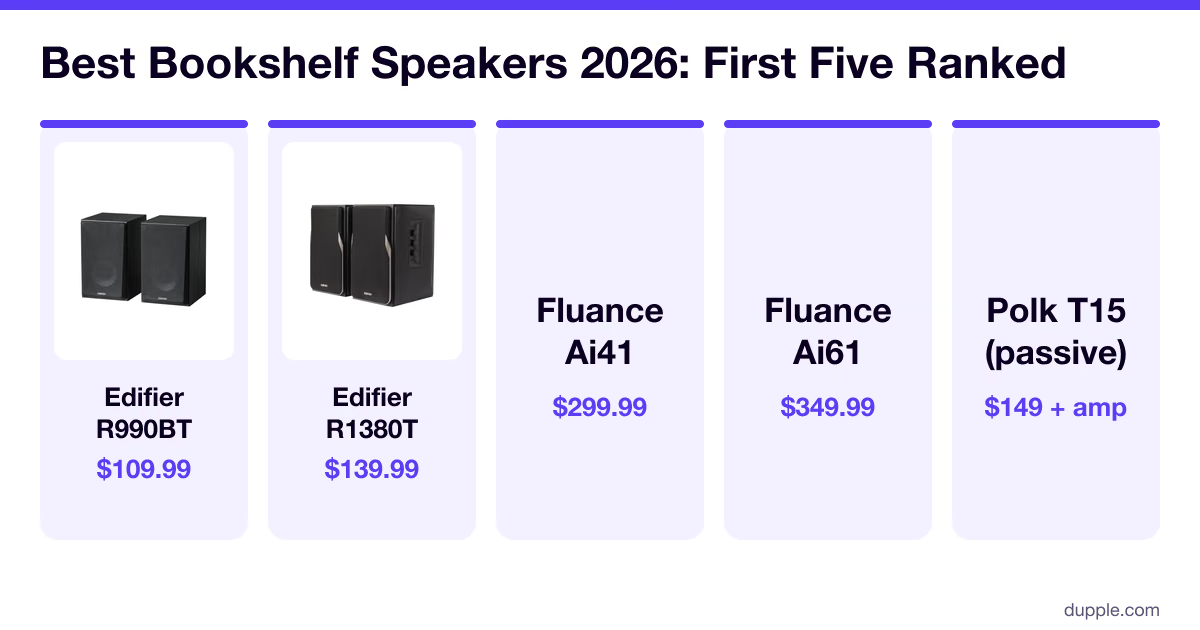

Key facts9 pairs compared: Edifier R990BT, Edifier R1380T, Fluance Ai41, Fluance Ai61, Polk T15, Polk…
- 9 pairs compared: Edifier R990BT, Edifier R1380T, Fluance Ai41, Fluance Ai61, Polk T15, Polk Monitor XT20, Kanto Tuk 2nd Gen, Klipsch R-50M, Kanto Tuk Passive 2nd Gen
- Edifier R990BT (best for: A desk with a Bluetooth source): $109.99
- Edifier R1380T (best for: Two wired sources in one room): $139.99
- Fluance Ai41 (best for: A desk or bedroom with Bluetooth and optical): $299.99
- Fluance Ai61 (best for: A larger room with a subwoofer): $349.99
Disclosure: some links on this page are affiliate links that may earn Dupple a commission at no extra cost to you. Rankings follow the criteria in the methodology.
Updated November 4, 2026: prices re-checked on each vendor's US store or pricing page. Compared from vendor specs and pricing pages, not tested hands-on.
As of November 2026, the Edifier R990BT at $109.99, the Edifier R1380T at $139.99 and the Fluance Ai41 at $299.99 rank first to third of nine bookshelf pairs, each read on its maker's US store on November 4, 2026. The order is the cost to play: the pair price, plus a $599 reference amplifier for the passive pairs, lowest first.
Dupple data: computed from vendor prices on November 4, 2026. Nine pairs are ranked that day, and their cost to play runs from $109.99 to $1,298.99.
The nine picks at a glance
The table lists the nine numbered picks in ranking order. Each figure is the vendor's own wording, shortened.
| Pair | Pair price (Nov 4, 2026) | Type | Amplifier, as stated | Frequency, as stated | Inputs, as stated | Best for |
|---|---|---|---|---|---|---|
| Edifier R990BT | $109.99 | Powered | Built in, 12 W + 12 W RMS (spec table) | 60 Hz to 18 kHz | Bluetooth V5.4, Line In 1, Line In 2 | A desk with a Bluetooth source |
| Edifier R1380T | $139.99 | Powered | Built in, 21 W + 21 W RMS (spec table) | 55 Hz to 20 kHz | Dual RCA, no Bluetooth in the spec table | Two wired sources in one room |
| Fluance Ai41 | $299.99 | Powered | Built in, 2 x 45 W RMS (90 W) | 35 Hz to 20 kHz, DSP enhanced | RCA, Bluetooth 5.0, digital optical, sub out | A desk or bedroom with Bluetooth and optical |
| Fluance Ai61 | $349.99 | Powered | Built in, 2 x 60 W RMS (120 W) | 32 Hz to 20 kHz, DSP enhanced | RCA, Bluetooth 5.0, digital optical, USB-C, sub out | A larger room with a subwoofer |
| Polk T15 | $149 a pair | Passive | Needs an amplifier: 20 to 100 W per channel | Total response 45 Hz to 24 kHz; -3 dB limits 65 Hz to 20,000 Hz | Binding posts | A buyer who already has an amplifier in that range |
| Polk Monitor XT20 | $279 a pair | Passive | Needs an amplifier: 30 to 200 W per channel | 38 Hz to 40 kHz | Binding posts | A larger room with a more powerful amplifier |
| Kanto Tuk 2nd Gen | $899.99 (Black or White; Walnut $999.99) | Powered | Built in, 130 W RMS | 50 Hz to 22 kHz | 2 x RCA, optical, USB-C, Bluetooth 5.4, sub out | A powered pair with Bluetooth and a subwoofer output |
| Klipsch R-50M | $424.99 a pair | Passive | No amplifier listed; spec sheet gives 75 W / 300 W power handling | 58 Hz to 21 kHz, plus or minus 3 dB (spec sheet) | Single gold-plated binding posts | A buyer with an amplifier who wants a Klipsch pair |
| Kanto Tuk Passive 2nd Gen | $699.99 (Matte White) | Passive | Needs a 4-ohm-compatible amplifier, 65 W RMS per speaker | 50 Hz to 22 kHz | Binding posts | A buyer with a 4-ohm-rated amplifier |
How the order is set
One rule orders the list, in three steps. First, the gates: the vendor calls the product a bookshelf speaker (desktop speakers fail), the brand's own US store shows it in stock on the day we read it, and the vendor prints a frequency range with both ends, on the product page or its spec sheet. Second, the cost to play: the set price for a powered pair, and the pair price plus the $599.00 reference amplifier for a passive pair. Third, the passing pairs are ordered by cost to play, lowest first. A tie goes to the lower bass limit, then to the model name. No tie arises among the numbered picks.
The brand cap: at most two numbered picks per brand, and a brand's other passing models sit in the box below the list with their cost to play. The places they free go to the next models on the same rule, and a shorter list is never the result of a lowered bar. Here the rule gives nine numbered picks, and the cap sends fifteen passing models to the box.
Edifier prints its dimensions per speaker and never says "pair" on the R990BT or R1380T, so we read each Edifier price as one pair. Polk, Fluance and Kanto print "pair" or "/ pair", and Klipsch prints "Per Pair".
Which costs least: cost to play, pair only and with the amplifier
A buyer who already owns an amplifier pays the pair price alone, which the "pair only" column shows. For a powered pair the two figures are the same. No vendor page we read lists a subscription or a recurring fee, so the cost to play is a one-time figure.
| Pick | Type | Pair price | Pair only (you own an amplifier) | Reference amplifier | Cost to play |
|---|---|---|---|---|---|
| 1. Edifier R990BT | Powered | $109.99 | $109.99 | Not needed | $109.99 |
| 2. Edifier R1380T | Powered | $139.99 | $139.99 | Not needed | $139.99 |
| 3. Fluance Ai41 | Powered | $299.99 | $299.99 | Not needed | $299.99 |
| 4. Fluance Ai61 | Powered | $349.99 | $349.99 | Not needed | $349.99 |
| 5. Polk T15 | Passive | $149.00 | $149.00 | $599.00 | $748.00 |
| 6. Polk Monitor XT20 | Passive | $279.00 | $279.00 | $599.00 | $878.00 |
| 7. Kanto Tuk 2nd Gen | Powered | $899.99 | $899.99 | Not needed | $899.99 |
| 8. Klipsch R-50M | Passive | $424.99 | $424.99 | $599.00 | $1,023.99 |
| 9. Kanto Tuk Passive 2nd Gen | Passive | $699.99 | $699.99 | $599.00 | $1,298.99 |
Dupple data: computed from vendor prices on November 4, 2026. Reference amplifier: Denon PMA-600NE at $599.00, read on denon.com the same day. No recurring cost is stated on the nine pages.
Passive pairs and the reference amplifier
Every passive pair is costed with one amplifier, so the comparison is like for like. The reference is the Denon PMA-600NE. Denon's US page sells it at $599.00, in stock, with 45 W per channel into 8 ohms and 70 W into 4 ohms (1 kHz, 0.7% THD); we read it at 11:09 CET on November 4, 2026. It is a reference, not a recommendation. A buyer who picks another amplifier pays that amplifier's price instead. Denon's PMA-600NE page
Each passive pair's figures are checked against the amplifier as its vendor prints them, and a match is claimed only where the figures show one.
- Polk T15: Polk recommends 20 to 100 W per channel, and the Denon's 45 W is inside that range. The T15's nominal impedance runs from 8 ohms to 6 ohms. The match holds at the 8-ohm end.
- Polk Monitor XT20: Polk recommends 30 to 200 W per channel, so 45 W is inside. Polk states compatibility with 4- and 8-ohm outputs, and the Denon's 8-ohm rating is one of those cases.
- Kanto Tuk Passive 2nd Gen: Kanto says the pair needs an external amplifier compatible with 4-ohm speakers, and prints 65 W RMS per speaker. Denon's 70 W at 4 ohms and Kanto's 65 W use different test conditions, so no match is claimed, and the pair is ranked on its price.
- Klipsch R-50M: the spec sheet lists binding posts, 75 W and 300 W power handling (CON and PEAK), and 8 ohms compatible, but no recommended amplifier power, so no match is claimed.
1. Edifier R990BT: $109.99 for a small desk with Bluetooth
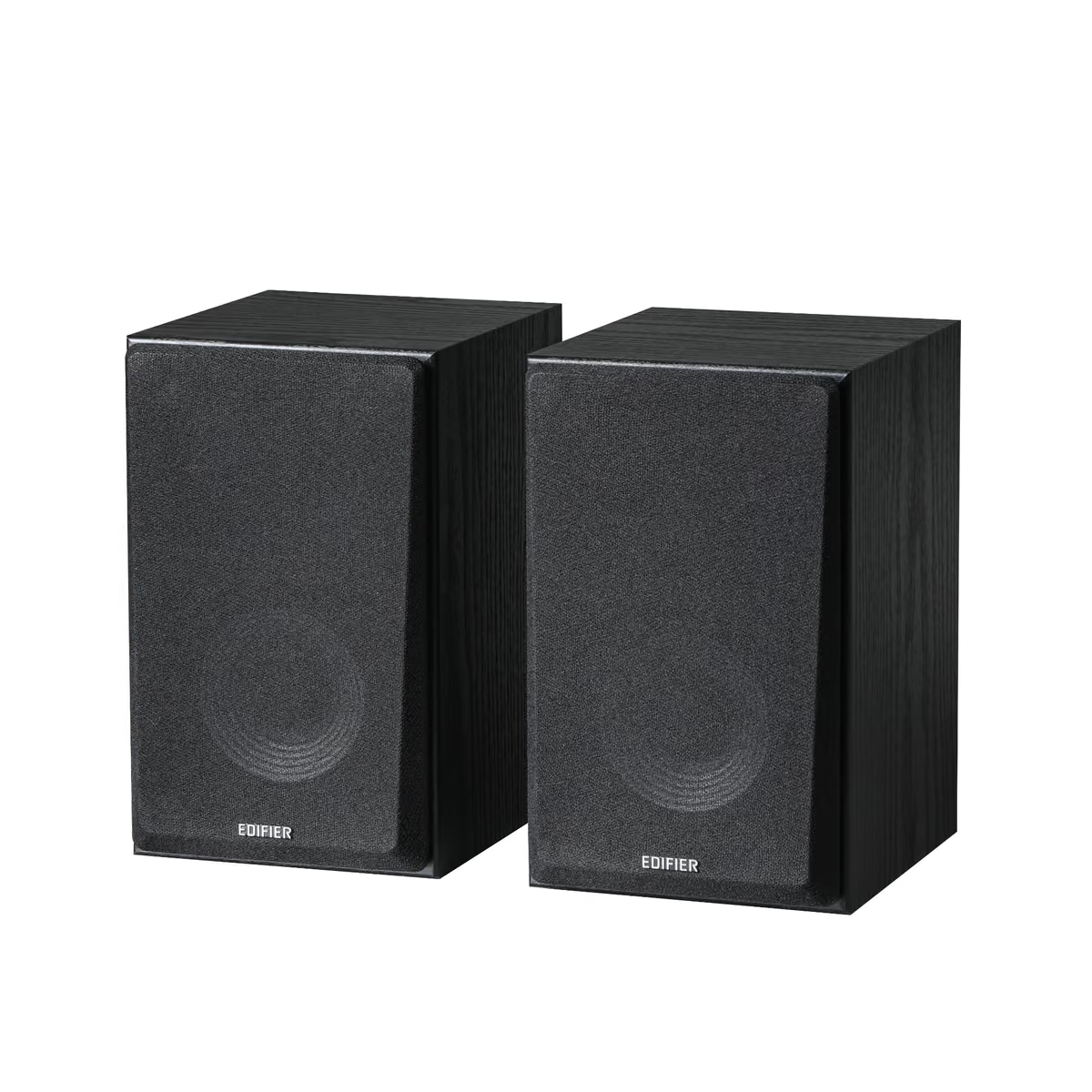
$109.99 on Edifier's US store, read November 4, 2026 at 11:16 CET in a headless browser, with "In stock, ready to ship" for the Black finish. The spec table prints 12 W + 12 W RMS, a 4-inch mid-low driver with a 1-inch treble driver, 60 Hz to 18 kHz, Bluetooth V5.4 with the SBC codec, and two line inputs. The highlights say 24 W RMS, which does not match the table, so we quote the table.
Pros: the lowest cost to play of the nine, Bluetooth, two line inputs and a 60 Hz lower limit.
Cons: the lowest printed power of the nine at 12 W per channel, SBC as the only codec, and a range that stops at 18 kHz.
Best for: a desk or a small room with a laptop or phone as the source. Our best portable monitor for a laptop guide covers the desk side of that setup.
See the Edifier R990BT on Edifier's US store
2. Edifier R1380T: $139.99 for two wired sources
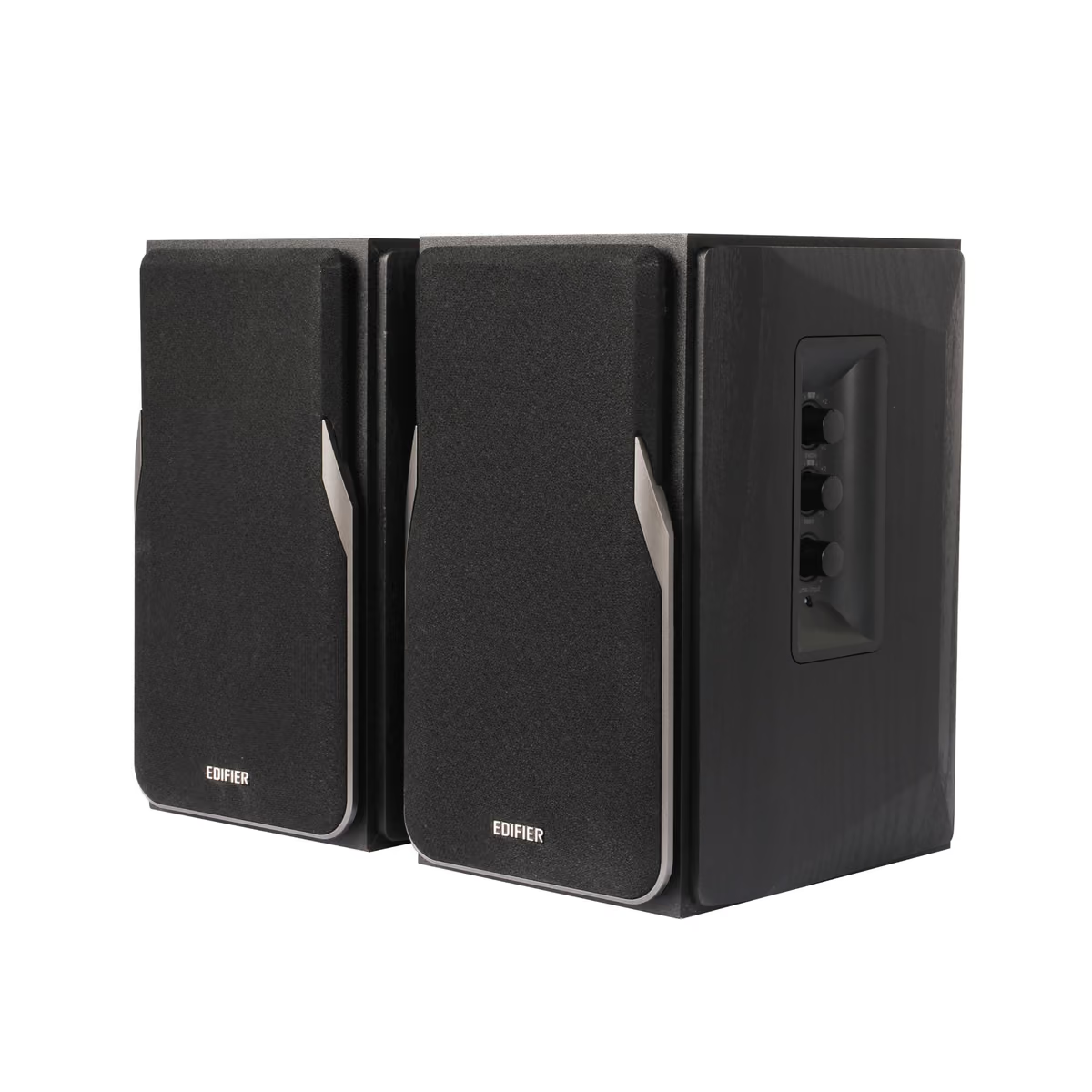
$139.99 on Edifier's US store, read November 4, 2026 at 11:17 CET. The Black finish reads "Hurry, only 18 items left in stock!", and the White finish is sold out. The spec table prints 21 W + 21 W RMS, a 4-inch mid-bass driver with a 1-inch tweeter, 55 Hz to 20 kHz, and dual RCA inputs. The spec table lists no Bluetooth.
Pros: 21 W per channel, a 55 Hz lower limit and two wired inputs for two sources.
Cons: no Bluetooth, optical or coaxial input in the spec table, and 18 units left in the Black finish on the day we read it.
Best for: a room with two wired sources, such as a TV and a laptop, where Bluetooth is not needed.
See the Edifier R1380T on Edifier's US store
3. Fluance Ai41: $299.99 a pair with Bluetooth and optical
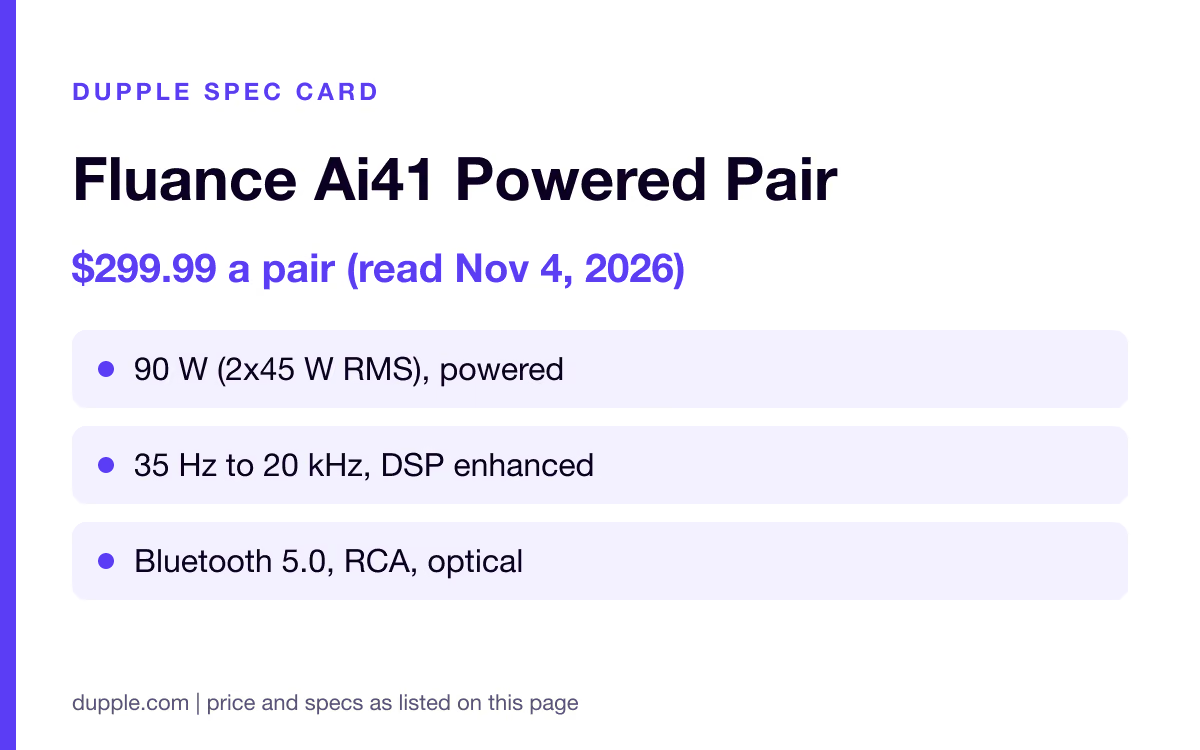
$299.99 a pair on Fluance's US store, read November 4, 2026 at 11:09 CET from the product's own data, with the status "In stock" for the Black Ash finish. The included list reads "Ai41 Powered Bookshelf Speakers (pair)". The page prints a 90 W continuous average output (2 x 45 W RMS), 35 Hz to 20 kHz with DSP enhancement. Inputs are RCA, Bluetooth 5.0 and digital optical, the subwoofer output uses an 80 Hz low-pass filter, and the phono preamp line reads "No".
Pros: powered, under $300, with Bluetooth, optical and RCA inputs and a subwoofer output.
Cons: 45 W per channel, against the Ai61's 60 W, and a lower limit that depends on the DSP, with no tolerance printed.
Best for: a desk or a bedroom where a Bluetooth source and an optical source share one pair.
The pair is sold on Fluance's Ai41 page
4. Fluance Ai61: $349.99 a pair for a larger room with a subwoofer
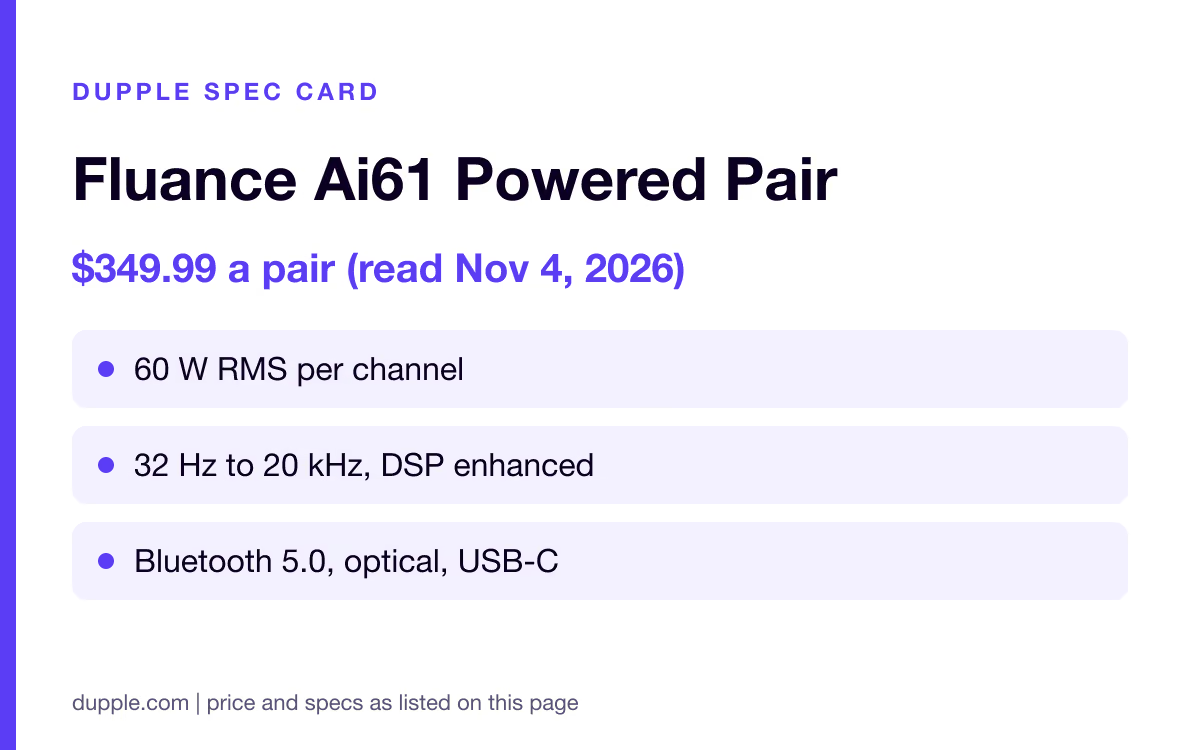
$349.99 a pair on Fluance's US store, read November 4, 2026 at 11:10 CET from the product's own data, with the status "In stock" for the Black Ash finish. The included list reads "Ai61 Powered Bookshelf Speakers (pair)", and the spec table reads "Pair, 1x Active, 1x Passive". It prints a 120 W continuous average output (2 x 60 W RMS) and 32 Hz to 20 kHz with DSP enhancement, with no tolerance given. Inputs are RCA, Bluetooth 5.0, digital optical and USB Type-C. The subwoofer output uses an 80 Hz low-pass filter, and the phono preamp line reads "No".
Pros: 60 W RMS per channel, a 6.5-inch woofer, four input types and a subwoofer output.
Cons: $50 more than the Ai41, no phono preamp, and a lower limit printed without a tolerance.
Best for: a larger room, or a pair that will take a subwoofer, with Bluetooth or optical sources.
The pair is sold on Fluance's Ai61 page
5. Polk T15: $149 a pair, or $748 with the reference amplifier
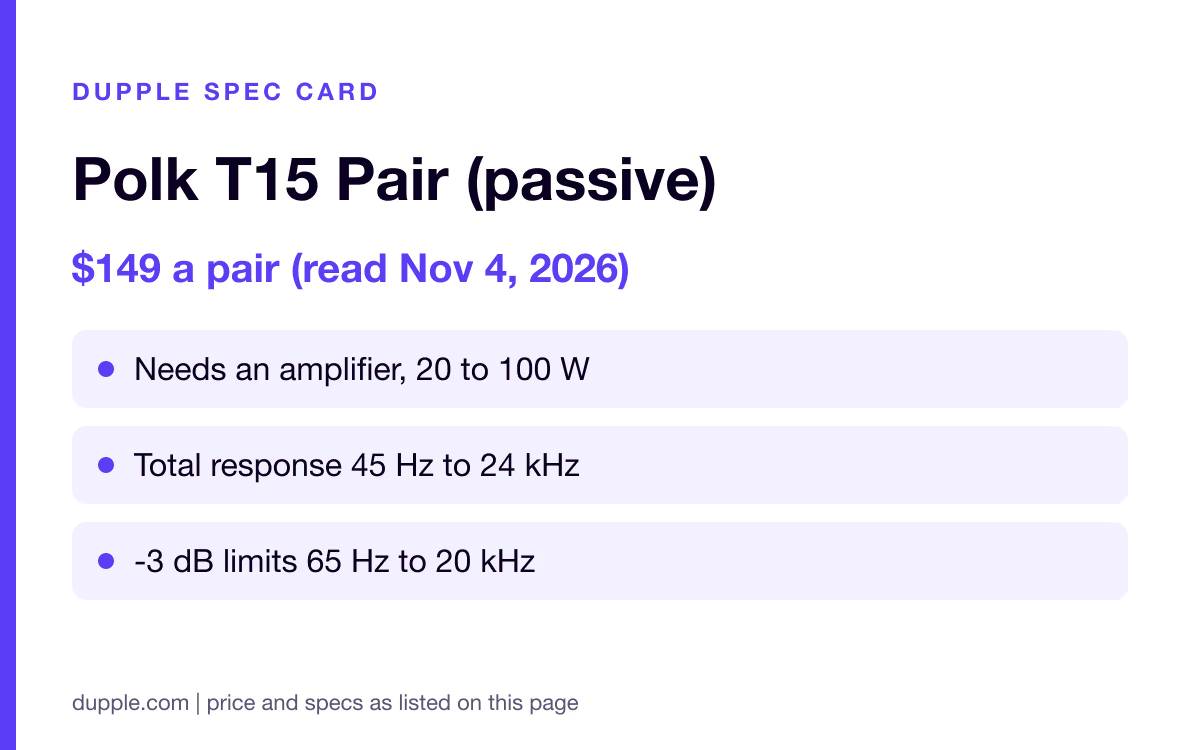
$149 a pair on Polk's US store, read November 4, 2026 at 11:11 CET. The product page reads "Availability: In Stock" and "$149 / pair". Polk labels 45 Hz to 24 kHz "Total Frequency Response" and prints "Lower and Upper -3dB Limits: 65 Hz to 20,000 Hz". It also prints a nominal impedance of 8 ohms to 6 ohms and a recommended amplifier power of 20 to 100 W per channel. The pair has no amplifier of its own, so its cost to play with the reference amplifier is $748.00. A buyer who owns an amplifier in that range pays $149.00.
Pros: the lowest pair price among the passive pairs read that day, and a total response figure printed from 45 Hz (Polk's label; its -3 dB limits are 65 Hz to 20,000 Hz).
Cons: it needs an amplifier, and the pair price does not include one.
Best for: a buyer who already owns an amplifier rated 20 to 100 W per channel.
The range is on Polk's bookshelf category
6. Polk Monitor XT20: $279 a pair, or $878 with the reference amplifier
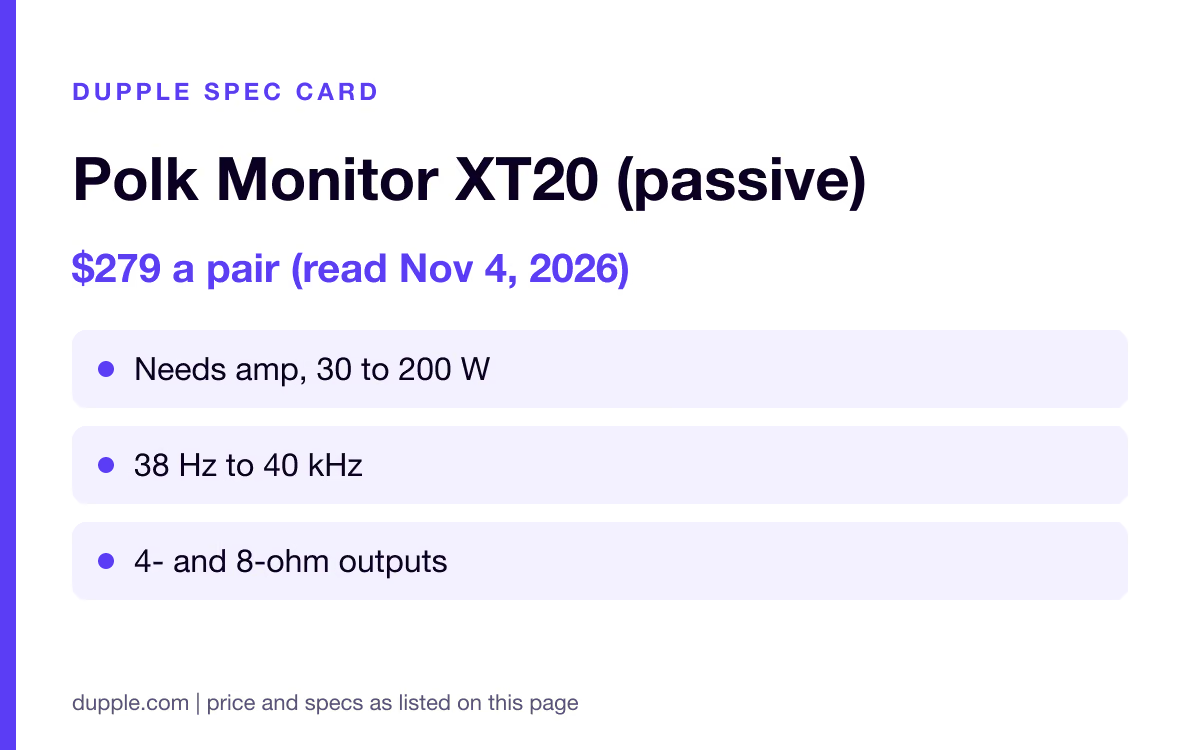
$279 a pair on Polk's US store, read November 4, 2026 at 11:11 CET, with "Availability: In Stock". Polk prints 38 Hz to 40 kHz and a recommended amplifier power of 30 to 200 W per channel, and compatibility with 4- and 8-ohm outputs. The reference amplifier's 45 W is inside that range, and its 8-ohm output is one of the two cases Polk names.
Pros: the widest printed range of the numbered passive pairs, 38 Hz to 40 kHz.
Cons: $130 more than the T15 at the pair price, and the amplifier is a separate purchase on top.
Best for: a larger room, with an amplifier rated 30 to 200 W per channel.
The range is on Polk's bookshelf category
7. Kanto Tuk 2nd Gen: $899.99 a pair for a powered set with a subwoofer output
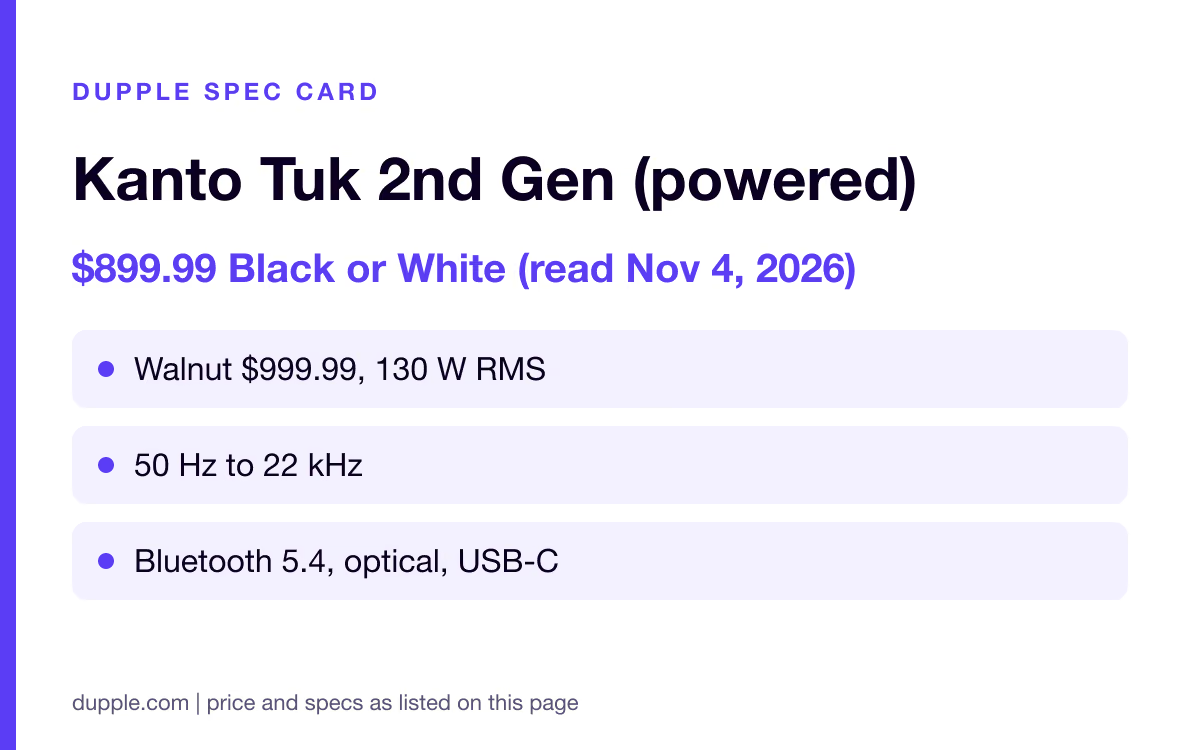
$899.99 a pair in Black or White on Kanto's US store, read November 4, 2026 at 11:41 CET from the product's own data (tukg2.js), with Black and White both in stock. Walnut is $999.99 and in stock, while Gloss Butter and Matte Burl are sold out, so the lowest in-stock finish sets the price. The page prints 130 W RMS (260 W peak), 50 Hz to 22 kHz, two RCA line inputs, optical, USB-C, Bluetooth 5.4 with AptX Adaptive, AAC and SBC, and a subwoofer output with a selectable 80 Hz filter.
Pros: Bluetooth 5.4, optical and USB-C in one powered pair, with a subwoofer output.
Cons: $550 more than the Ai61 for the pair, and no phono preamp is printed in the spec table.
Best for: a powered pair for a room with a Bluetooth source and a subwoofer added later.
The pair is sold on Kanto's Tuk 2nd Gen page
8. Klipsch R-50M: $424.99 a pair, or $1,023.99 with the reference amplifier
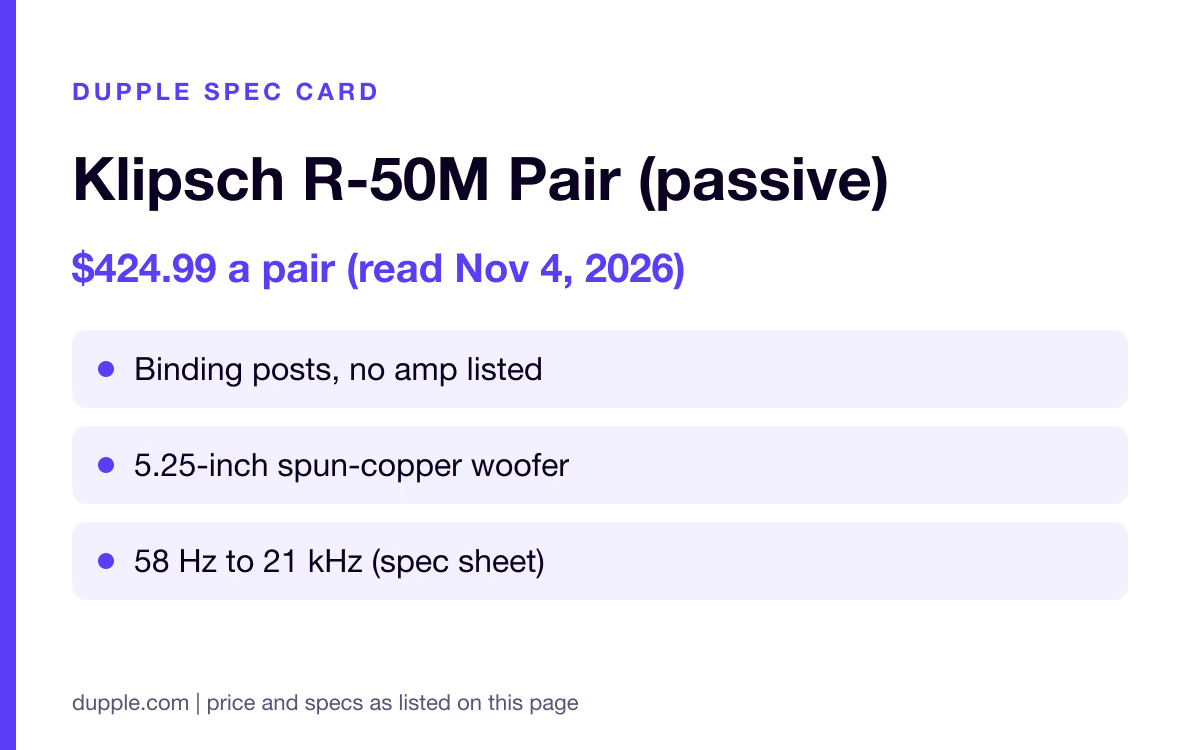
$424.99 a pair on Klipsch's US store, read November 4, 2026 at 12:51 to 12:53 CET through a text reader of the product page. The page is titled "R-50M Bookshelf Speakers", shows "$424.99 Per Pair" and an "Add to Cart" button, and prints no out-of-stock label. Klipsch's bookshelf collection tags the pair "FLASH SALE" with no end date printed, so the listed price ranks it. The 58 Hz to 21 kHz range (plus or minus 3 dB) comes from Klipsch's R-50M spec sheet, linked from the product page, not from the product page text.
Pros: $275 under the Kanto Tuk Passive at the pair price, a 58 Hz to 21 kHz range on the spec sheet, and a 5.25-inch woofer.
Cons: no amplifier is included, Klipsch prints no recommended amplifier power, and the range sits on the spec sheet rather than the product page.
Best for: a buyer who already owns an amplifier and wants a Klipsch pair under $500.
The pair is sold on Klipsch's R-50M page
9. Kanto Tuk Passive 2nd Gen: $699.99 a pair, or $1,298.99 with the reference amplifier
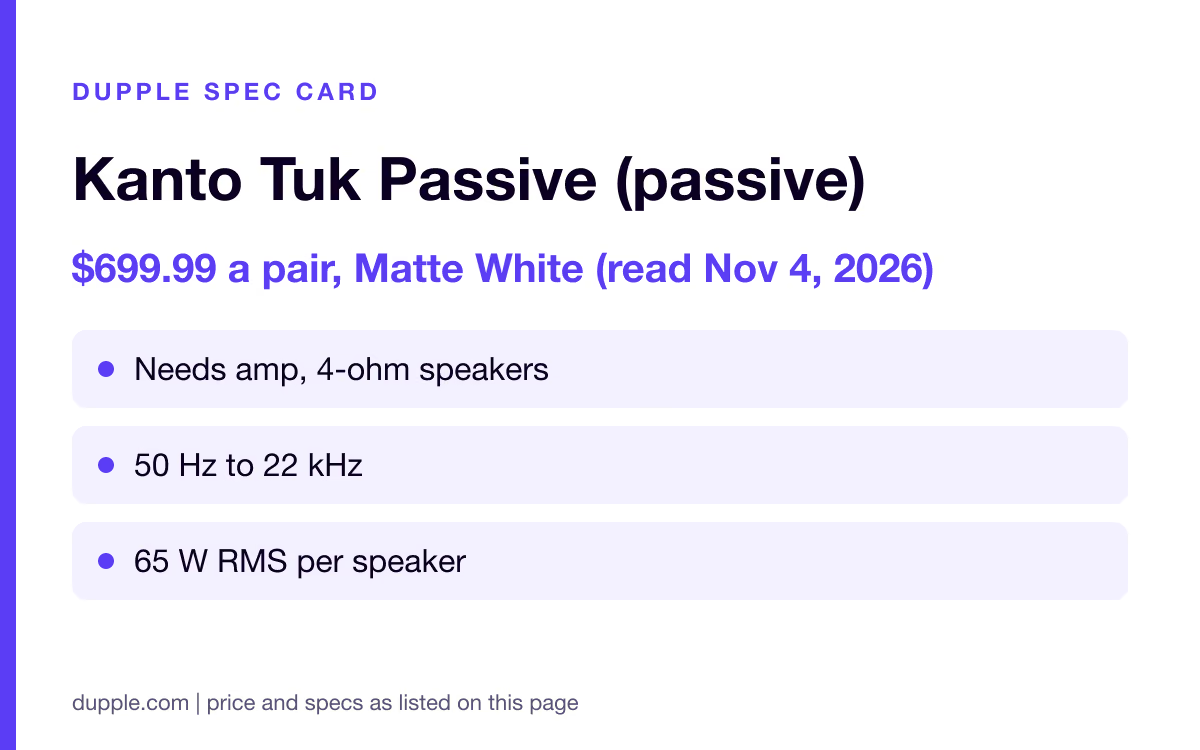
$699.99 a pair in Matte White on Kanto's US store, read November 4, 2026 at 11:18 CET, with "Add to cart" on that option. Matte Black is also $699.99, and Walnut at $799.99 is sold out. Kanto prints 65 W RMS per speaker (130 W peak), 50 Hz to 22 kHz, an impedance of 4 ohms, AMT tweeters and 5.25-inch aluminum woofers. Under connectivity it prints "External Amplifier Required (Compatible with 4-Ohm Speakers)". Denon prints 45 W at 8 ohms and 70 W at 4 ohms (1 kHz, 0.7% THD); Kanto's 65 W RMS per speaker uses other test conditions, so no match is claimed.
Pros: a 50 Hz lower limit and a 22 kHz upper limit with AMT tweeters, at $699.99 for the pair.
Cons: the highest cost to play of the nine, at $1,298.99, and the amplifier must suit 4-ohm speakers.
Best for: a buyer who already has a 4-ohm-compatible amplifier and wants a passive pair from Kanto.
The range is on Kanto's speakers page
Also worth a look: passing pairs outside the two-per-brand cap
These models pass the gates, but their brand already has two numbered picks. Passive rows add the reference amplifier.
| Model | Pair price | Cost to play | Stock, as read | Frequency, as stated | Power and inputs, as stated |
|---|---|---|---|---|---|
| Edifier R1280T | $149.99 a set | $149.99 | In stock | 52 Hz to 20 kHz | 21 W + 21 W RMS; dual RCA |
| Edifier R1280TS | $169.99 a set | $169.99 | In stock | 52 Hz to 20 kHz | 21 W + 21 W RMS; two line inputs |
| Edifier R1280DB | $189.99 a set | $189.99 | In stock | 55 Hz to 20 kHz | 21 W + 21 W RMS; Bluetooth, optical, coaxial, dual RCA |
| Edifier R1280DBs | $199.99 a set | $199.99 | In stock | 51 Hz to 20 kHz | 21 W + 21 W RMS; Bluetooth, line in, optical, coaxial |
| Edifier R1700BT | $219.99 a set | $219.99 | In stock | 60 Hz to 20 kHz | 66 W total RMS; AUX, RCA, Bluetooth |
| Edifier R1700BTs | $229.99 a set | $229.99 | 20 units left | 52 Hz to 20 kHz | 66 W total RMS; Bluetooth, dual RCA |
| Edifier R2750DB MKII | $499.99 a set | $499.99 | In stock | 45 Hz to 40 kHz | 144 W RMS total; Bluetooth, HDMI eARC, optical, coaxial, line in. Ties with the S1000MKII; the name places it first |
| Edifier S1000MKII | $499.99 a set | $499.99 | In stock | 45 Hz to 40 kHz | 120 W RMS total; Bluetooth 5.0, optical, coaxial, two line inputs |
| Fluance Ri71 | $499.99 a pair | $499.99 | In stock | 46 Hz to 30 kHz, DSP enhanced | Powered, 2 x 60 W RMS; Bluetooth 5.0 with aptX HD |
| Fluance SX6 (SX6-BK) | $149.99 a pair, plus $599.00 | $748.99 | In stock | 60 Hz to 20 kHz | Passive, 8 ohms, 30 to 100 W RMS handling |
| Fluance Signature HFS | $199.99 a pair, plus $599.00 | $798.99 | In stock | 60 Hz to 20 kHz | Passive, 8 ohms, 30 to 120 W; Fluance calls it a passive surround speaker that also wall-mounts |
| Polk ES15 | $299 a pair, plus $599.00 | $898.00 | In stock | 44 Hz to 40 kHz | Passive, amplifier 20 to 100 W per channel |
| Polk ES20 | $399 a pair, plus $599.00 | $998.00 | In stock | 41 Hz to 40 kHz | Passive, amplifier 20 to 125 W per channel |
| Polk Reserve R100 | $699 a pair, plus $599.00 | $1,298.00 | In stock | -3 dB 58 Hz to 39 kHz | Passive, amplifier 30 to 150 W per channel |
| Polk Reserve R200 | $799 a pair, plus $599.00 | $1,398.00 | Limited stock | -3 dB 51 Hz to 38 kHz | Passive, amplifier 30 to 200 W per channel |
Left out: out of stock, not a bookshelf, or not readable today
Each row gives the price the vendor shows and the reason for leaving the model out.
| Model | Price shown | Reason |
|---|---|---|
| Edifier R1380DB | $169.99 | All finishes sold out, read at 11:22 |
| Edifier M60 | $199.99 | Edifier calls it a compact desktop speaker |
| Edifier M90 | $369.99 | Edifier's own copy says "desktop audio", so it fails the bookshelf gate (in stock, 50 Hz to 40 kHz, read at 11:47) |
| Polk Monitor XT15 | $179 a pair | Out of stock, read at 11:14 |
| Fluance Reference XL8S | $179.99 a pair | Out of stock, read at 11:11 |
| Kanto Yu4 2nd Gen | $449.99 | Sold out, read at 11:17 |
| Kanto Yu6 2nd Gen | $549.99 | Sold out, read at 11:17 |
| Kanto Yu4 Passive 2nd Gen | $249.99 | Sold out, read at 11:17 |
| Kanto Yu6 Passive 2nd Gen | $349.99 | Sold out, read at 11:17 |
| Kanto Tuk Grand 2nd Gen | $1,099.99 | Sold out, read at 11:17 |
| Kanto Tuk Grand Passive 2nd Gen | $899.99 | Sold out, read at 11:18 |
| Kanto Ren | $699.99 | Sold out, read at 11:17 |
| Kanto Ora, Ora4 and Uki | $349.99, $449.99 and $269.99 | Kanto calls them powered desktop speakers, so they fail the bookshelf gate, though Ora and Ora4 show "Add to cart" |
| Klipsch R-40M and R-40PM | $299.99 and $549.99 | R-40M: "Out of Stock." R-40PM: "Temporarily Out of Stock. Available for Backorder." |
| Klipsch R-50PM, The Fives II, The Sevens II and The Nines II | $649.99, $1,399.99, $1,999.99 and $2,399.99 (collection page) | Their own pages are titled "Powered Speakers", not bookshelf speakers, and they sit under a "POWERED SPEAKERS" heading on Klipsch's bookshelf page. They fail the bookshelf gate on the same reading as Kanto's desktop models. |
| Klipsch RP-500M II and RP-600M II | No Klipsch price | Klipsch shows only a "SHOP" link to Crutchfield, so there is no price on its own store. |
| ELAC DB52 and DB62 | No US price | The ELAC product page read at 11:13 shows no price and no buy button, and the DB52 and DB62 pages read earlier that morning point to a dealer finder |
| KLH Model Three | $1,599.98 a pair | The page has an add-to-cart button, but its only low-frequency figure is 35 Hz at -10 dB, with no upper limit, so it fails the gate that needs a range with both ends |
| Audioengine HD5 and P4 (closest models) | HD5 $419 (white), $449 (black, walnut); P4 $189 | Audioengine files its models under Computer Speakers, Home Music Systems and Passive Speakers, and each product's "Ideal Listening Space" says Desktop or Room, so none passes the bookshelf gate. The HD5 is powered, 50 Hz to 22 kHz (plus or minus 1.5 dB) and in stock. The P4 is a passive "desktop speaker". |
How to choose
- Under $150 for a desk with Bluetooth: the Edifier R990BT, with 60 Hz stated as its lower limit.
- Two wired sources and no Bluetooth: the Edifier R1380T, with two line inputs and 21 W per channel.
- Bluetooth and a subwoofer output under $350: the Fluance Ai61, with a subwoofer output at 80 Hz.
- A passive pair you already power: check that your amplifier's rating falls inside the range the pair prints, then compare the pair price alone.
- A passive pair with no amplifier yet: add the amplifier's price from its maker's US store before you compare. This page uses the Denon for the sum.
FAQ
Which bookshelf speaker on this list costs least?
The Edifier R990BT, at $109.99 on Edifier's US store, read November 4, 2026. It is powered, so it needs no amplifier, and its spec table prints 12 W + 12 W RMS and a frequency range of 60 Hz to 18 kHz.
Do passive bookshelf speakers need an amplifier?
Yes. Polk's pages give a recommended amplifier power per channel, and Kanto's Tuk Passive page says an external amplifier is required. Klipsch's R-50M spec sheet lists binding posts and no built-in amplifier. Each passive pair here is costed with the same reference amplifier, so the pair price alone is the figure for a buyer who owns one.
Does the Edifier R1380T have Bluetooth?
Not in the spec table on Edifier's page, read November 4, 2026. The listed inputs are dual RCA, and the description names two line-in connections. The Edifier models in the box below the list that list Bluetooth are the R1280DB, R1280DBs, R1700BT, R1700BTs, R2750DB MKII and S1000MKII.
Do these speakers need a subscription?
None of the vendor pages we read lists a subscription, plan or recurring fee for these pairs, so the cost to play is a one-time figure.
Can I add a subwoofer?
The Fluance Ai41 and Ai61 both have a subwoofer output with an 80 Hz low-pass filter, and the Kanto Tuk 2nd Gen has a subwoofer output with a selectable 80 Hz filter.
Why are there nine picks, and not more?
Nine pairs pass every gate on November 4, 2026 and fit the two-per-brand cap. Fifteen more pass but sit in the box because their brand already has two numbered picks. Out-of-stock, sold-out, desktop and unreadable models are left out. The list is the result of the rule, not a lower bar.
Does the cheapest pair sound worst?
The order measures the cost to play after the gates, so it says nothing about sound. We make no sound-quality claim beyond the figures each vendor prints, and we ran no listening test.
Methodology
We compared the bookshelf speaker pairs a US buyer can order from the brand's own US store or pricing page, across Edifier, Fluance, Polk, Kanto, Klipsch, ELAC, KLH and Audioengine. Every number comes from a vendor page read on November 4, 2026, never Amazon, review sites or memory. Times are CET. No paid placement decides the order.
The ranking rule is the one in "How the order is set": three gates, then cost to play, lowest first, with at most two numbered picks per brand. The Denon PMA-600NE at $599.00 is added to every passive pair.
Cart checks ran on the Edifier R990BT and R1380T, the Fluance Ai41 and Ai61, the Polk T15 and Monitor XT20, the Kanto Tuk 2nd Gen (Black, White and Walnut) and Tuk Passive (Matte White and Black), and the Denon PMA-600NE. Each total matched its product page, with no code and no automatic discount. The Fluance carts show euros to our connection, so their dollar amounts come from the store's cart data. The Klipsch cart could not be read from our connection, so the R-50M is ranked on its product page price. The Klipsch page and spec sheet were read through a text reader, and Audioengine's pages in a headless browser. We did not test any speaker. Frequency, power and input figures are each vendor's own statement. Where a page disagrees with itself, as the R990BT's highlights do with its spec table, we quote the spec table.
Sources
| Brand | Page | Read (CET) |
|---|---|---|
| Denon (reference amplifier) | Denon PMA-600NE page | 11:09 |
| Edifier R990BT | R990BT page | 11:16 |
| Edifier R1380T | R1380T page | 11:17 |
| Edifier box models, M60 and M90 | Edifier bookshelf collection, product pages R1280T to R2750DB MKII, and M90 | 10:39 to 10:41 (collection and text reads); 11:22 to 11:23 (headless browser); M90 at 11:47 |
| Fluance Ai41 | Ai41 page | 11:09 |
| Fluance Ai61 | Ai61 page | 11:10 |
| Fluance Ri71, SX6, Signature HFS, Reference XL8S | Ri71 page, SX6 Black Ash page, Signature HFS page, Reference XL8S page | 11:09 to 11:11 |
| Polk | polkaudio.com bookshelf product pages (T15, Monitor XT20, Signature Elite ES15 and ES20, Reserve R100 and R200), Monitor XT15 page | 11:11; Monitor XT15 at 11:14 |
| Kanto Tuk 2nd Gen and Tuk Passive 2nd Gen | Tuk 2nd Gen page, Tuk Passive page | 11:18 |
| Kanto sold-out and desktop models | Kanto speakers collection, product pages Yu4 and Yu6 (2nd Gen and Passive), Tuk Grand (2nd Gen and Passive), Ren, Ora, Ora4 and Uki | 11:17 to 11:18 |
| Klipsch | klipsch.com/bookshelf-speakers (collection), R-50M product page and its spec sheet; other Klipsch pages as in the Left out table | 10:38 (collection); 12:51 to 12:53 (R-50M) |
| ELAC | elac.com/debut-2-0 | 11:13 |
| KLH Model Three | KLH Model Three page | 11:18 |
| Audioengine | audioengine.com: HD5 and P4 product pages and category pages, read in a headless browser | 13:02 to 13:07 |
Related reading
- Best portable monitor for a laptop, for the desk setup the R990BT fits.
- Shokz OpenRun Pro 2 review, for an open-ear Bluetooth option when a desk speaker is not wanted.
- Best bone conduction headphones, for listening without a speaker at all.
- Best portable projector, for a room where the speakers will sit beside a picture.
The cheapest powered pair here is the place to start for a desk, and a passive pair only makes sense once you know what amplifier you already own. See Edifier's bookshelf speakers on its US store
Some offers on this page may be paid placements or contain affiliate links.