

Last updated: May 2026
What Is Unitel Voice?
Unitel Voice is the virtual phone system for small businesses that need a professional phone presence without buying PBX hardware or running enterprise VoIP. The product provides business phone numbers (toll-free and local), automated attendants, voicemail-to-email, call routing, and mobile apps that turn personal devices into business phones.
The pitch is uncomplicated. Solo professionals and small businesses (1-20 people) need a real business number, not their personal mobile. They need an automated greeting that sounds professional, the ability to route calls to the right person, and voicemail that arrives in inbox. Unitel Voice delivers exactly this for a flat monthly fee.
The company has been operating in the virtual phone space since 2007, making it one of the older entries in the category. Competitors like Grasshopper have larger marketing budgets; Unitel competes on price, simplicity, and not pushing customers to features they do not need.
Try Unitel VoiceHow Unitel Voice Works
Pick a business number during signup. Toll-free numbers (800/888/877/866/855) come with most plans; local area code numbers are available for specific cities. You can keep your existing number if you have one through number porting.
Configure the automated attendant (sometimes called auto-attendant or IVR). Standard greetings cover "Press 1 for sales, 2 for support" style flows. More advanced setups route calls based on time of day, caller ID, or department.
Incoming calls forward to any number you choose: your mobile, your home phone, multiple team members in sequence, or a ring group that calls everyone simultaneously. Voicemails get transcribed and emailed to you, so you read voicemails in your inbox without dialing the system.
The mobile apps for iOS and Android let team members make and receive business calls from their personal phones while keeping personal and work calls separate. The caller ID shows your business number on outgoing calls so your personal number stays private.
Business SMS works on most plans, letting customers text your business number while team members reply from the app or web portal.
Unitel Voice Pricing in 2026
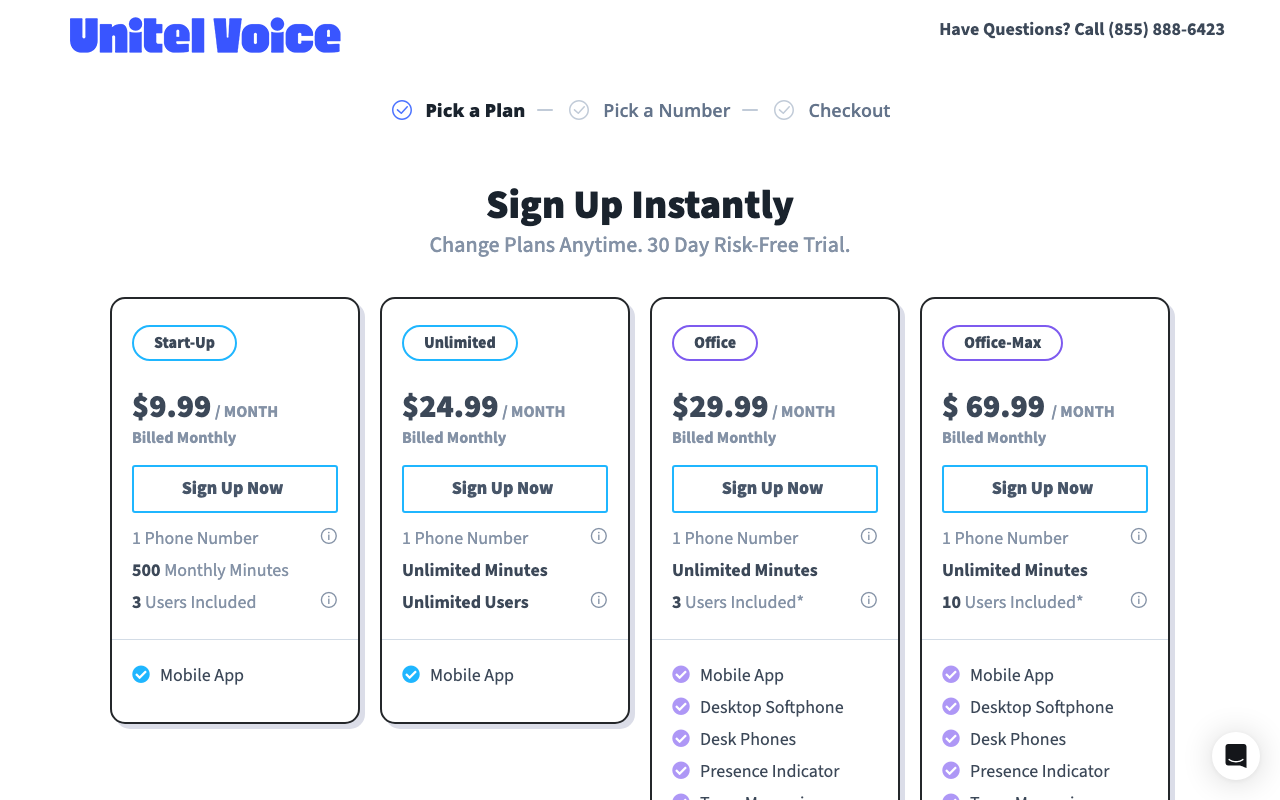
Starter: $24.99/month annually. 500 minutes/month, 1 toll-free number, basic auto-attendant, voicemail-to-email, mobile apps.
Business: $39.99/month annually. 1,500 minutes, multiple numbers, advanced auto-attendant, business SMS, call recording.
Premium: $69.99/month annually. 5,000 minutes, unlimited extensions, advanced features, priority support.
Plans include annual discount versus monthly billing. Overage rates apply on minute caps; most small businesses stay within their tier.
Compared to Grasshopper at $29-$80/month, Unitel Voice is similar or slightly cheaper. Compared to RingCentral at $30-$50/user/month, Unitel is significantly cheaper for small teams because pricing is per business rather than per user.
See Unitel Voice PlansWhere Unitel Voice Wins
- No-per-user pricing: a 5-person team pays the same flat monthly rate as a solo founder. Big advantage over per-seat VoIP.
- Easy setup: number live within hours. Most setup happens through the web portal without IT support.
- Mobile-first model: works on personal phones via the app. No new hardware required.
- Voicemail-to-email transcription: read voicemails like text messages.
- Toll-free numbers included: 800/888 numbers come with base plans rather than as expensive add-ons.
Where It Falls Short
- Limited integrations: no native Salesforce or HubSpot integration, less appealing for sales-heavy teams that want call logging.
- Call quality depends on mobile data: as a VoIP product, calls depend on internet quality. Spotty mobile data means dropped calls.
- Fewer features than RingCentral: lacks conference bridges, advanced video meeting features, contact center capabilities.
- UI feels dated: functional but visually behind newer competitors like OpenPhone.
- Minute caps: heavy phone use can blow past plan limits, requiring upgrades.
Unitel Voice vs Grasshopper vs OpenPhone vs RingCentral
Grasshopper is the closest direct competitor. Similar pricing, similar features, larger brand. Choose based on UI preference; functionality is nearly identical.
Quo (formerly OpenPhone) is the modern VoIP alternative built for distributed teams. Stronger team collaboration, better integrations with CRMs, slightly higher price. Pick OpenPhone for tech-forward teams.
RingCentral is the enterprise option. Most features, highest price, more setup. Pick RingCentral if you have 50+ users and need contact center capability.
800.com is the simplest option: just a toll-free number for forwarding. Cheaper than Unitel, fewer features.
Who Should Use Unitel Voice
Solo professionals: consultants, freelancers, real estate agents needing a separate business number.
Small businesses 2-10 people: where the flat-rate pricing beats per-seat models.
Home-based businesses: keep personal mobile private while presenting a professional business number.
Service businesses needing call routing: distribute incoming calls across team members.
Skip it if: you need deep CRM integration (use OpenPhone), have 25+ users (RingCentral scales better), or want video meetings bundled (use Zoom Phone).
Frequently Asked Questions
Can I keep my existing number?
Yes. Number porting takes 7-21 days depending on your current carrier.
Do calls cost extra beyond the monthly fee?
Within plan minutes, no. Overage rates apply on calls beyond the included minutes.
Does Unitel Voice work internationally?
Inbound calls from international numbers work. Outbound international calling requires per-minute rates and may need plan upgrades.
Can multiple team members answer the same number?
Yes. Set up ring groups (calls everyone simultaneously) or sequential ringing (rings person 1, then 2, then 3).
Is there a contract?
Month-to-month available. Annual prepay offers 15-20% discount.