
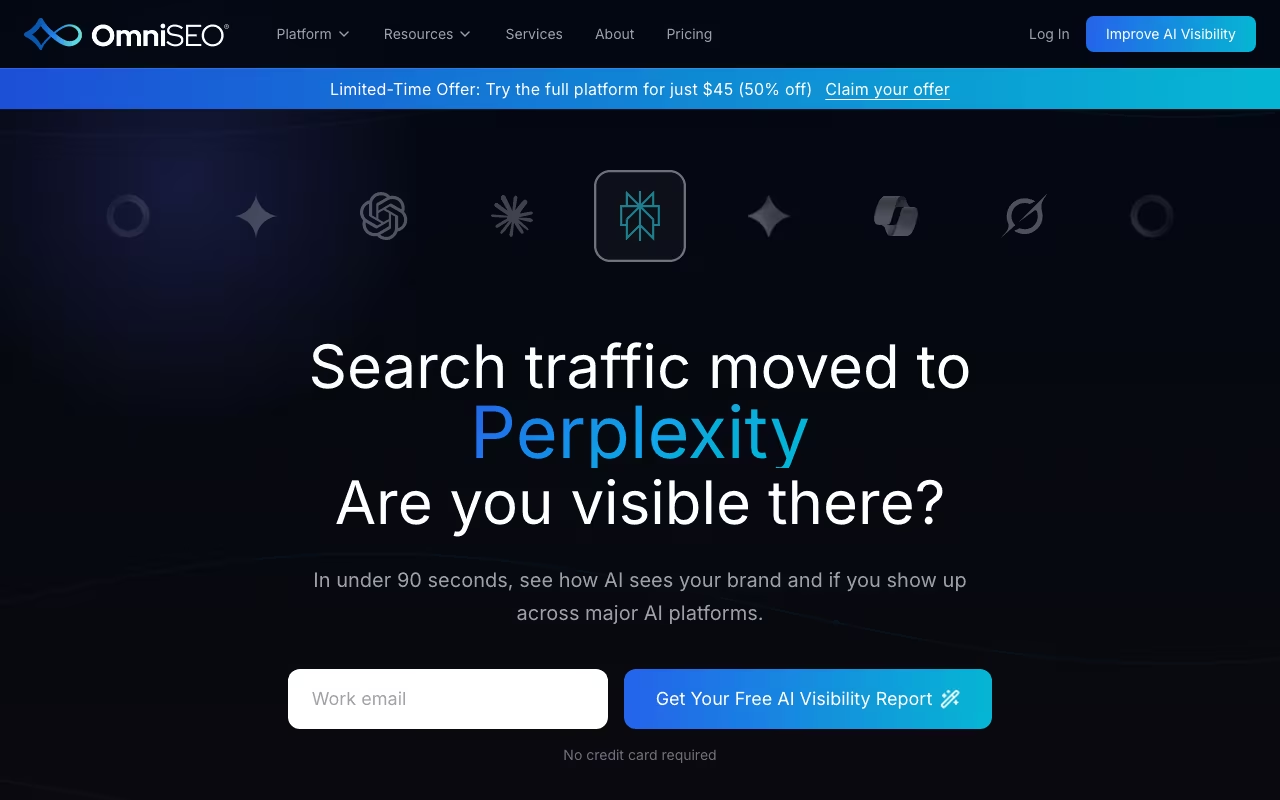
Ask ChatGPT "what's the best SEO tool for small businesses?" and it will likely recommend Semrush, Ahrefs, and Surfer SEO, the household names. A lot of smaller or newer tools simply don't get mentioned, on ChatGPT, Perplexity, Gemini, or Copilot. The question for marketers is no longer just "are we ranking on Google?" but "are we in the AI answer?" OmniSEO is one of the few tools built to answer that question across 10 AI platforms at once.
Built by WebFX (a 650+ person digital marketing agency, not a 3-person startup), OmniSEO monitors your brand's visibility across ChatGPT, Perplexity, Google AI Overviews, Gemini AI Mode, Copilot, Claude, Meta AI, Grok, DeepSeek, and more. It tells you where you appear, where competitors appear instead, and what to change. This is the category called GEO (Generative Engine Optimization), and OmniSEO has the broadest platform coverage of any tool in the space.
Request Your OmniSEO Demo Get started →Tracking AI Visibility Across 10 Platforms
The core dashboard shows a visibility score for your brand on each AI platform. You can track a set of buying-intent prompts (things like "best CRM for real estate agents" and "top project management tools for agencies"), and OmniSEO runs each prompt through all 10 AI engines to show where you appear, where you're cited, and where competitors show up instead.
For a cross-platform visibility comparison, use a defined set of prompts and record the platform, model, date and returned sources. Repeat the observations before drawing conclusions; this review provides no documented client benchmark.
A useful citation check distinguishes a brand mention from a correct source. Inspect the destination page, the quoted information and its date. A mention that points to outdated information can require a different correction from an absent mention.
Prompt performance monitoring tracks specific questions over time, checked as often as weekly. Updating content pages with structured FAQ sections and clearer product comparisons can move ChatGPT visibility noticeably over a matter of weeks, and OmniSEO shows the correlation directly.
DataMind Recommendations
Treat optimization recommendations as hypotheses. Record the proposed change and the evidence behind it, then compare repeated observations before and after implementation. This review does not establish a measured visibility improvement or time saving.
Competitor share-of-voice analysis is particularly useful for sales enablement. You can see exactly which buying prompts your competitors win and reverse-engineer why. If a competitor dominates "best accounting software for freelancers" across 8 platforms, you can examine their content, schema markup, and citation structure to understand the gap.
See OmniSEO's AI Tracking Dashboard Get started →What It Costs
- Essentials: $89/month ($45 first month, $890/year). 4 AI channels, 50 prompts/month, 5 competitors, 5 seats.
- Professional: $349/month ($175 first month, $3,490/year). 10 AI channels, 100 prompts/month, 10 seats, 200 ad-hoc queries/month.
- Enterprise: $899+/month custom. 500+ prompts, unlimited seats, dedicated GEO specialist, custom integrations.
No free plan. No free trial. Demo only. This is my biggest frustration with OmniSEO. At $89/month minimum, you cannot test the product with your own brand data before committing. The demo call gives you a sample report, but it is not the same as logging in and running your own prompts for a week.
The Essentials plan is limited. 4 AI channels means you skip 6 platforms, which defeats the purpose of cross-platform monitoring. 50 prompts per month sounds fine until you realize that tracking 25 buying queries across 4 platforms burns through your allocation in one monitoring cycle. Most teams doing this seriously will land on Professional at $349/month, which is $4,188/year. That is more than Ahrefs ($99-449/month) and comparable to enterprise Semrush plans.
Where OmniSEO Gets It Right
- Broadest AI platform coverage: 10 platforms including niche ones like DeepSeek and Grok that most competitors ignore. Otterly.ai covers 4-5. SE Ranking covers 3.
- Agency pedigree: WebFX has 650+ employees and 28 years in digital marketing. The product reflects real agency workflows, not academic theory. They eat their own cooking.
- Impact-ranked recommendations: DataMind tells you what to fix and in what order. Most competitor tools show you data and leave you to figure out the "so what." OmniSEO gives you the action items.
- Enterprise GEO specialist: The Enterprise plan includes a dedicated specialist who works with your team on optimization. For companies new to GEO, this hand-holding has real value.
Where OmniSEO Falls Short
- No free trial: Demo-only access is a dealbreaker for many teams. You are committing $89-349/month based on a sales call and a sample report. In a category this new, buyers want to test before they buy.
- Expensive for small teams: $89/month for partial coverage, $349/month for the full picture. Solo founders and small marketing teams should look at Otterly.ai ($29/month) or SE Ranking's built-in AI monitoring first.
- Integration requirements: For HubSpot, Google Analytics, Google Search Console or Slack workflows, confirm the fields your chosen plan can export and whether API access or a custom integration is required.
- Learning curve is real: The interface is dense. First-time users face a wall of metrics, scores, and platform comparisons. It took me about 3 sessions over a week to feel comfortable navigating the dashboard and understanding what each score meant. GEO is a new discipline, and OmniSEO assumes you already know the basics.
- Prompt limits feel restrictive: 50 prompts on Essentials, 100 on Professional. If you manage multiple product lines or brands, you will burn through prompts fast. Each prompt variation counts separately, so "best CRM for agencies" and "best CRM for real estate" are two prompts, not one.
OmniSEO vs. Otterly.ai vs. SE Ranking
Seo tools, published pricing
| Tool | Pricing | Model |
|---|---|---|
| OmniSEO | $89/mo (Essentials), $349/mo (Professional), $899+/mo (Enterprise) | Paid |
| SE Ranking | €87.20/mo (Core, annual), €188/mo (Growth, annual), 14-day free trial | Subscription |
| Semrush | $129.95/mo (Pro), $249.95/mo (Guru), $499.95/mo (Business) | Subscription |
| Surfer SEO | $69/mo (Essential), $129/mo (Scale), $219/mo (Scale AI) | Subscription |
| Ten Speed | SEO tool, custom pricing | Subscription |
| Rank Prompt | SEO AI tool, custom pricing | Subscription |
vs. Otterly.ai ($29-149/month): Otterly.ai covers ChatGPT, Perplexity, Google AI Overviews, and a few others at a fraction of the price. The interface is simpler and there is a 14-day free trial. If your budget is under $100/month and you only care about 3-4 major AI platforms, Otterly is the smarter buy. OmniSEO wins on breadth (10 platforms vs. 4-5) and the depth of its recommendation engine. For enterprise teams tracking competitors across every AI engine, OmniSEO justifies the premium.
vs. SE Ranking ($52-207/month): SE Ranking is a full SEO platform that added AI visibility monitoring as a feature within its existing toolset. If you already use SE Ranking for keyword tracking and site audits, the AI monitoring is a free bonus. But it covers only 3 AI platforms and the data is less detailed than OmniSEO. If you need a full SEO suite with basic AI tracking, SE Ranking is the practical choice. If AI visibility is your primary focus, OmniSEO goes deeper.
vs. manual tracking (free): You can record prompts, responses and source links in a spreadsheet. Compare the work required for your chosen prompts and platforms with the reporting a paid product offers. No hands-on timing comparison is documented here.
OmniSEO is for mid-market and enterprise marketing teams that already invest in SEO and want to understand (and improve) their visibility in AI-generated answers. If your prospects are asking ChatGPT and Perplexity for product recommendations, and you need to know whether your brand appears in those answers, OmniSEO gives you the most complete picture available today. The price is enterprise-grade, so small teams with tight budgets should start with Otterly.ai and graduate to OmniSEO when the data matters enough to justify $349/month.
Book Your OmniSEO Demo Today Get started →