
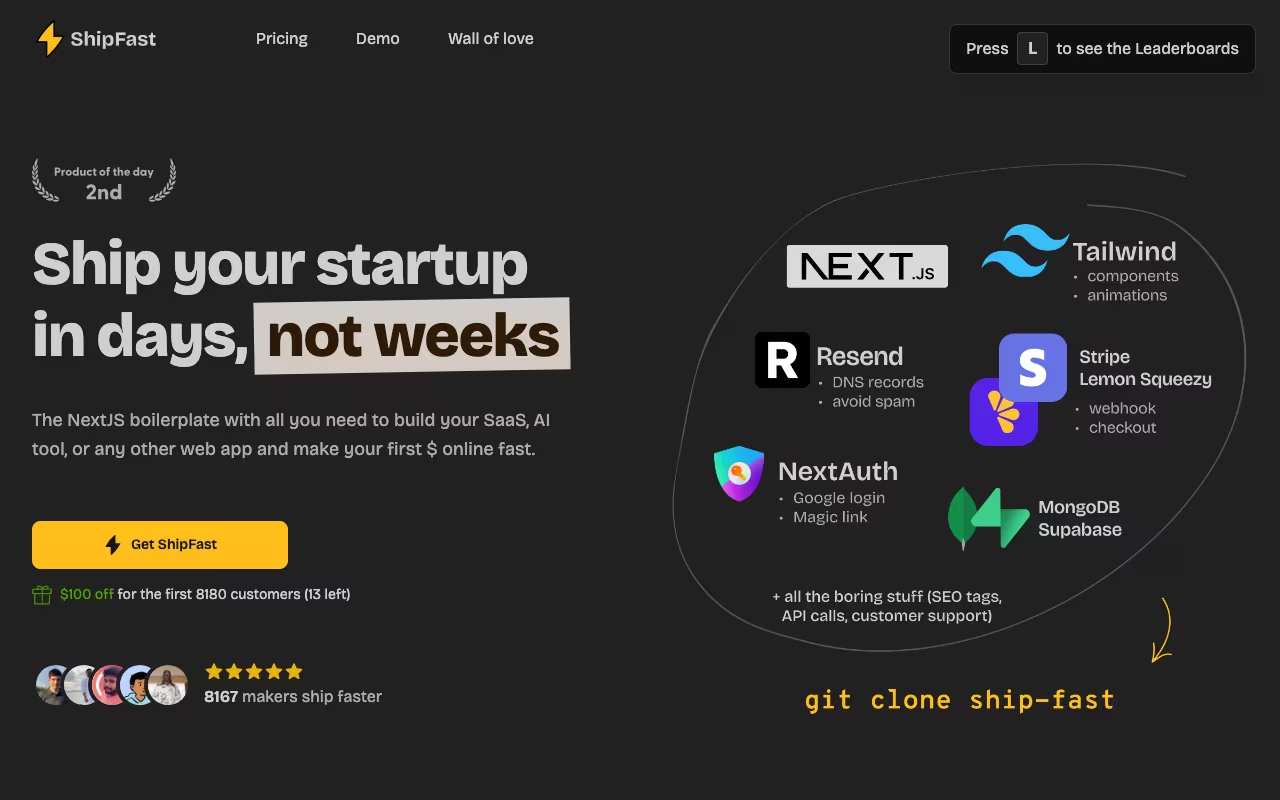
ShipFast is a Next.js boilerplate created by Marc Lou, Product Hunt's Maker of the Year 2023. You pay once ($199-299), get a production-ready codebase with authentication, payments, database, email, and a marketing landing page already wired up, and skip the 40-80 hours of setup work that every SaaS project requires before you write your first line of actual product code.
What You Get for $199
The Starter tier ($199, one-time) includes the full Next.js boilerplate in both JavaScript and TypeScript. Authentication covers Google OAuth, magic link email login, and protected API routes. Payments integrate Stripe (subscriptions and one-time) and Lemon Squeezy as an alternative. Database options include MongoDB and Supabase (PostgreSQL). Email setup works with Mailgun and Resend for transactional messaging.
The frontend ships with Tailwind CSS components, a pre-built landing page optimized for conversions, and an SEO-optimized blog system. The codebase uses Next.js App Router and is described as "AI-friendly," meaning it works well with Cursor, GitHub Copilot, and Claude for code generation. ChatGPT prompts for generating privacy policies and terms of service are included. The whole thing deploys on Vercel's free tier.
The All-in tier ($249) adds Discord community access with 5,000+ builders and priority support. The Bundle ($299) adds CodeFast, Marc Lou's 12+ hour Next.js/React video course. All tiers include lifetime updates and a license reusable across unlimited projects.
Get ShipFast Get started →Prices checked on the ShipFast pricing in September 2026. Plans and limits change, so confirm before you buy.
The Community Moat
ShipFast's biggest advantage over competing boilerplates is its community. With 8,100+ active users and 5,000+ in the Discord, most edge cases and integration questions have already been solved by someone. When you hit a problem combining Stripe webhooks with Supabase auth, there is likely a thread about it. This saves time that documentation alone cannot.
Marc Lou has used the boilerplate across 27+ of his own products, which means it has been battle-tested in production beyond the typical "example project" level. Users report launching products in about 7 days on average, with multiple testimonials of achieving first revenue within days of purchase. ShipFast itself generated over $1 million in lifetime revenue by end of 2024, proving that the "ship fast" philosophy works at least for its creator.
What It Does Not Include
ShipFast is deliberately minimal beyond the boilerplate essentials. There are no built-in AI features (you integrate those yourself), no test suite, no role-based access control, no multi-tenancy, no analytics, and no enterprise features. If you need RBAC, audit logs, or complex permissions, you are building those from scratch or looking at Makerkit ($299) instead.
The stack is opinionated. If you prefer Auth.js over NextAuth, Drizzle over the included database setup, or a different payment processor, you will be rewriting core modules. The code is closed-source before purchase with no refund policy once GitHub repo access is granted, so you are trusting the reviews and Marc Lou's track record.
See ShipFast Pricing See plans →Competition and Value Assessment
LaunchFast ($79) costs nearly a third of the price and includes AI-first features plus 81 end-to-end tests. Shipped.club ($149) is Supabase-native at a middle price point. Makerkit ($299) handles multi-tenant B2B architecture. SaaS-Starter is free and Vercel-backed. All of these are viable alternatives depending on your priorities.
ShipFast's 4.9/5 rating across 124 reviews on its own site and 5.0/5 on AppSumo reflects genuine user satisfaction. Reddit sentiment is more mixed, with some users questioning whether $199 is justified when free alternatives exist. The honest answer is that ShipFast is selling speed and community, not unique technology. If your time is worth more than $199, and you work in the Next.js ecosystem, the time savings are real. If you are comfortable building your own boilerplate over a weekend, the free alternatives will serve you fine.
ShipFast works best for solo founders and indie hackers who want the fastest path from idea to deployed SaaS. It is not for enterprise teams, complete beginners, or developers who want deep customization control. Know your use case before purchasing.
Technical Details Worth Knowing
The boilerplate uses Next.js App Router, which is the modern approach. Tailwind CSS handles styling with pre-built component variations for common SaaS patterns: pricing tables, feature grids, testimonial sections, FAQ accordions, and hero sections. The landing page is not just functional; it is specifically structured around conversion optimization principles with above-the-fold value proposition, social proof, feature breakdown, pricing, and CTA sections.
Database flexibility between MongoDB and Supabase (PostgreSQL) lets you choose based on your data model preferences. The Stripe integration handles both subscription billing and one-time payments with webhook processing already configured, which is typically one of the most error-prone parts of SaaS setup. Lemon Squeezy integration provides an alternative for founders who prefer its simpler merchant-of-record model. Email transactional setup through Mailgun or Resend means password resets, welcome emails, and notifications work from day one without additional configuration or third-party integration work.
Start Building with ShipFast Get started →How ShipFast works
ShipFast is a paid Next.js starter codebase, not a hosted service. You buy access to a private repo, clone it, and run npm install on Node 18.17 or later. From there the setup work is mostly environment variables in .env.local: NEXTAUTH_URL, NEXTAUTH_SECRET, GOOGLE_ID and GOOGLE_SECRET, MONGODB_URI, RESEND_API_KEY, and the Stripe trio of STRIPE_PUBLIC_KEY, STRIPE_SECRET_KEY and STRIPE_WEBHOOK_SECRET. A central config.js file, which the docs call the backbone of the app, drives the app name, the pricing plans and the theme, so a lot of what would normally be scattered edits happens in one place.
You pick your lane at the start rather than accepting one blessed path. ShipFast ships in JavaScript or TypeScript, with the /app router or the /pages router, using NextAuth plus MongoDB or Supabase auth, Mailgun or Resend for transactional email, and Stripe or Lemon Squeezy for payments. Styling is Tailwind throughout. What you get out of the box is the plumbing most side projects rebuild from scratch: checkout and webhook handling, Google OAuth and magic-link sign-in, a database layer, transactional email, an SEO-ready blog, and a set of Tailwind landing-page components covering pricing tables, testimonials, FAQ blocks, CTAs and modals. The docs also walk through DNS setup for email deliverability, and OpenAI is wired in for dynamic content generation. It is marketed as working well alongside coding assistants such as Cursor, Copilot and Claude. Purchase also includes a Discord community and a bundle of partner discounts.
Where ShipFast wins
- The paid, auth and email triad is already wired end to end, including the Stripe webhook handler, which is usually the part that eats the first week of a new project.
- Real stack choice rather than one opinionated path: JavaScript or TypeScript, app router or pages router, NextAuth with MongoDB or Supabase, Mailgun or Resend, Stripe or Lemon Squeezy.
- The marketing surface is included, not just the app shell. SEO setup, a blog, and pre-built pricing, testimonial, FAQ and CTA sections come with it.
- One purchase covers unlimited projects with lifetime updates on all three tiers, so the cost per project drops quickly if you launch often.
- DNS and email-deliverability setup is documented, which most boilerplates leave entirely to you.
Where it falls short
- No free tier and no trial. Entry is $199, and the vendor states that purchases cannot be refunded once repo access is granted: "ShipFast is yours forever, so it can't be refunded."
- Next.js only. If you work in Remix, SvelteKit, Nuxt, Rails or plain React, none of it transfers.
- The integration list is short and opinionated: MongoDB or Supabase for data, Stripe or Lemon Squeezy for payments, Mailgun or Resend for email. Postgres via Prisma, Paddle, Auth0 and Clerk are not part of the package.
- The JavaScript and TypeScript versions are maintained as separate codebases, so updates and community snippets do not always line up with the copy you chose.
- Support is informal. It is email, Twitter and Discord rather than a contracted SLA, and hosting, domain and third-party API costs all sit on top of the license.
Who should use ShipFast
ShipFast fits solo founders and small teams already working in Next.js and Tailwind who want to skip the auth, payments and email wiring on something they intend to launch within weeks. The economics work best if you ship more than one project, since the license covers unlimited projects with lifetime updates: at that point the $199 entry is spread across everything you build.
Skip it if you are not on Next.js, because nothing carries over to another framework. Skip it if you need Postgres with Prisma, or a payment provider outside Stripe and Lemon Squeezy, since those are not in the box. Skip it if you want to evaluate before paying, because there is no trial and no refund once you have repo access. And skip it if you are a beginner expecting hand-holding: what you are buying is a codebase and a Discord, not a support contract.