
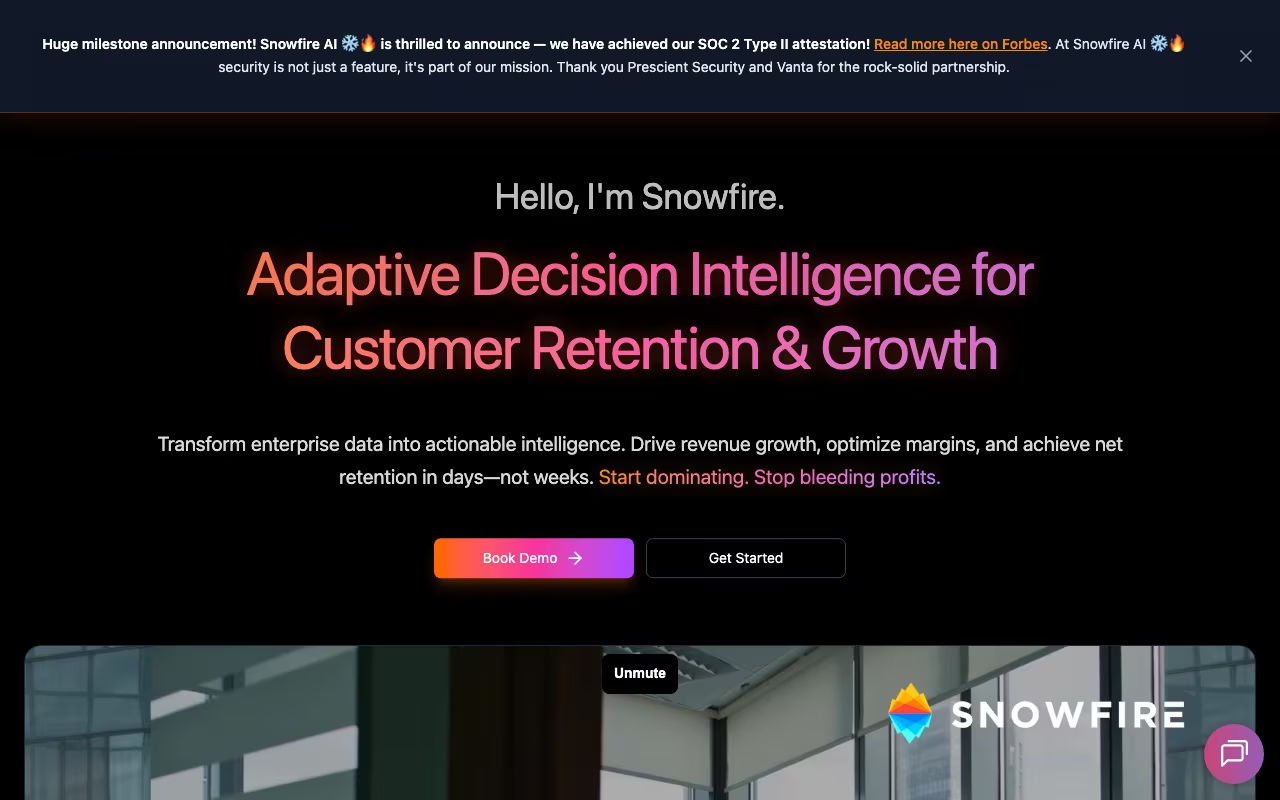
Important clarification first: "Snowfire AI" refers to two completely separate companies. Snowfire.com is a Swedish website builder (reviewed separately on this site). Snowfire.ai is an enterprise decision intelligence platform based in Austin, Texas, founded in April 2024 by cybersecurity veteran Greg Genung. They share a name and nothing else. This review covers Snowfire AI the decision intelligence platform.
What Snowfire AI Actually Does
Snowfire AI connects to your company's data sources (they claim 700+ connectors covering everything from cloud platforms to legacy systems to spreadsheets) and synthesizes that data into real-time executive dashboards. The platform builds what it calls a "large metric model" for each client, automatically generating available metrics from all connected data sources.
The target user is a C-suite executive who currently makes decisions based on reports compiled by analysts from scattered data sources. Snowfire AI promises to replace that manual process: connect your systems, and the platform surfaces actionable insights through personalized dashboards tailored to specific executive roles (CEO, CFO, CTO, CMO, CHRO).
Features include Market Signal Intelligence (combining internal data with external signals like competitor activity and industry trends), predictive analytics with real-time alerts, interactive dashboards with heatmaps and drill-down capabilities, and access across web, tablet, and mobile. The company claims deployment takes 24 hours.
Request a Snowfire AI Demo Get started →Very Early Stage
Snowfire AI emerged from stealth in April 2025 and raised a $2.3 million pre-seed round the same month. By December 2025, they reported $3.3 million in revenue over seven months and set a $15 million revenue target for 2026 with a $22 million pipeline. The team is 11-50 employees. They won a 2025 Global Recognition Award for executive decision-making.
These are promising early numbers, but this is still a very young company. The pre-seed funding stage means the product is evolving rapidly. Features, pricing, and even the core product positioning could change significantly over the next year. If you are evaluating enterprise software, this context matters.
Pricing and Availability
Snowfire AI uses custom enterprise pricing only. There are no published plans, no self-serve signup, and no free tier. You request a demo, discuss your data infrastructure, and get a custom quote. The cost has been described as potentially "prohibitive for small organizations," confirming this is built for Fortune 5000 companies, not mid-market businesses.
The target market is enterprise executives, military, and government agencies. Industries served include finance, manufacturing, retail, healthcare, and private equity. If your organization does not have complex, multi-source data challenges requiring C-suite-level synthesis, you are not the target customer.
Learn More About Snowfire AI Get started →Snowfire AI publishes no list prices; plans are quoted by sales, per the Snowfire AI website (checked September 2026).
The Competitive Landscape
Decision intelligence is a growing category. Established players include Pyramid Analytics, Tellius, Diwo, and Quantexa. Larger BI platforms like Tableau, Power BI, and Looker also compete for the executive dashboard use case, though they position differently. Snowfire AI's claimed differentiators are speed of deployment (24 hours versus weeks or months for traditional BI implementations), role-specific personalization, and the breadth of data connectors.
The company claims their platform reduces decision-making time by up to 50% and increases decision accuracy by 30%. These are marketing claims without independent verification, which is expected at this stage. The 10x ROI claim for smaller firms is also unverified.
Should You Consider It
Snowfire AI is listed on Gartner Peer Insights under "Decision Intelligence Platforms" but has negligible third-party reviews on G2, Capterra, or Trustpilot. This is expected for an enterprise product that launched publicly less than a year ago and sells through demos rather than self-serve. You will not find the volume of user reviews that established BI platforms have accumulated over decades.
If you are a large enterprise struggling to synthesize data across hundreds of systems for executive decision-making, Snowfire AI is worth a demo conversation. The 24-hour deployment claim alone, if accurate, would be remarkable compared to traditional BI implementation timelines. But approach with appropriate caution for a pre-seed stage company. Ask for customer references, verify the deployment timeline claim, and understand what happens to your data integration if the company pivots or shuts down. The technology sounds promising, but the track record is measured in months, not years. One thing worth noting is how Snowfire AI positions against traditional BI tools. Tableau, Power BI, and Looker require significant implementation time, dedicated analysts, and ongoing maintenance. Snowfire AI claims to bypass that entire process by automatically discovering metrics from connected data sources. If the 24-hour deployment claim holds up in practice, it represents a genuinely different approach to enterprise intelligence. The personalized dashboards per executive role is also a differentiation from traditional BI, which typically requires custom dashboard building for each stakeholder. Whether this automated approach produces insights as nuanced as carefully curated analyst-built dashboards remains to be proven at scale across diverse industries and use cases.
Request a Snowfire AI Quote Get started →How Snowfire AI works
Snowfire AI is an enterprise decision intelligence platform built for the C-suite (CEO, CFO, COO, CRO, CMO, CHRO, CIO, CISO and more). You start by connecting source systems through what the vendor calls an integration catalog with over 700 applications, covering CRM (Salesforce and HubSpot are the two named), ERP and finance, marketing, warehouse and support. For each connector you set permissions defining which teams, roles and workflows can use that source, and you choose how fresh the data needs to be.
Snowfire then scans the schemas, detects candidate metrics and maps them into normalized business concepts, storing formulas, lineage and owners in a searchable metric catalog. That is the customer-facing Metric Intelligence layer, powered by an engine the company calls the Large Metric Model. On top of that governed metric layer the product does three things. It pushes scored, role-aware Signals when something material changes, with thresholds you configure by metric, role, business unit and urgency plus windows, composite logic and sensitivity settings. It answers plain-language business questions with lineage back to source. And it opens structured decision threads, where an insight gets an owner, a set of options, and a tracked outcome.
Signals land in Slack, Microsoft Teams, email or in-app, and can escalate into those decision threads. Governance controls include role-based access, field masking, approval workflows for metric and model changes, audit trails, MFA and SSO-style enterprise login. The marketing spine is data sovereignty: raw data stays inside an isolated tenant, only the computed answer of a query leaves, and nothing is retained or used to train models. The recommended rollout is deliberately narrow, connecting only the systems behind one first live use case, proving value there, then expanding.
Where Snowfire AI wins
- Lineage on every answer. A natural-language answer can show the metric definition, the formula, the source systems and the business context behind it, which is the gap most generic AI chat layers leave open.
- Governance sits in the read path, not bolted on afterwards. Masking and role-based permissions carry through to shared artifacts, so a signal forwarded to another executive is filtered to that recipient's access level, and audit trails record what was accessed, shared and decided.
- A concrete data-residency story. The vendor states raw data never leaves the customer's isolated tenant, only the minimal computed result of a query is exposed, and that result is not retained or used to train any model. SOC 2 Type I and Type II attestation is claimed.
- Delivery inside tools people already use (Teams, Slack, email, in-app) rather than as another dashboard to log into. The CRO case study leans on this hard as the adoption argument.
- Genuinely broad executive coverage, with dedicated solution pages and pre-framed decision questions for 15+ roles and 14 industries, so the templates and signal patterns are not a sales-only product.
Where it falls short
- No pricing anywhere. There is no pricing route on the site at all: no tiers, no starting price, no free tier, no self-serve trial. Every path ends in book a demo or get a proposal, so budget has to be discovered through sales.
- The time-to-value claims contradict each other. The homepage and demo page say production-ready in 24 hours and that most teams reach production value in about 24 hours, while the flagship CRO case study and the deployment page describe a Day 1 to Week 12 rollout and going live company-wide in 12 weeks. Treat 24 hours as a first-connector milestone, not a deployment.
- The 700+ connector number is a headline with little behind it. Beyond Salesforce and HubSpot the site names only categories (CRM, ERP, finance, marketing, warehouse, support), so you cannot confirm your specific ERP or warehouse is covered.
- Proof is thin and singular. Essentially all outcome evidence traces to one anonymized $4B enterprise with 200+ sellers ($1.1M net-new pipeline per rep per week). There is a Gartner Peer Insights quote, but no named public references and no independent benchmarks.
- Heavily Microsoft-shaped in practice. The most detailed deployment narrative is a Teams-embedded sales workflow, so if your executives do not live in Teams or Slack the delivery model is less proven.
- The metric layer is the real project. Signals and answers are only as good as the governed KPI definitions, so metric discovery, normalization and approval is unavoidable setup work no matter how fast the first connector lights up.
Who should use Snowfire AI
Large enterprises, with the reference customer sitting at $4B in revenue, where a security review is the actual gate on AI adoption, where executives already argue about whose revenue number is right, and where data cannot be sent to a public model provider. The fit is best if you can name one painful decision loop to start with, such as pipeline forecast accuracy, and your leadership already runs Teams or Slack day to day.
Skip it if you want transparent pricing, if you are under a few hundred employees, if you need a self-serve trial before committing, or if what you actually want is a BI replacement rather than an executive layer that sits on top of one.