Before adding return protection, identify the questions customers have about eligibility, fees, deadlines and who handles claims. Clear terms help customers evaluate the offer; this review does not document consulting experience or establish an effect on conversion.
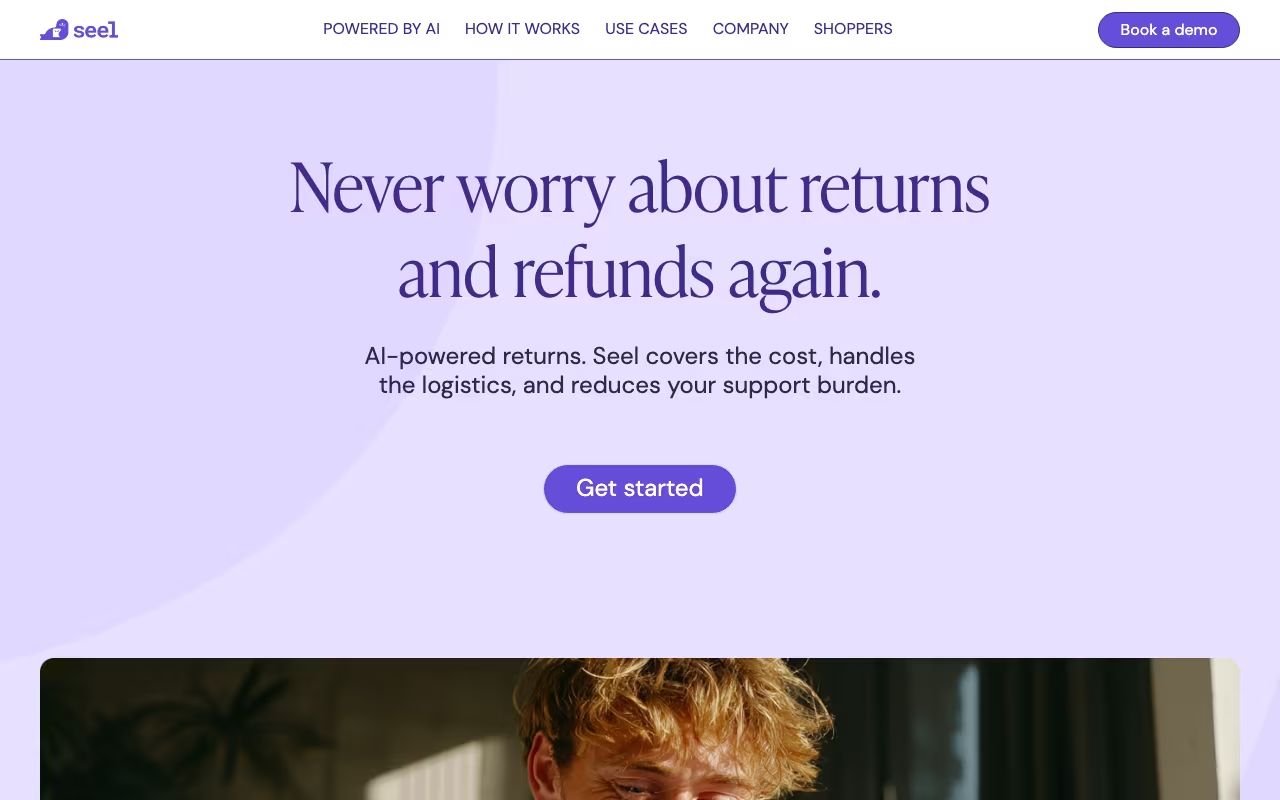
Seel does exactly that. It embeds optional protection offers into your checkout flow. Free returns for $2.99. Delivery guarantee for $1.49. Price protection for a small fee. The customer opts in and pays the fee. The merchant pays nothing. Seel absorbs 100% of the claim risk, handles all refund processing, and manages customer communication. Your support team never touches it.
Founded by ex-Affirm engineers, backed by $23.6M from Lightspeed Venture Partners. 4.8/5 on the Shopify App Store from 213+ reviews. Currently supports Shopify, BigCommerce, and Adobe Commerce.
Add Seel to Your Store Free Get started →What Happens When You Add Seel to a Shopify Store
Confirm the installation requirements for your storefront and checkout configuration. Review a sample protection offer, its wording and available customization before estimating implementation work.
Request a demonstration of the full customer journey, from the protection offer to a claim and refund notification. This review does not document a live order, a test return or a measured approval time.
That zero-touch claim resolution is the real selling point. If you run a store doing 500+ orders per month, even a 5% return rate means 25 returns. Handling those manually costs your support team hours each week. Seel removes that workload entirely.
The AI Pricing Engine Behind Each Offer
Seel does not charge a flat fee for protection. Its AI pricing engine sets the fee dynamically per order based on product category, return probability, shipping distance, carrier reliability, and historical claim data from Seel's network. A $30 t-shirt might show a $1.49 protection offer. A $400 piece of furniture might show $6.99.
Check the fee displayed for representative baskets and the conditions attached to the offer. This review has no documented sample establishing typical fees, customer acceptance or differences by order value.
The downside: you cannot override or customize these prices. Seel's algorithm decides, and you accept it. If the fee is set too high for your product niche and customers stop opting in, there is no manual lever to pull. You can contact Seel's team to discuss pricing optimization, but there is no self-serve pricing control in the dashboard.
Install Seel Free on Shopify Get started →Return Assurance: The Feature That Changes Final-Sale Economics
Most merchants lose money on returns. Return Assurance flips the equation. Customers pay a small fee ($2-$5) at checkout to guarantee they can return any item, even items marked as final-sale. Seel handles the refund directly. The merchant keeps the original sale revenue.
This is genuinely powerful for certain categories. If you sell apparel, swimwear, custom products, or anything with high fit uncertainty, you have two bad options today: accept returns and eat the cost, or mark items final-sale and watch conversion rates drop. Seel gives you a third option: final-sale items with optional buyer-funded return protection. Customers who want flexibility pay for it. Customers who are confident pay nothing extra.
For a store selling custom-printed phone cases that were previously non-returnable, adding Return Assurance can lead to a noticeable uptick in orders for more experimental designs (bold patterns, unusual colors) that customers had previously avoided because they could not return them.
Shipping Protection and Product Protection
Shipping Protection covers lost, stolen, or damaged packages. When a customer files a claim, Seel's AI processes it instantly in most cases. No waiting 48 hours for a support agent to review photos of a crushed box. The Resolution Center lets customers file claims, track status, and receive refunds without ever contacting your store.
Product Protection covers extended warranties and accidental damage, similar to what you would get from Extend or Clyde. Seel manages the entire lifecycle: enrollment, claims, payouts. The margins are smaller here because warranty claims take longer to materialize, but for electronics and appliance sellers, it is a revenue-neutral way to offer peace of mind.
What It Costs You (Nothing)
Free to install. Free to run. No monthly subscription. No per-transaction fees. No revenue share on your sales. Seel earns money exclusively from the protection fees customers pay at checkout. This is the cleanest merchant-side pricing model in the post-purchase protection space.
For comparison: Route charges merchants directly for orders where the customer does not opt in to protection (the "Route+" model has drawn criticism for this). Extend takes a revenue share from warranty sales. AfterShip charges monthly SaaS fees starting at $11/month plus per-shipment costs. Seel's model means your only "cost" is a small widget in checkout that most customers actually appreciate seeing.
The catch is that you cannot control the customer-facing pricing. If Seel's algorithm prices protection at $4.99 and your competitor's store shows $2.99 through Route, you cannot match it. But in practice, most shoppers are not comparison-shopping protection fees across stores.
Conversion Impact: The 5% Lift Claim
Any conversion-lift claim needs a dated source, a defined merchant sample and a comparison method. No such study was verified for this review, so no uplift estimate is used here.
Whether you hit 5% depends heavily on your product type. Stores selling apparel, shoes, and accessories (high fit uncertainty) will likely see a bigger lift than stores selling consumables or low-cost items where return anxiety is minimal. A realistic range is 2-8% depending on your category and average order value.
Where Seel Falls Short
- Platform restrictions: Shopify, BigCommerce, and Adobe Commerce only. No WooCommerce, no Wix, no custom platforms. If you are on WooCommerce, look at Route or AfterShip instead.
- No pricing control: You cannot set or adjust protection fees. Seel's algorithm decides everything. If the fees feel too high for your niche, you are stuck with them or you turn the feature off entirely.
- Mixed support reviews: The 4.8/5 average is strong, but the 1-star reviews on Shopify's app store consistently mention slow response times and claim disputes. A few merchants reported that Seel denied claims they expected to be approved, with limited recourse.
- Low-volume stores get little value: If your store processes fewer than 100 orders per month, the opt-in volume will be too small to meaningfully impact conversion rates or support workload. Seel makes the most sense for stores doing 500+ orders monthly.
- Reporting requirements: Ask which reports are available for opt-ins, claims and product categories, and how any conversion estimate is calculated. This review does not document a dashboard test.
Evaluate Seel against your storefront requirements, customer-facing terms and support process. Confirm current merchant charges and cancellation terms before adopting it. This review does not establish installation time, zero total cost or elimination of support work.
Get Seel Free for Your Store Get started →