
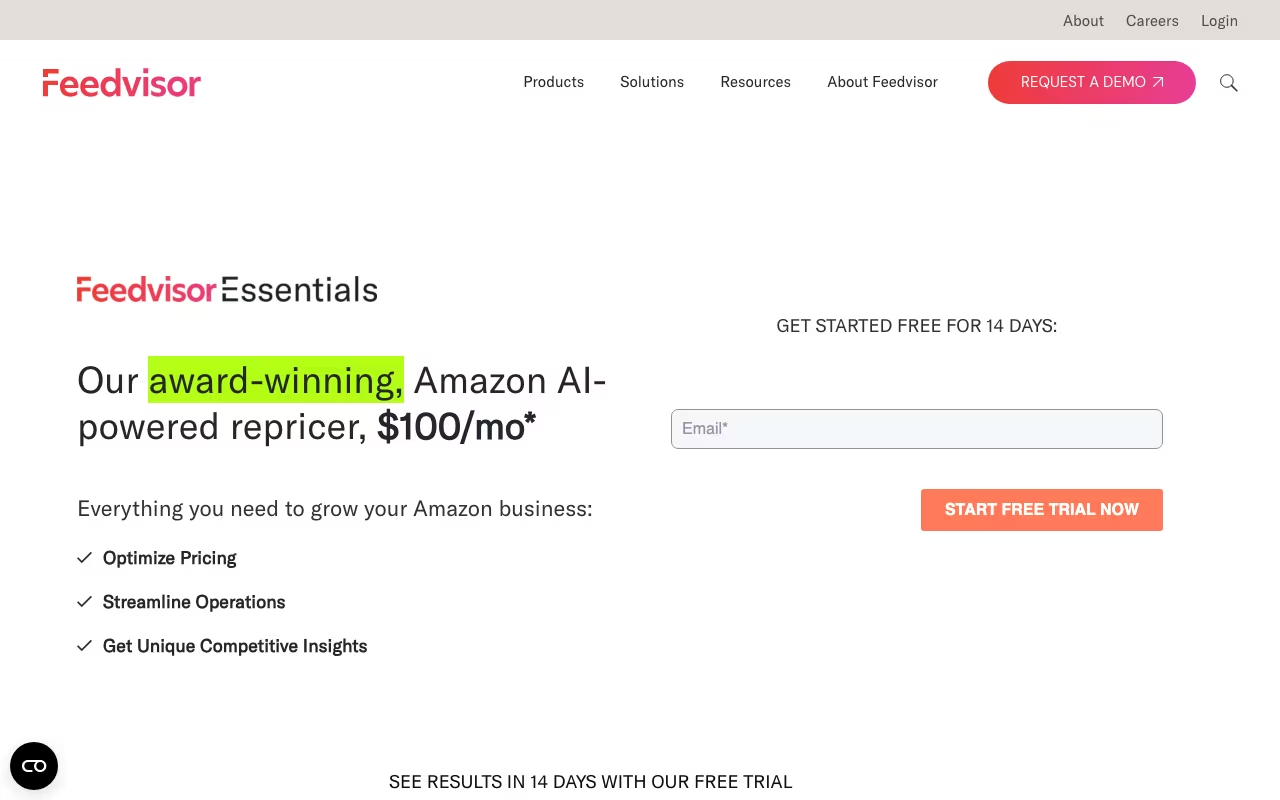
Amazon sellers face two problems that compound each other: pricing too high loses the Buy Box, pricing too low kills margins. Feedvisor uses AI to solve both simultaneously, adjusting prices in real time based on competitor behavior, demand signals, and margin targets. It is one of the oldest Amazon optimization platforms (founded 2012) and serves both mid-market sellers and enterprise brands.
The platform has expanded beyond repricing into advertising optimization, inventory insights, and profitability analytics. But repricing remains the core, and it is where Feedvisor's AI has the deepest competitive moat.
Try Feedvisor Get started →AI Repricing
Feedvisor's repricing algorithm processes millions of data points (competitor prices, Buy Box ownership, inventory levels, demand elasticity) to set optimal prices in real time. Unlike rule-based repricers that follow simple "match lowest price minus $0.01" logic, Feedvisor's AI considers the full competitive landscape and your margin targets simultaneously.
The algorithm adapts to market changes faster than human-set rules can. If a competitor runs out of stock, Feedvisor raises your price to capture the margin opportunity. If a new competitor undercuts aggressively, it adjusts only enough to maintain Buy Box share without racing to the bottom. Sellers consistently report improved margins from this dynamic optimization.
Advertising Optimization
Feedvisor manages Sponsored Products, Sponsored Brands, and Sponsored Display campaigns with AI-driven bid optimization. The system adjusts bids, reallocates budget across campaigns, and identifies keyword opportunities based on performance data. For large catalogs with hundreds of active campaigns, the automated management saves hours of manual PPC work.
The advertising and repricing modules work together. If the AI increases your price on a product, it can simultaneously adjust ad spend to account for the margin change. This integrated approach is something standalone repricers or standalone ad managers cannot do.
See Feedvisor's AI in Action Get started →Feedvisor360 Portal and Analytics
Feedvisor360 is the SaaS portal that provides a unified view of pricing, advertising, inventory, and profitability data. Dashboards show real-time metrics on Buy Box ownership, margin trends, ad performance, and inventory health. For sellers managing large catalogs, having everything in one dashboard saves the spreadsheet gymnastics of pulling reports from Seller Central, ad console, and third-party tools.
The profitability module calculates true profit after Amazon fees, FBA costs, ad spend, and COGS for every SKU. Most sellers overestimate margins because they miss one or more cost components. Feedvisor's all-in calculation gives you the real number.
Pricing
- Feedvisor Essentials (from $100/month): AI repricing, basic analytics, Buy Box optimization. Suited for smaller sellers and resellers who primarily need repricing.
- Feedvisor 360 (from $1,500/month): Full platform including advertising optimization, advanced analytics, inventory insights, profitability reporting. For mid-market to enterprise sellers managing large catalogs.
The gap between $100 and $1,500 is significant. Essentials covers repricing well but misses the advertising and analytics capabilities that justify the platform for larger operations. Most serious sellers will need the 360 tier, making Feedvisor a meaningful budget commitment.
Strengths
- AI repricing is best-in-class: The algorithm's ability to balance Buy Box share with margin targets produces results that rule-based repricers cannot match.
- Integrated pricing + advertising: Coordinated optimization across repricing and ad spend is unique. Price changes inform bid adjustments automatically.
- Enterprise-grade analytics: True profitability per SKU after all costs. Most sellers do not have this level of financial visibility.
- 12+ years of market data: The AI benefits from over a decade of Amazon marketplace data. Newer competitors do not have this depth.
- Walmart support: Cross-marketplace optimization for sellers on both Amazon and Walmart.
Limitations
- $1,500/month minimum for full platform: Feedvisor 360 is expensive. Small sellers cannot justify this until they are doing significant volume.
- Amazon-centric: Walmart support exists but the platform is built for Amazon first. Sellers on Shopify, eBay, or other channels need separate tools.
- Steep learning curve: The platform is powerful but not intuitive. Expect onboarding time and training before you are comfortable with the analytics dashboards.
- Opaque pricing: The "starting at" prices require a sales conversation to get actual quotes. No self-serve signup for 360.
- Overkill for small catalogs: If you sell 50 SKUs, the AI repricing advantage is marginal. Manual repricing or simpler tools like Bqool handle smaller catalogs fine.
The Bottom Line
Feedvisor is built for Amazon sellers serious enough to invest in AI optimization. The repricing algorithm is the strongest in the market, and the integrated approach (pricing + advertising + analytics in one platform) creates efficiencies that separate tools cannot. At $100/month for Essentials and $1,500+/month for the full platform, it is a significant expense, but sellers at scale consistently report ROI from improved margins and Buy Box capture. If you are doing $1M+ in annual Amazon revenue and want every competitive edge available, Feedvisor is worth a demo. Below that volume, simpler repricers deliver enough value at a fraction of the cost.
Get a Feedvisor Demo Get started →How Feedvisor works
Feedvisor sells a platform called Agentis, an AI optimization system for Amazon sellers and brands. It bundles three functions that most companies buy separately: advertising management (Sponsored Products and Sponsored Brands, Amazon DSP, and Amazon Marketing Cloud), algorithmic dynamic pricing, and market intelligence. The argument for buying them together is that they feed each other rather than running as isolated tools. The pricing engine knows what ad spend is doing, and bids adjust based on inventory, demand, and competitive signals instead of being set blind.
The pricing side is branded ProductSphere. It maps the competitive field per SKU and then acts to hit a stated business objective, whether that is margin, market share, or sales velocity. The intelligence layer tracks competitors on price, promotions, rank, reviews, units sold, ad position, and Buy Box share, which is the same data the pricing and bidding decisions draw on.
Getting started means connecting Amazon Seller Central plus your advertising accounts (Sponsored Ads, DSP, and AMC). Feedvisor holds Amazon Marketplace Developer and Advanced Partner certifications, so those connections are sanctioned API access rather than scraping. The operating model is different from a rules engine: instead of writing per-SKU rules by hand, you set a business objective and the algorithm chooses prices and bids from the competitive and demand data it collects. Walmart is offered as an expansion for select customers. There is no self-serve signup anywhere on the site. The only path in is Request a Live Demo, which implies a scoping call, a proposal, and a guided onboarding rather than a credit card start.
Where Feedvisor wins
- Pricing, advertising, and competitive intelligence run off one data layer instead of three disconnected tools, so a bid decision can account for the current price and margin on that SKU.
- The Amazon advertising surface coverage is deep: Sponsored Ads plus DSP plus Amazon Marketing Cloud, not just Sponsored Products like many cheaper tools.
- ProductSphere repricing is objective-driven (margin, Buy Box, velocity) rather than a simple match-the-lowest-competitor rule that races prices to the floor.
- Certification as an Amazon Marketplace Developer and Advanced Partner means the integration is officially sanctioned, which matters for account safety and data reliability.
- It operates at real scale by its own account: $8B+ in GMV optimized annually, with published portfolio averages of 40 to 60% TACoS improvement and roughly 10% margin expansion.
Where it falls short
- No pricing is published anywhere on the site. The /pricing URL returns a 404 and every path funnels to a demo request, so your budget is unknowable before a sales call.
- There is no free trial, no free tier, and no self-serve signup. You cannot evaluate the product at all without engaging a salesperson.
- It is effectively Amazon-only. Walmart is described as an expansion for select customers, and no other marketplace, DTC store, or retail channel is named.
- The headline performance claims (40 to 60% TACoS improvement, 10% margin expansion) are vendor-reported portfolio averages with no methodology disclosed.
- No minimums are stated, but the enterprise-brand customer framing and the demo-only funnel both signal this is not built for small or hobby sellers.
Who should use Feedvisor
Feedvisor fits established Amazon brands and aggregators with meaningful ad spend and enough SKUs that manual repricing and bid management have already broken down. The specific reason to choose it over point tools is wanting pricing and advertising decided together rather than by two teams looking at two dashboards. If you are running DSP and AMC alongside Sponsored Ads, the coverage here is unusually complete.
Skip it if you sell on channels other than Amazon, since Walmart is limited to select customers and nothing else is supported. Skip it if you need to compare prices across vendors before talking to a salesperson, because there is no number to compare. And skip it if you are a small seller: the demo-only, no-published-pricing model is built for larger accounts, and the evaluation cost alone (calls, scoping, proposal) is more than a small catalogue justifies.