
B2B market research has a quality problem. Finding verified professionals to survey is expensive ($200-$500+ per complete), panels are full of fraudulent respondents, and most platforms require long-term commitments. Emporia Research built its platform around solving the verification problem first: 800+ million professional records, all LinkedIn-verified, with 200+ targeting attributes.
Whether you need 500 IT decision-makers to complete a 15-minute survey or 20 CMOs for 45-minute depth interviews, Emporia connects you with verified B2B professionals at $50-$90 per quantitative response and $250-$700 per qualitative interview. No subscriptions, no commitments.
Start Your Research with Emporia Get started →The mrxCore Platform
Emporia's core product, mrxCore, is an audience intelligence engine that sits on top of 800M+ professional records with 200+ targeting attributes (job title, seniority, industry, company size, geography, tech stack, and more). Every respondent is LinkedIn-verified, which dramatically reduces the fake-respondent problem that plagues generic panels.
You can target extremely specific B2B audiences: "VP of Engineering at SaaS companies with 100-500 employees in the DACH region" or "procurement managers at Fortune 500 manufacturing firms." The granularity is what justifies the per-response pricing.
Audience Targeting
The 200+ targeting attributes go beyond basic demographics. You can target by job function, seniority level, department, company revenue, employee count, industry vertical, technology stack used, geographic region, and dozens of other professional characteristics. This specificity is what makes B2B research viable. Generic panels give you "business professionals." Emporia gives you "VP of Engineering at SaaS companies with 100-500 employees using AWS in the DACH region."
Built-in Research Tools
Emporia includes a survey builder with logic flows, skip patterns, and question randomization. No need for SurveyMonkey or Typeform on top. The builder handles both quantitative surveys and qualitative screeners.
Qualitative research support covers video interviews, focus groups, and in-depth interviews with incentive management built in. Emporia recruits participants, handles scheduling, manages incentive payments, and provides an AI insights engine for analysis.
The Pori anti-fraud verification engine screens every respondent at no extra cost. This is not just basic bot detection. Pori cross-references professional credentials, employment history, and response patterns to weed out fraudulent or inattentive participants before they contaminate your data.
Get a Research Quote from Emporia Get started →Pricing
Project-based pricing with no subscriptions or long-term commitments:
- Quantitative surveys: $50-$90 per completed response (varies by targeting difficulty and survey length)
- Qualitative interviews: $250-$700 per interview (includes incentives and recruitment)
- Self-serve or fully managed: Choose assisted DIY or let Emporia handle everything
This is expensive relative to consumer panels, but B2B research is inherently more expensive because the respondents are harder to find and their time is worth more. For perspective, commissioning a similar study through a traditional research agency would cost 3-5x these rates.
What Emporia Does Well
- Respondent quality: LinkedIn-verified professionals with the Pori anti-fraud engine. Data quality is the primary reason to use Emporia over cheaper alternatives.
- Targeting granularity: 200+ attributes on 800M+ records means you can reach extremely specific B2B audiences that generic panels cannot.
- No commitments: Project-based pricing. Run one study or ten. No subscription, no minimum spend.
- Built-in tools: Survey builder, qualitative recruitment, incentive management, and AI insights in one platform. No stacking separate tools.
- Global coverage: B2B audiences across North America, Europe, APAC, and LATAM.
- Self-serve or managed: Choose assisted DIY for cost savings or let Emporia handle recruitment, fieldwork, and analysis end-to-end.
Where It Falls Short
- Price per response: $50-$90 per complete makes large-scale studies expensive. 500 responses at $70 each is $35,000.
- No consumer research: Emporia is B2B only. If you need consumer panels, use Prolific or UserTesting.
- Turnaround times: Niche audiences take longer to recruit. A study targeting C-suite executives at enterprise companies may take 2-4 weeks to field.
- Panel-side complaints: Trustpilot reviews (4.1/5 from 268 reviews) show some respondents frustrated with payment redemption and survey rejections. This is the respondent experience, not the buyer experience, but it could affect panel willingness.
- Opaque pricing: Exact costs depend on targeting and methodology. You need to request a quote rather than see transparent pricing on the website.
- Not for simple surveys: If you just need 1,000 consumer responses for a product poll, Emporia is overkill and overpriced. Use SurveyMonkey, Typeform, or Prolific instead.
Verdict
Not to be confused with consensus.app (the AI research search engine) or any consumer survey platforms. Emporia Research is squarely in the B2B sample and insights space.
Emporia Research is the right choice when B2B data quality matters more than cost. The LinkedIn-verified audience, Pori fraud screening, and 200+ targeting attributes deliver a level of respondent quality that generic panels cannot match. The pricing ($50-$90 per response) is justified for studies where bad data costs more than good data. If you are running brand tracking, product-market fit research, or competitive intelligence with B2B professionals, Emporia's verification layer is worth the premium. For consumer research or budget-constrained studies, look elsewhere.
Start Your Emporia Research Project Get started →How Emporia Research works
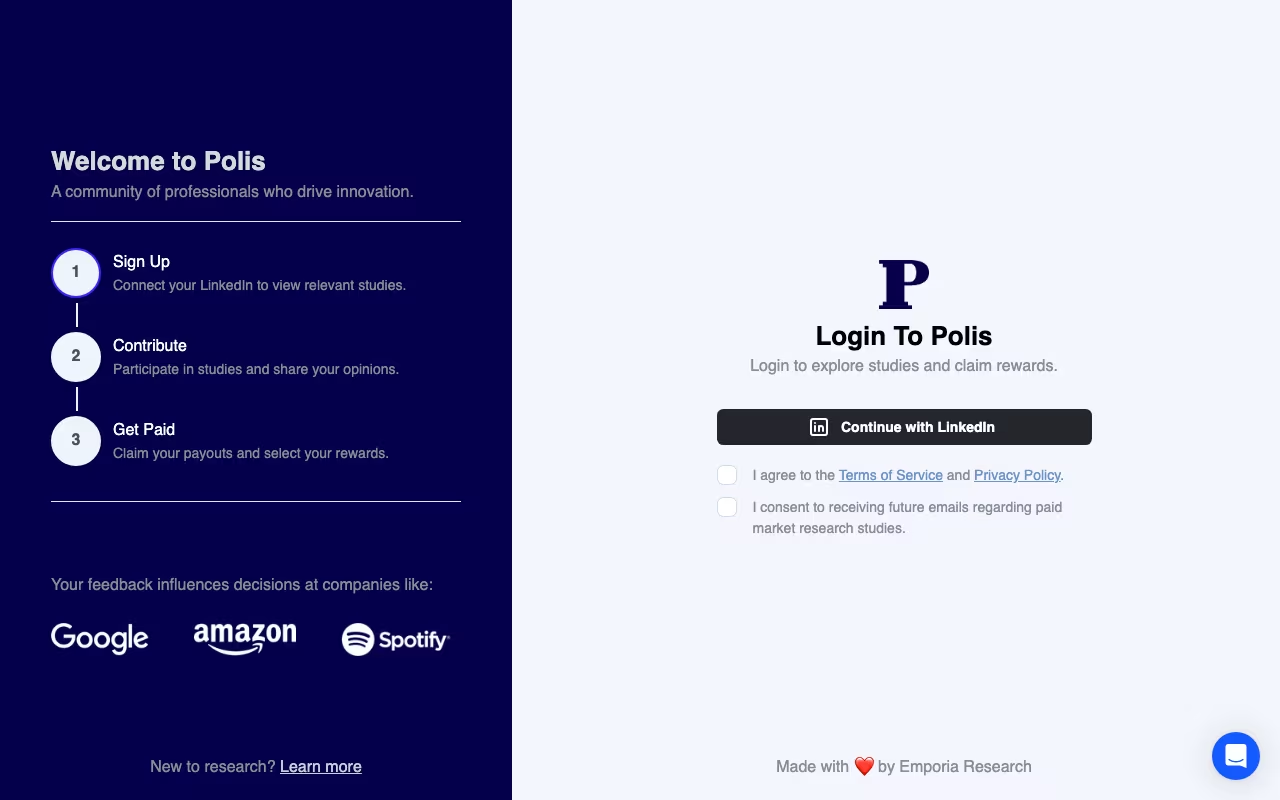
Emporia Research is a B2B respondent-sourcing and fieldwork platform for market research, not a survey tool in the analytics sense. It recruits verified working professionals for studies and positions itself as the middle path between traditional online panels (too consumer, too gamed) and expert networks (too expensive). The pitch rests on scale plus verification: 800M+ employee records across 75M+ organizations, 200+ targetable attributes, and LinkedIn-based identity verification on every respondent. There are three connected pieces: mrxCore (the buyer-side platform), Polis (the respondent marketplace), and Levada (the supplier-side portal for partners bringing their own audiences).
In mrxCore you design and field the study, either DIY or handed to Emporia as a managed project. That covers surveys, one-on-one interviews and focus groups, plus non-survey activities such as app sign-ups, white paper downloads and webinar registrations. You define the audience against nearly 200 attributes: industry across 140+ sectors, job function, seniority from entry level through C-suite, years of experience, company size and revenue band, and geography across 179 countries. Screening questions are generated dynamically and responses are scored.
Every respondent then passes through Pori, the anti-fraud engine, which runs nine layers: live LinkedIn profile validation, work-email domain analysis, identity lookup against flagged records, synthetic-identity detection, VPN and proxy detection, device fingerprinting, response-quality analysis for gibberish and LLM-generated text, straight-lining and speeding pattern checks, and human review of borderline cases. Respondents join Polis by connecting LinkedIn via OAuth. On the supply side, partners with their own B2B audiences (panels, niche communities, professional newsletters, LinkedIn creators) apply to Levada and route respondents through a dashboard offering smart matching, a URL manager and instant sample ID verification.
Where Emporia Research wins
- Verification is the product, and it is specified rather than hand-waved. Nine named Pori checks, including live LinkedIn validation and detection of LLM-generated open-ends, and that last one matters a lot now that respondents paste chatbot answers into verbatims.
- Unusually buyer-friendly commercial structure for this category: pay-as-you-go on a cost-per-complete basis, participant incentives included in the quoted cost, no annual contract, no minimum spend, no subscription.
- Real B2B targeting depth. 200+ attributes across 140+ industries with seniority up to C-suite, and the vendor demonstrates niche feasibility with examples as narrow as truck drivers hauling rare earth metals in Alberta.
- Qual as well as quant. It handles interviews, focus groups and activity-based recruits such as webinar registrations and white paper downloads, so one supplier covers both sides of a research program.
- Transparent about panel composition, publishing the geographic split (North America 56.2%, EMEA 22.8%, APAC 13.8%, LATAM 7.2%; US 66.6%, India 9.9%, UK 5.4%) instead of just claiming global coverage.
Where it falls short
- No published prices at all. Cost-per-complete is entirely quote-driven: you email project specs to [email protected] and wait. There is no rate card, no ballpark by seniority and no self-serve checkout, which makes budgeting a study from the site alone impossible.
- Levada has no open API. The vendor says it uses direct links instead, to maintain quality, so supplier-side automation is limited to bulk link generation and real-time status codes inside the app.
- Buyer-side integrations are barely specified. mrxCore mentions supporting your programming tool of choice for survey design, but no named integrations with Qualtrics, Decipher, Confirmit or any analytics stack are documented.
- The LinkedIn dependency is structural. Recruitment and verification both run through LinkedIn OAuth, which skews the reachable audience toward LinkedIn-active professionals and away from roles and regions where LinkedIn use is low.
- Heavy US concentration. At 66.6% US, non-US B2B studies outside the UK and India will likely hit feasibility constraints the site does not quantify.
- The 100% verified claim is absolute and therefore unfalsifiable. There is no published incidence, no fraud-rejection rate and no third-party audit of Pori to support it. Incentives paying out only 12 days after participation is also a respondent-side friction point that can affect completion.
Who should use Emporia Research
Research agencies, consultancies, PE and VC diligence teams, and in-house insights groups running B2B studies where respondent authenticity is the actual risk: commercial due diligence, pricing research, competitive intelligence, thought leadership. The pay-as-you-go model with no minimum makes it viable for a single project, not just for firms carrying an annual panel contract, which is rare in this category.
Skip it if you need consumer sample, if your study targets markets outside North America and the UK at any real scale, if you need tight API integration into an existing survey stack, or if you cannot move forward without a published rate card.