
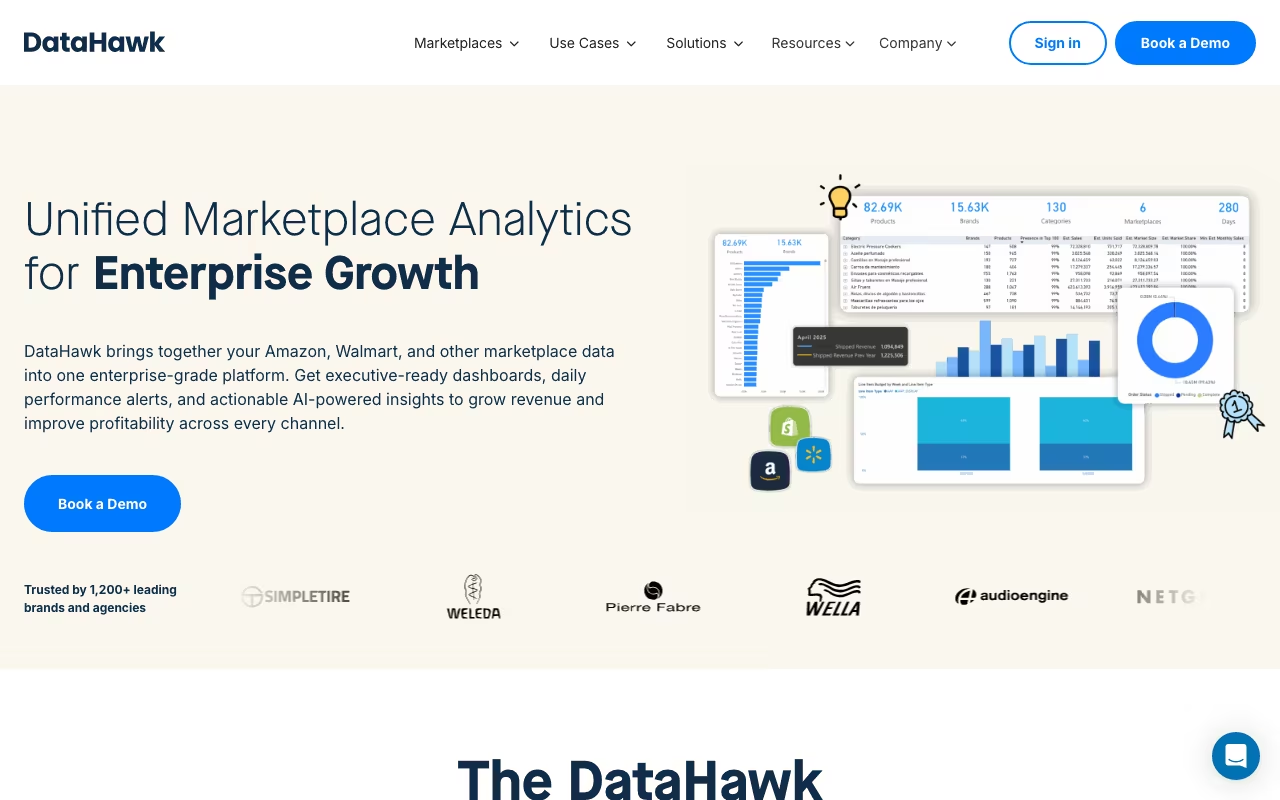
Amazon sellers managing large catalogs need more than Seller Central dashboards. They need keyword tracking, competitive monitoring, SEO optimization, profitability analysis, and anomaly detection across hundreds or thousands of ASINs. DataHawk is an enterprise-grade marketplace analytics platform that unifies all of this in one place.
Acquired by Worldeye Technologies (which also owns Viral Launch) in April 2025, DataHawk continues operating independently with the same team and services. The platform supports Amazon, Walmart, and Shopify marketplaces. It carries a 4.5/5 on Trustpilot and 4.3/5 on G2, with users praising the data depth but noting the price tag.
Book a DataHawk Demo Get started →Keyword and SEO Intelligence
DataHawk tracks keyword rankings across Amazon and Walmart, showing where your products rank for target terms, how rankings change over time, and where opportunities exist. The keyword research module identifies high-volume, low-competition terms to target in your listings.
The listing quality scoring evaluates your product pages against SEO best practices: title optimization, bullet point quality, image count, A+ content, and backend search terms. The score gives a concrete number to improve rather than vague "optimize your listing" advice.
Product Monitoring and Anomaly Detection
Real-time alerts flag pricing shifts, hijackers on your listings, ranking drops, review changes, and stock issues. The AI-driven anomaly detection identifies unusual patterns (sudden ranking drops, unexpected price changes from competitors) before they become problems.
For sellers managing hundreds of ASINs, manual monitoring is impossible. DataHawk's automated alerts replace the constant Seller Central refreshing that eats up hours per day.
See DataHawk in Action Get started →Financial Reporting and Profitability
The financial module calculates true profitability per SKU after Amazon fees, FBA costs, advertising spend, COGS, and shipping. Most sellers overestimate margins because they miss one or more cost components. DataHawk's all-in calculation shows the real number.
The Sales Estimator covers 3M+ ASINs with historical trend charts, giving competitive intelligence on how other products in your category are performing. Market intelligence dashboards provide benchmarking against competitors in your niche.
API and Data Export
DataHawk provides API access and data export for teams that need to feed marketplace data into their own BI tools, spreadsheets, or reporting systems. Advanced dashboards support cross-filtering, shared views among team members, and export-ready formats for agency client reporting. The visualization layer is clean and well-organized, though some users want more customization in report layouts.
Pricing
Pricing checked against DataHawk's own site. Plans and limits change, so confirm before you buy.
DataHawk uses custom/enterprise pricing only. No public tiers, no self-serve signup. Pricing is based on two components:
- Platform fee: Based on your sales volume
- Credits fee: Based on the number of keywords, products, and categories you track
Annual commitment required. No free plan. You must book a demo for a quote. Based on user reports, expect mid-four-figures per year for moderate usage, with costs scaling significantly for large catalogs.
DataHawk claims 130% average revenue lift in the first 6 months, 31% average RoAS boost in 12 months, and 25 hours saved per month. These are self-reported numbers, but the directional claim (better data leads to better decisions) is sound.
Strengths
- Thorough data: Keyword tracking, product monitoring, SEO scoring, financial reporting, and competitive intelligence in one platform. Replaces 3-4 separate tools.
- Real-time alerts: Automated anomaly detection catches hijackers, price changes, and ranking drops before they cost you money.
- Multi-marketplace: Amazon, Walmart, and Shopify support from one dashboard.
- Advanced dashboards: Cross-filtering, shared views, and export-ready reports for team collaboration and agency reporting.
- Frequent updates: Users note regular product improvements and new features.
Limitations
- Enterprise pricing only: No self-serve plans. The sales-driven pricing process adds friction for smaller sellers who just want to sign up and start.
- Annual commitment: No monthly option. You are locked in for a year before you can evaluate ROI.
- Complexity: The platform is powerful but requires dedicated resources to set up and use effectively. Not a "plug and play" tool.
- Financial analysis depth: Some users want more granular financial breakdowns than what is currently available.
- Acquisition uncertainty: The Worldeye Technologies acquisition in April 2025 introduces some product direction uncertainty, though services have continued unchanged so far.
Our Take
Since the Worldeye Technologies acquisition, DataHawk has continued operating with the same team and feature set. Viral Launch (also owned by Worldeye) focuses on product launches while DataHawk handles ongoing analytics and optimization. The two platforms complement each other rather than overlapping.
DataHawk is built for brands and agencies managing large Amazon catalogs where data-driven decisions move the needle. The combination of keyword intelligence, product monitoring, SEO scoring, and financial analytics in one platform replaces a stack of separate tools. The enterprise pricing and annual commitment make it a serious investment, but for sellers doing $500K+ in annual Amazon revenue, the data visibility pays for itself through better keyword targeting, faster anomaly response, and accurate profitability tracking. Book a demo and compare the data depth to whatever you are using today.
Get a DataHawk Quote Get started →How DataHawk works
DataHawk is a marketplace analytics platform that consolidates Amazon and Walmart sales, advertising, SEO/keyword and inventory data into one warehouse and reporting layer. It delivers daily SKU-level analytics, ad metrics and profitability signals, plus competitive intelligence on buy box, category trees, best sellers, keyword search volumes and share of voice. On top of the data it runs anomaly detection, daily performance alerts and automated reporting.
You connect accounts through official Amazon partner integrations covering Seller Central, Vendor Central and Amazon Advertising, and through an approved Walmart Marketplace connection. Public market data (buy box, category trees, best sellers, keywords, search volume, trends) is collected independently of your account, so competitive intelligence doesn't depend on what you sell.
Coverage spans 25+ Amazon country marketplaces including US, UK, DE, FR, IT, ES, CA, MX, BR, JP, IN, AU, AE, SA, SG, PL, SE, NL, BE, TR, EG and CN, with historic and current series retained.
Output goes to executive-ready dashboards, or out via native connectors to Power BI, Tableau, Looker Studio, Google Sheets and Excel, or into hosted warehouse infrastructure on Snowflake and Google BigQuery, plus a composable analytics API. Agency setups get multi-account dashboards, white-label reports and role-based access.
Two AI pieces sit on top. Sherlock is an agent that detects performance issues, explains the cause and recommends a fix, currently in beta with waitlist access. An MCP server lets ChatGPT, Claude or any AI client query your Amazon data directly. Onboarding is vendor-led and described as taking weeks, with a dedicated customer success team and scheduled check-ins.
Where DataHawk wins
- Genuinely broad geographic coverage: 25+ Amazon marketplaces with historic and current data, which matters if you sell across EU, LATAM and MENA rather than US-only.
- Data-out is a first-class feature, not an afterthought: Snowflake and BigQuery hosting plus Power BI, Tableau, Looker Studio, Sheets and Excel connectors and an API, so it can act as your marketplace data warehouse.
- Covers Seller Central and Vendor Central through official Amazon partner integrations, plus approved Walmart Marketplace access. 1P vendors are often excluded by competing tools.
- Unifies four data types most sellers keep in separate tools (sales, advertising, organic SEO/keyword rank and inventory) joined at SKU level with profitability.
- An agency-specific build: multi-account dashboards, white-label reporting, role-based access, and a Model Context Protocol server for querying the data from ChatGPT or Claude.
Where it falls short
- No public pricing at all. Custom quotes on annual plans only, sold via demo, with no self-serve signup, no free tier, no published trial and no disclosed SKU, seat or data-retention limits.
- Annual contracts are the stated norm, so there is no low-commitment way to test it against your actual catalogue.
- Marketplace coverage is effectively Amazon plus Walmart. Other marketplaces are referenced but never named, so anyone selling on eBay, Shopify, Target or European marketplaces needs something else alongside it.
- Sherlock is in beta behind a waitlist, despite being the most prominent thing on the site. You cannot count on it being available when you buy.
- Setup is not self-serve: onboarding is measured in weeks with a customer success team, and custom dashboards and dedicated project management are billed separately as professional services.
- No data refresh frequency is published beyond "daily" SKU analytics, so near-real-time ad decisioning is not something the site commits to.
Who should use DataHawk
DataHawk suits mid-market and enterprise Amazon and Walmart brands, particularly multi-country sellers and Vendor Central accounts that most tools ignore. It also suits agencies managing many accounts who want white-label reporting and a clean pipe into Snowflake, BigQuery or Power BI rather than another dashboard nobody logs into.
Skip it if you're a small seller who wants to swipe a card and start today, because there is no self-serve path. Skip it if you sell mainly outside Amazon and Walmart. And think hard before signing if you can't commit to an annual contract before seeing the product run against your own data, since that is how it is sold.