
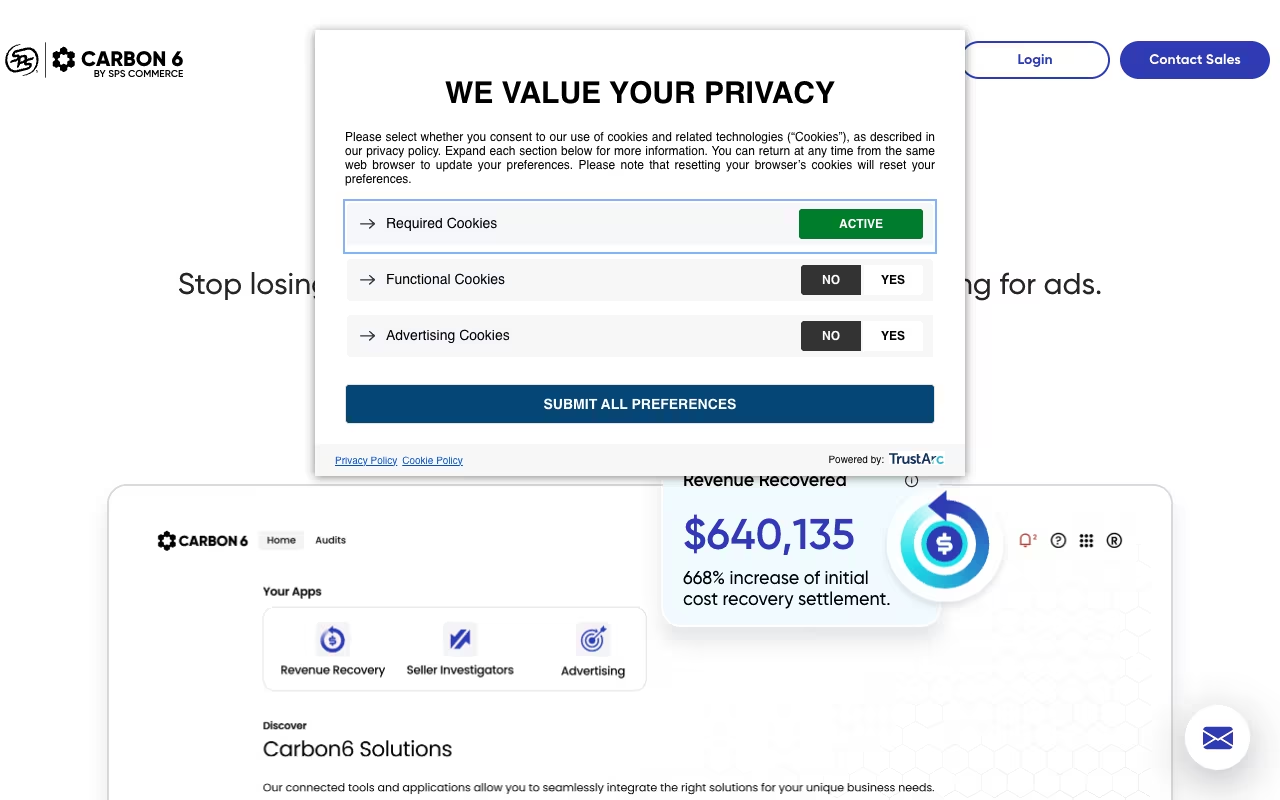
Selling on Amazon in 2026 means juggling inventory, PPC campaigns, profitability tracking, competitor monitoring, and refund recovery. Most sellers cobble together 4-5 different tools for this. Carbon6 took a different approach: buy the best point solutions (SoStocked, PixelMe, D8aSuite, ManageByStats, and others) and stitch them into one platform. SPS Commerce acquired Carbon6 for $210M in February 2025, so there's real corporate backing behind the suite now.
The result is an integrated Amazon seller suite with 9 distinct tools covering inventory forecasting, PPC management, external traffic attribution, FBA reimbursement recovery, and even Walmart expansion. Whether the integration justifies the cost depends on your scale.
Explore Carbon6 Tools Get started →The Tool Suite
SoStocked (Inventory): Demand forecasting with seasonality and promotion adjustments. Transfer planning across FBA warehouses. Reorder alerts that balance cash flow against stockout risk. This is Carbon6's strongest piece.
PPC optimization: Bid management, keyword research, campaign analytics. Amazon's ad costs keep climbing, so anything that improves ACOS matters. Carbon6's ad tools are solid but not as deep as dedicated PPC platforms like Perpetua or Pacvue.
Profitability analytics: True SKU-level profitability accounting for Amazon fees, advertising, returns, and shipping. This is where most sellers get surprised. That "profitable" product might be losing money once you account for everything.
PixelMe (Attribution): Track external traffic to Amazon listings. If you're running Facebook ads or influencer campaigns that drive to Amazon, PixelMe shows which channels actually convert.
Refund recovery: Amazon regularly owes sellers money for lost inventory, overcharged fees, and damaged goods. Carbon6 identifies and files claims. I've seen sellers recover thousands they didn't know Amazon owed them.
Pricing
Each tool is priced separately. A few examples:
- SoStocked: ProfitFlow at $97/month. Inventory add-on from $250/month.
- ManageByStats: Free plan (4 accounts, 100 keywords). Pro at $59.97/month.
- Seller Investigators: 25% commission on recovered FBA reimbursements. No upfront cost.
- PixelMe: $500/month for 1-10 ASINs. $500 onboarding fee. 6-month minimum.
- WallySmarter (Walmart): Free to start.
Some sources list platform bundles (Starter $49, Growth $199, Scale $499/month), but Carbon6's website pushes you toward "Book a Demo" for most products. Expect the full suite to run $300-500+/month depending on what you need.
Get Carbon6 Pricing See plans →Where It Delivers
- FBA reimbursement recovery: Seller Investigators claims a 95.9% success rate on filed cases. Carbon6 says they've recovered $450M+ total. No competitor offers this at scale, and it's commission-based, so you pay nothing if they recover nothing.
- SoStocked inventory forecasting: Still one of the best Amazon inventory tools. Demand forecasting with seasonality, promotion adjustments, and reorder alerts.
- External traffic attribution: PixelMe lets you track Google/Meta ads driving to Amazon. Neither Helium 10 nor Jungle Scout offers this.
- Free entry points: ManageByStats and WallySmarter both have free tiers. You can start without committing.
Where It Doesn't
- Acquisition stitching shows: You can tell these were separate products. UI patterns, navigation, and design language vary between tools. It's getting better, but it's not smooth yet.
- Pricing is confusing: Multiple tools with different pricing tiers means figuring out your actual cost takes a spreadsheet of its own.
- Overkill for small sellers: If you have 10 SKUs doing $100K/year, Helium 10 or Jungle Scout is probably enough.
- Amazon-only: If you sell on Shopify, Walmart, or eBay too, you'll still need other tools for those channels.
Carbon6 vs. Helium 10 vs. Jungle Scout
Data tools, published pricing
| Tool | Pricing | Model |
|---|---|---|
| Carbon6 | Amazon seller tools, custom pricing | Subscription |
| Survicate | $59/mo (lowest published recurring price) | Subscription |
| FlexiQuiz | $20/mo (lowest published recurring price) | Subscription |
| Databox | $59/mo (lowest published recurring price) | Subscription |
| Crazy Egg | $29/mo (Starter), $99/mo (Plus), $249/mo (Pro), $599/mo (Enterprise) | Subscription |
| SurveyMonkey | Free (10 questions), $25/mo (Standard), $75/mo (Premier) | Freemium |
Helium 10 is the market leader with broader capabilities in a single platform. Better product research tools. More polished UX. But their inventory and profitability analytics aren't as deep as Carbon6's.
Jungle Scout is best for product research and opportunity discovery. Less useful for operational management of an existing catalog.
Sellerboard focuses purely on profitability analytics and does it well at a lower price point.
Carbon6 makes sense for established sellers who need inventory + PPC + profitability in one connected system. If you just need product research or basic analytics, simpler tools are better.
The Verdict
Carbon6 is built for Amazon sellers doing serious volume who need their operational tools to share data. If you're managing hundreds of SKUs across multiple warehouses and spending real money on PPC, the integrated approach saves time and surfaces insights you'd miss with disconnected tools.
Start with the one tool that solves your biggest headache (usually inventory or profitability). Expand from there only if the data integration actually improves your decisions.
Start With Carbon6 Get started →How Carbon6 works
Start with the most important fact: Carbon6 no longer exists as a standalone product. carbon6.io returns a 301 permanent redirect to SPS Commerce's Revenue Recovery page. The brand and its own site are retired, and the offering now ships as SPS Revenue Recovery.
That product is a deduction-management and revenue-recovery platform for brands selling into retailers and marketplaces. It identifies, recovers and prevents revenue lost to chargebacks, deductions, shortages, compliance fines and fee discrepancies. SPS claims more than $2 billion in deductions recovered, recovery rates up to 99%, and over $300 million recovered specifically for Amazon suppliers.
Mechanically, you connect your trading-partner accounts and the platform automatically identifies recoverable deductions across retailers. It then files disputes, retrieving and attaching the supporting documentation itself rather than handing that job back to your team. Workflows are centralized, so multiple retailers and distributors are managed in one place instead of one vendor portal at a time. A root-cause layer surfaces the upstream reason behind each loss (EDI mismatches, carrier errors, product setup problems) so the same deduction stops recurring.
It sells two ways: full-service, where SPS manages recovery on your behalf, or self-guided platform access where your team drives it. The Amazon module covers six claim types specifically: shortages and deductions, undelivered or overcharged vendor returns, billable overages, price claims, invalid accruals and overbilling, and Amazon chargebacks. Onboarding begins with a complimentary audit at no cost or commitment. The product is positioned inside SPS's broader Intelligent Supply Chain Network, meaning it is designed to sit alongside SPS EDI and fulfillment products.
Where SPS Revenue Recovery wins
- Documentation retrieval and attachment is automated. The tedious, error-prone part of disputing a deduction is handled by the platform instead of consuming your AP team's week.
- Root-cause analysis goes past clawing money back. It traces EDI mismatches, carrier errors and product setup problems so the same deductions stop being generated in the first place.
- Genuine multi-retailer coverage, named explicitly: Walmart, Target, Amazon, Kroger, UNFI and CVS, consolidated into one workflow rather than six separate vendor portals.
- Deep Amazon vendor-side coverage across six distinct claim types, with the vendor stating it continuously updates its deduction logic as Amazon changes its rules.
- Full-service or self-guided. A small brand without a dedicated AP analyst can still use it, and the free audit produces a real recovery estimate before you commit to anything.
Where it falls short
- The Carbon6 brand is gone. If you are evaluating based on Carbon6 reviews, comparison articles or its former multi-tool suite, none of that maps to what you can actually buy today.
- No pricing is disclosed anywhere. No contingency percentage, no platform fee, no tiers. Every path runs through a sales conversation that starts with the audit.
- Coverage is retailer and vendor-side (1P and big-box supply relationships). The named partners are six large US retailers, so fit is unverified if you sell into regional grocers, international retailers, or operate as a pure 3P Amazon seller.
- It is positioned as part of the SPS ecosystem, which raises the likelihood that the best value requires adopting SPS EDI as well, and that standalone use is the less-supported path.
- Public pages are thin on operational detail. There is nothing on how data connections are made, how long onboarding takes, or what self-guided access includes versus full-service.
Who should use SPS Revenue Recovery
This fits brands with meaningful wholesale or Amazon vendor volume, specifically enough deduction leakage that a percentage-based recovery pays for itself. If you are shipping into Walmart, Target, Kroger, UNFI or CVS and writing off deductions because chasing them costs more than they return, that is the exact problem being solved. Companies already running SPS Commerce for EDI are the most natural buyers, since the product is built to sit inside that ecosystem.
The complimentary audit makes the first step genuinely low-risk: you get a recovery estimate without cost or commitment, which is the cleanest way to find out whether the leakage justifies the engagement.
Skip it if you are a 3P-only Amazon seller, if your retail accounts fall outside the large US names listed, or if your process requires published pricing before you will engage with a sales team.