
The 8 Best Conversion Rate Optimization Tools (2026)

Key facts8 tools compared: Microsoft Clarity, VWO, Hotjar, Optimizely, Mouseflow, Convert, PostHog…
- 8 tools compared: Microsoft Clarity, VWO, Hotjar, Optimizely, Mouseflow, Convert, PostHog, Unbounce
- Microsoft Clarity (best for: Any site, any budget): Free
- VWO (best for: Mid-market testing programs): From ~$314/mo
- Hotjar (best for: Qualitative behavior research): Free; Plus from $32/mo
- Optimizely (best for: Enterprise experimentation teams): $40K+/yr
Most "CRO tool" roundups read like a vendor directory: 25 logos, a feature checkbox grid, no opinion. That is useless when you are staring at a flat signup rate and trying to decide where to spend money this quarter.
CRO tools need to match sites with 5,000 monthly visitors just as well as sites with 5 million, and the requirements are very different. The tool you need is not the one with the longest feature list. It is the one that matches your traffic volume, your team's appetite for setup work, and the specific bottleneck you are trying to fix. A 2,000-visitor-a-month landing page does not need a $40,000 enterprise testing platform. A high-traffic ecommerce store does not need a free heatmap tool that deletes your data after 30 days.
If you want the short answer: start with Microsoft Clarity because it is genuinely free and shows you where users rage-click. Once you have enough traffic to run statistically valid tests, add VWO or Optimizely. Below I break down the eight tools worth your time in 2026, who each one is actually for, what they cost, and where each one falls short.
Quick comparison
| Tool | Best for | Price | Standout |
|---|---|---|---|
| Microsoft Clarity | Any site, any budget | Free | Unlimited heatmaps + AI Copilot |
| VWO | Mid-market testing programs | From ~$314/mo | Testing + Insights on one platform |
| Hotjar | Qualitative behavior research | Free; Plus from $32/mo | Recordings, surveys, feedback widgets |
| Optimizely | Enterprise experimentation teams | $40K+/yr | Server-side and feature experiments |
| Mouseflow | SMB behavior analytics | Free; from $31/mo | Automatic Friction Score |
| Convert | Privacy-first A/B testing | From $399/mo | GDPR-safe, first-party cookies only |
| PostHog | Product-led and dev teams | Free tier; usage-based | Analytics + experiments + replays in one |
| Unbounce | Landing page conversion | From $74/mo (annual) | Smart Traffic AI routing |

Microsoft Clarity (the one you install today)
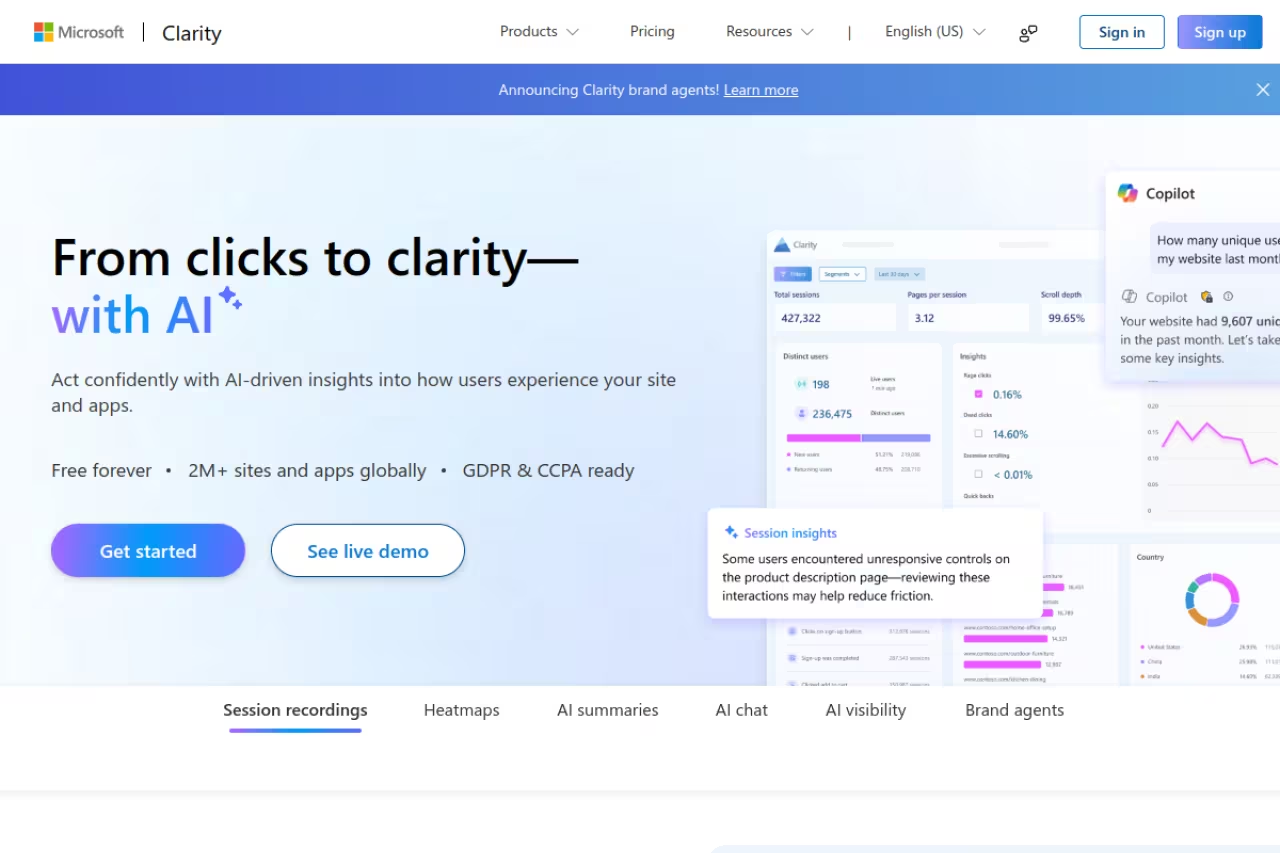
Microsoft Clarity is the rare free tool that is not a crippled trial. It gives you heatmaps, session recordings, scroll maps, rage-click and dead-click detection, and an AI Copilot you can ask plain-English questions like "which pages have the highest rage-click rate?" There are no traffic limits, no credit card, and no paywalled premium tier. Microsoft makes its money elsewhere, so the analytics stay free.
Who it is for: everyone, honestly. If you are not running Clarity, install it before you read the rest of this list. It is the fastest way to see why people leave a page instead of guessing.
The catch: data retention. Clarity keeps session recordings and heatmap data for about 30 days, and there is no way to extend it. For point-in-time diagnostics that is fine. For tracking how a change performed over a quarter, you will need to export or pair it with something that retains longer. It also does not run A/B tests, so it tells you where the friction is but not which fix wins.
Install this first: a genuinely free tool with heatmaps, recordings, and no traffic limits that shows why people leave a page. Data is kept for about 30 days and it doesn't run A/B tests, so it shows friction, not which fix wins.

VWO (the mid-market workhorse)
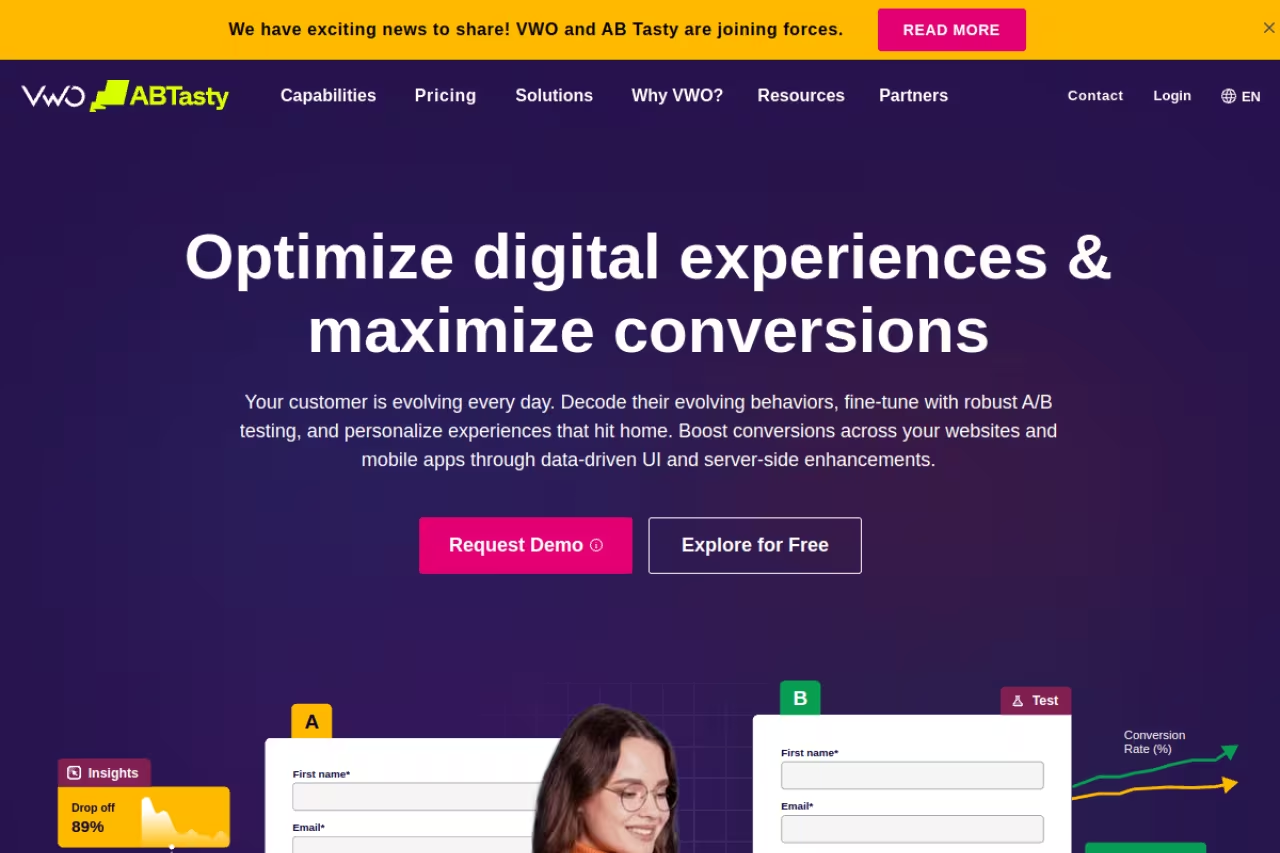
VWO is the tool I reach for once a site has enough traffic to test properly. It bundles two things most teams otherwise buy separately: VWO Testing (A/B, split-URL, and multivariate tests with a visual editor) and VWO Insights (heatmaps, session recordings, funnels, form analysis, on-page surveys). Having the qualitative "why" and the quantitative "which wins" in one place shortens the loop between spotting a problem and shipping a fix.
Who it is for: marketing and growth teams at companies past product-market fit, roughly the £100K to £5M revenue band, who want a real testing program without an enterprise contract.
The mid-market workhorse for growth teams past product-market fit, bundling testing with heatmaps and recordings. Costs climb fast with traffic, and the old free Starter plan is gone in favor of a 30-day trial.
Pricing: VWO charges by monthly tracked users (MTUs) and which modules you turn on. The published Starter price sits around $314/month billed annually for Testing up to 10,000 MTUs, per VWO's pricing page, with Growth, Pro, and Enterprise quoted custom. Note one 2026 change: VWO discontinued its old free Starter plan, so new accounts get a 30-day trial instead.
Where it falls short: costs climb fast with traffic. At 100,000 MTUs the Growth tier runs into the high hundreds per month, and the Pro tier well past a thousand. If your traffic is spiky or you only test occasionally, you pay for visitors you are not experimenting on.

Hotjar (the behavior-research standard)
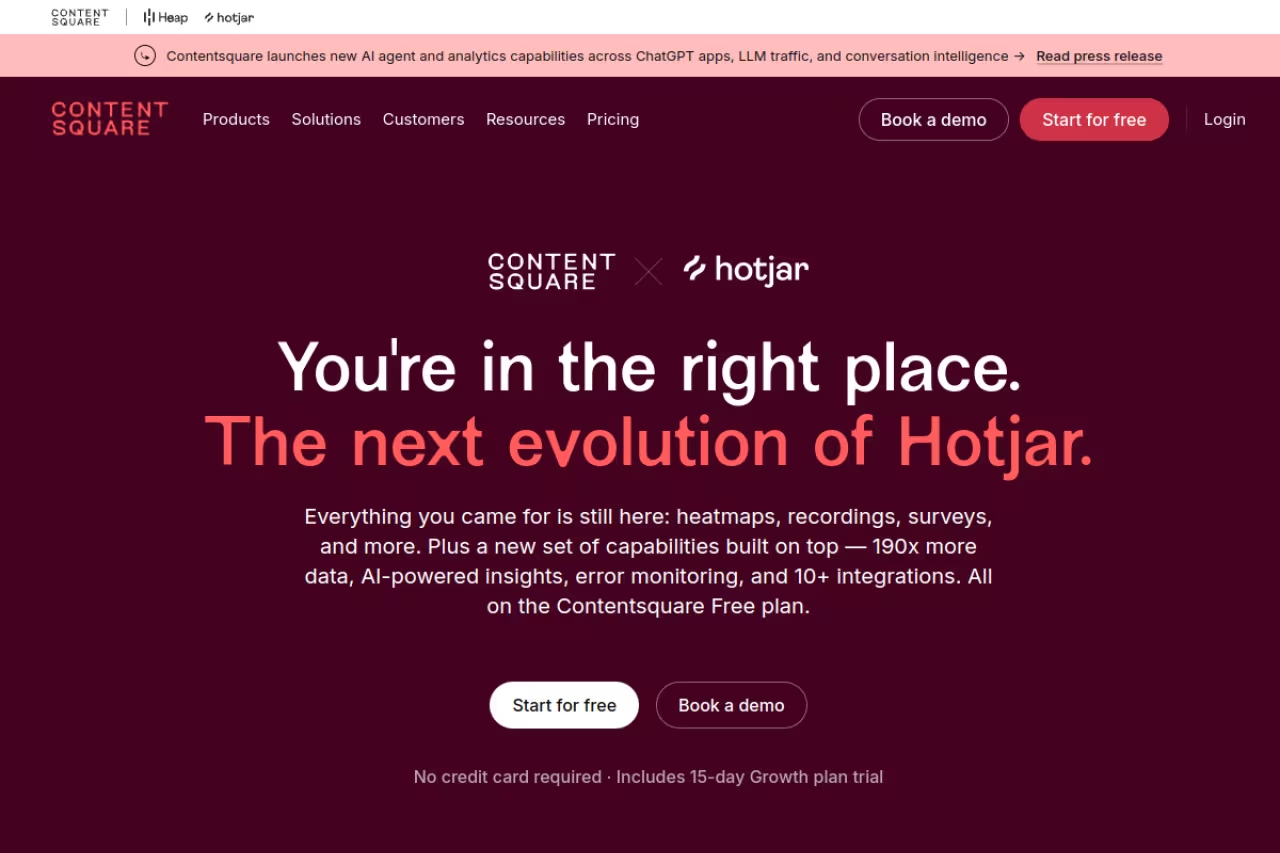
Hotjar built the category most people picture when they hear "heatmaps." In 2026 it is split into three products you buy separately or bundle: Observe (heatmaps and recordings), Ask (surveys and feedback widgets), and Engage (recruiting users for interviews). The feedback widgets are the real differentiator. You can drop a one-question poll on a checkout step and get qualitative answers Clarity simply does not collect.
Who it is for: teams that want to understand user intent and frustration, especially when you need direct feedback ("what stopped you from signing up today?") rather than just click data.
The behavior-research standard when you need direct user feedback, with widgets Clarity can't match. Plans are migrating to a unified Contentsquare platform, so expect the structure to change, and buying several products adds up.
Pricing: there is a permanent free Basic tier (Observe captures ~35 daily sessions, Ask allows 20 survey responses a month). Paid Observe runs $32/month (Plus), $80 (Business), and $171 (Scale) on annual billing, with a 20% discount when you bundle products, per the Hotjar pricing page.
The catch: Hotjar was acquired by Contentsquare, and through 2026 the separate Observe/Ask pricing is migrating to a unified Contentsquare platform with new Growth, Pro, and Enterprise tiers. If you sign up now, expect the plan structure under your feet to change. Buying multiple products also adds up quickly once you outgrow free.
If you are building a content or newsletter funnel and want a steady stream of what is working in growth, the Dupple X membership is where I pull a lot of this signal from.

Optimizely (the enterprise standard)
Optimizely is what large organizations run when experimentation is a company-wide discipline, not a side project. Beyond client-side A/B tests it does server-side and feature experimentation, so product and engineering teams can test code paths and roll out features behind flags, not just swap headlines. The statistical engine (Stats Engine) is built to reduce false positives at scale.
Who it is for: enterprises with a dedicated experimentation team, heavy traffic, and the budget to match. If "who owns CRO" has an answer at your company and that answer is a team of people, this is your tier.
The enterprise standard for teams running experimentation as a company-wide discipline, including server-side and feature tests. It is overkill for small teams, since it only pays off with dozens of meaningful tests a month.
Pricing: there is no public price, and it is not cheap. Standalone Web Experimentation generally runs $40,000 or more per year, climbing into six figures once you bundle personalization or feature experimentation, according to multiple buyer reports like Vendr's marketplace data. Pricing scales with MTUs, and exceeding your allocation triggers steep jumps.
Where it falls short: overkill for small teams, full stop. The setup, the contract negotiation, and the learning curve only pay off when you run dozens of meaningful tests a month. Below that volume you are renting a Formula 1 car to drive to the grocery store.

Mouseflow (the SMB friction finder)
Mouseflow quietly assembled one of the most complete behavior-analytics feature sets at small-business prices: session replay, seven heatmap types, funnels, form analytics, and feedback campaigns. Its signature feature is the automatic Friction Score, which rates every session for signs of user frustration (JavaScript errors, rage clicks, disruptive popups) so you can jump straight to the worst sessions instead of scrubbing through hundreds.
Who it is for: SMBs and lean growth teams that want more depth than Clarity's free tier but cannot justify VWO's testing budget yet.
An SMB friction finder with more depth than Clarity's free tier, built around an automatic Friction Score, from $31/month. Pricing is gated by sessions, and it doesn't run experiments, so you still need a testing tool.
Pricing: a free plan covers 500 sessions a month. Paid tiers run $31 (Starter, 5,000 sessions), $109 (Growth, 15,000), $219 (Business, 50,000), and $399 (Pro, 150,000) per month, with annual discounts, per Mouseflow's pricing.
The catch: pricing is gated by sessions, not features, so high-traffic sites burn through tiers fast. And like Clarity and Hotjar, Mouseflow shows you problems but does not run experiments, so you still need a testing tool to validate fixes.
Convert (the privacy-first tester)
Convert is the A/B testing platform I recommend when GDPR and ePrivacy compliance are non-negotiable. It uses only first-party cookies, is designed to avoid collecting personal data, and markets itself as flicker-free, which matters because the visual flash of a variant loading can itself tank your results. It runs classic A/B, multivariate, split-URL, and personalization campaigns.
Who it is for: EU-facing teams, agencies, and ecommerce stores that want serious experimentation without the enterprise lock-in or the privacy headaches that come with heavier platforms.
The privacy-first tester for EU-facing teams, agencies, and stores where GDPR compliance is non-negotiable, with flat pricing from $399/month. It is testing-focused, so pair it with a behavior tool, and the entry price rules out hobby projects.
Pricing: plans start at $399/month, with Growth (A/B plus behavioral targeting), Pro (adds multivariate and multi-page testing), and Enterprise tiers, per Convert's pricing page. It is transparent and flat, no surprise overage invoices.
Where it falls short: it is testing-focused, so you do not get Hotjar-style feedback widgets or Clarity's free heatmaps in the same place. You will likely pair it with a separate behavior tool. The $399 entry point also prices out hobby projects.

PostHog (the all-in-one for product teams)
PostHog is the developer-leaning option that folds product analytics, session replay, feature flags, and experiments into one platform. Its experimentation is tied to feature flags, so you define a hypothesis, pick a primary metric, run the test, and read statistical significance without stitching three tools together. For product-led companies, having behavior, funnels, and experiments in one schema is a real advantage.
Who it is for: SaaS and product-led teams comfortable with a more technical setup, and startups that want one bill instead of five.
The all-in-one for product teams, folding analytics, replay, feature flags, and experiments into one bill, with a generous free tier. It is built for product teams, not marketers, and setup and usage-based billing can feel heavy.
Pricing: the free tier is the most generous in the category, with 1M events, 5,000 recordings, and 1M feature flag requests a month, then usage-based pricing after, per PostHog's pricing. There is also an open-source self-hosted option.
The catch: it is built for product teams, not marketers. If your CRO work is mostly landing pages and you do not have engineering support, the setup and event-instrumentation overhead will feel heavy. Usage-based billing also gets unpredictable at scale if you do not watch your event volume.

Unbounce (the landing page specialist)
Unbounce is not a general analytics tool, it is a conversion-focused landing page builder, and that focus is the point. You build pages, popups, and sticky bars with a no-code editor, run A/B tests, and use Smart Traffic, an AI feature that routes each visitor to the variant most likely to convert them. Unbounce claims Smart Traffic delivers around a 30% average lift over traditional A/B testing.
Who it is for: marketers and agencies running paid campaigns who need high-converting standalone pages fast, without involving developers.
The landing page specialist for marketers and agencies running paid campaigns who need pages fast without developers, from $74/month. It only optimizes pages built in Unbounce, and Smart Traffic is locked behind the $187 Optimize plan.
Pricing: the Build plan is $74/month billed annually, Experiment is $112/month (unlimited A/B testing), and Optimize is $187/month (adds Smart Traffic), per Unbounce's pricing page. All plans include a 14-day trial.
Where it falls short: it optimizes the pages you build in Unbounce, not your whole site. If your conversion problem lives inside your app or your existing CMS, this does not help. Smart Traffic is also locked behind the higher Optimize plan.
How to choose
Pick based on the bottleneck in front of you, not the tool with the most features.
- You do not know why people leave. Start with Microsoft Clarity. It is free, installs in minutes, and shows you rage clicks and drop-offs. Add Hotjar or Mouseflow when you want surveys or friction scoring.
- You have enough traffic to test (roughly 1,000+ conversions a month). Move to VWO or Convert. You need real statistical power before A/B testing produces trustworthy results, so do not buy a testing tool before your traffic justifies it.
- You are a product-led SaaS. PostHog keeps analytics, flags, and experiments in one place and scales with you.
- You are enterprise with a dedicated team and budget. Optimizely is the standard.
- Your problem is specifically landing pages for paid ads. Unbounce is purpose-built for that and nothing else.
One rule that saves money: do not pay for testing capacity you cannot fill with statistically valid tests. Most teams should run free diagnostics first, find the real friction, and only then buy a testing platform sized to their traffic. If you want the same kind of curated signal on what is actually moving conversions across the AI and growth world, the Dupple X membership and our top tools roundup are built for exactly that. You can start a Dupple X trial here.
FAQ
What is the best free conversion rate optimization tool?
Microsoft Clarity is the strongest fully free option. It offers unlimited heatmaps, session recordings, rage-click detection, and an AI Copilot with no traffic caps. Pair it with Google Analytics 4 for conversion and funnel tracking, and you have a capable CRO stack at zero cost. The main limit is short data retention (about 30 days for recordings).
How much do conversion rate optimization tools cost?
It ranges from free to six figures. Microsoft Clarity and PostHog's free tier cost nothing. Behavior tools like Hotjar and Mouseflow start around $31 to $32/month. Dedicated testing platforms like VWO and Convert start in the $300 to $400/month range. Enterprise experimentation with Optimizely typically starts around $40,000 per year and scales with traffic.
Do I need both a testing tool and a heatmap tool?
Often, yes, because they answer different questions. Heatmap and session-recording tools (Clarity, Hotjar, Mouseflow) show you where and why users struggle. A/B testing tools (VWO, Convert, Optimizely) tell you which fix actually wins. VWO and PostHog bundle both, which is why they are popular for teams that want one platform instead of two subscriptions.
How much traffic do I need before A/B testing is worth it?
As a rough rule, you want at least a few hundred to a thousand conversions per variant per month to reach statistical significance in a reasonable timeframe. Below that, tests take months to conclude and results are easily distorted by noise. If your traffic is low, focus on qualitative tools and obvious friction fixes first, and hold off on a paid testing platform.
Is Hotjar still worth it after the Contentsquare acquisition?
For now, yes, especially for its free tier and feedback widgets. Hotjar's Observe and Ask products still work as before, but the pricing and plan structure are migrating to a unified Contentsquare platform through 2026. If you adopt it, expect plan changes and review your subscription when the migration reaches your account.
Related guides
Some offers on this page may be paid placements or contain affiliate links.
Across our whole catalogue the median is $24 a month and 33% of tools advertise a free tier. Figures are the lowest recurring monthly price quoted in our own review of each tool, read on 2026-08-19. Full method and every category.
