
Best AI Content Detectors in 2026: Compared and Ranked

Key facts7 tools compared: Originality.ai, GPTZero, Copyleaks, Winston AI, Turnitin, Sapling, GPTZero…
- 7 tools compared: Originality.ai, GPTZero, Copyleaks, Winston AI, Turnitin, Sapling, GPTZero (free) vs ZeroGPT
- Originality.ai (best for: Publishers and editors): From $14.95/mo
- GPTZero (best for: Free use and educators): Free (10k words/mo)
- Copyleaks (best for: Enterprise and multilingual): From ~$10.99/mo
- Winston AI (best for: Agencies and teams): From $18/mo
Every AI detector on the market will tell you it's 99% accurate. Almost none of them are, and the gap between the marketing number and the real-world number is where people get burned. A teacher fails a student over a false positive. An editor rejects a legitimate writer. A marketer ships "humanized" slop because the detector they trusted waved it through.
This guide compares the major detectors against the kind of texts they need to tell apart: raw GPT-5 output, raw Claude output, lightly edited AI drafts, and genuinely human-written essays. Published benchmarks and independent testing show the results are all over the place. Some tools nail the AI samples and stay calm on the human ones. Others flag old, human-written writing as machine-made.
If you just want the answer: Originality.ai is the most accurate paid option available, and GPTZero is the best free tier worth using. Below is the full ranking with real pricing, the numbers that actually matter, and where each one falls down. This is for editors, educators, marketers, and anyone who needs to know whether a piece of text came from a person or a model.
Quick comparison
| Tool | Best for | Price | Standout |
|---|---|---|---|
| Originality.ai | Publishers and editors | From $14.95/mo | Highest accuracy on paraphrased text |
| GPTZero | Free use and educators | Free (10k words/mo) | Sentence-level highlighting |
| Copyleaks | Enterprise and multilingual | From ~$10.99/mo | 30+ language coverage |
| Winston AI | Agencies and teams | From $18/mo | Per-word credit clarity |
| Turnitin | Schools and universities | Institutional license | Integrated into LMS grading |
| Sapling | Quick free spot-checks | Free (2k chars) | No signup to test |
| GPTZero (free) vs ZeroGPT | Budget, no account | Free | Unlimited basic scans |

Originality.ai: the one editors should pay for
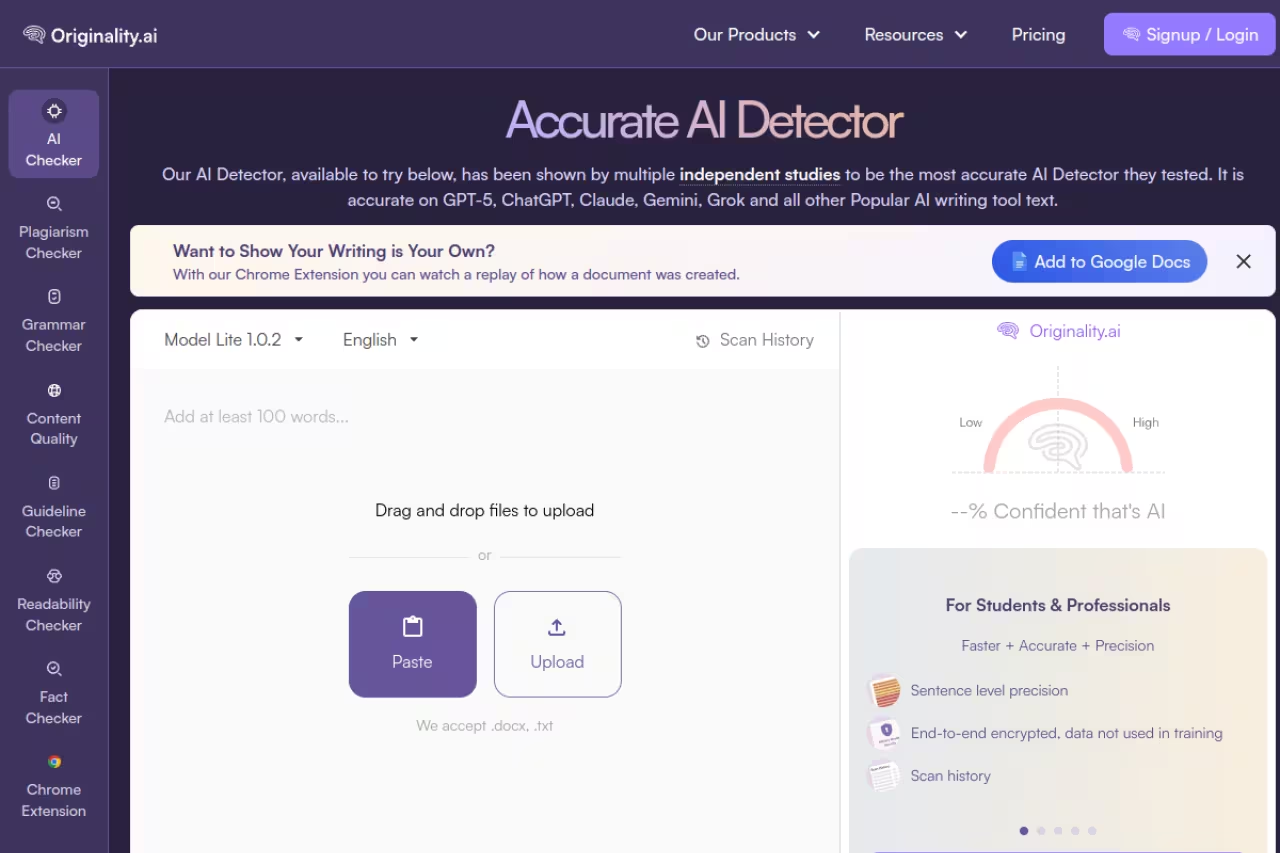
Originality.ai is built for people who publish for a living, and it shows. It's one of the only tools that stays accurate on paraphrased and lightly edited AI text, which is exactly the content most detectors miss. In independent benchmarks it consistently lands at the top: the RAID evaluation and several head-to-head studies put it around 96 to 97% accuracy on adversarial and paraphrased samples, well ahead of the pack.
Who it's best for: content teams, SEO agencies, and editors checking freelance submissions at volume. The plagiarism checker, fact checker, and readability scoring in the same scan make it a genuine editorial workflow tool, not just a yes/no detector.
The detector for people who publish for a living, staying accurate on paraphrased text (96 to 97% in independent benchmarks) and bundling plagiarism and fact checks. It leans toward flagging, so expect false positives on clean human writing, and the credit model is stingy at volume.
the Pro plan is $14.95/month ($12.95 if you pay annually) for 2,000 credits, where one credit covers 100 words. There's a $30 pay-as-you-go option with 3,000 credits that don't expire for two years, which suits occasional users. API access lives on the $179/month Enterprise plan. Pricing is confirmed on their pricing page.
The catch: the credit model is stingy if you scan long-form constantly. 2,000 credits is roughly 200,000 words a month, which sounds like a lot until you're checking a content team's full output. It also leans toward flagging, so it can produce false positives on human writing that happens to be clean and structured. Always read the sentence breakdown before you act on a score.

GPTZero: the best free detector, and a solid paid one
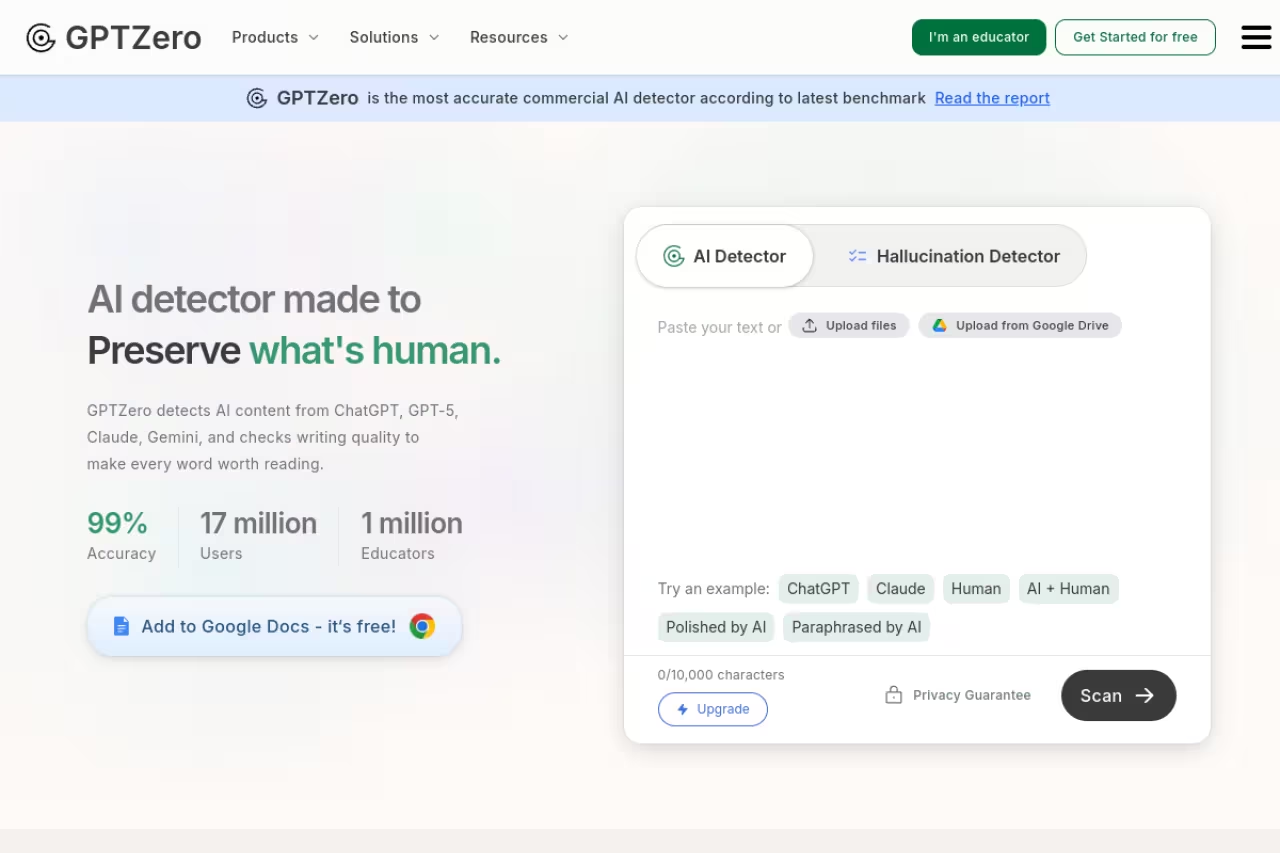
GPTZero started as a college student's side project to catch ChatGPT essays and grew into the detector with over 10 million users, mostly teachers and students. Its free tier is the most generous worth recommending: 10,000 words per month of basic scanning plus a handful of advanced scans, no payment required.
Who it's best for: educators, students checking their own work before submission, and anyone who needs a reliable free option. The sentence-level highlighting is the standout feature. Instead of one verdict for a whole document, it color-codes which passages read as AI, which makes it far more useful for a conversation with a writer or a student.
The best free detector, and a solid paid one for educators, students and anyone who wants a reliable no-cost option. Sentence-level highlighting is the standout, but like every detector its accuracy drops once a human edits the AI text.
free for 10,000 words/month. The Individual plan runs about $14.99/month (roughly $9.99 billed annually), and the Professional plan around $23.99/month adds API access and reporting. GPTZero claims around 99% accuracy on pure AI text, validated by Penn State's AI research lab. It scores about 95.7% on the RAID benchmark for newer GPT content.
The catch: like every detector, accuracy drops once a human edits the AI text even a little. It's strong on unedited model output and weaker on the hybrid drafts most people actually produce. Treat the score as evidence, never proof.

Copyleaks: the enterprise and multilingual pick
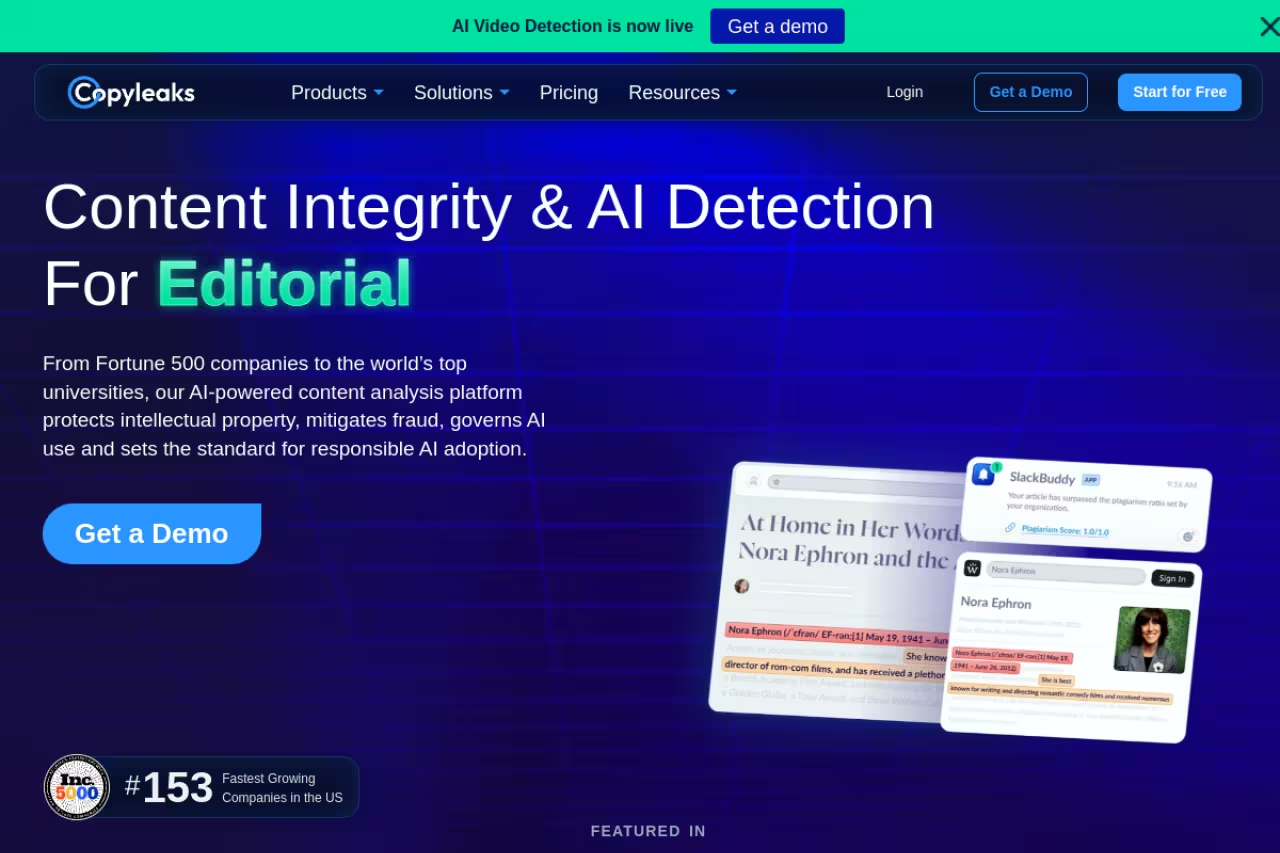
Copyleaks is the detector enterprises and universities tend to land on, partly because it covers more than 30 languages and partly because it slots into LMS and workflow integrations that the smaller tools don't offer. It pairs AI detection with one of the better plagiarism engines on the market.
Who it's best for: organizations that need detection at scale, in multiple languages, with audit trails and API access. If your content isn't only in English, this is the one to look at first.
The enterprise and multilingual choice, covering more than 30 languages with LMS integrations and a strong plagiarism engine. Do not trust the 99%+ headline, since independent testing puts English accuracy closer to 79 to 91%.
personal plans start around $10.99/month with monthly page quotas, scaling up through business and enterprise tiers. A free tier covers roughly 10 pages a month so you can test it.
The catch: the accuracy gap between the marketing and reality is wide here. Copyleaks advertises 99%+ accuracy with a sub-0.2% false positive rate, but independent testing on thousands of samples puts real English accuracy closer to 79 to 91% with false positive rates in the 6 to 12% range. For non-English text, accuracy can drop into the mid-70s. It's capable, but do not trust the headline number.

Winston AI: clean credits for teams
Winston AI is aimed at agencies and content teams that want detection plus plagiarism checking with a transparent credit system. One word costs one credit for AI detection and two credits for plagiarism, which makes budgeting predictable in a way the vaguer "scans per month" pricing doesn't.
Who it's best for: agencies managing multiple writers, and teams that want HUMN-1 certification to vouch for human-written content to clients.
A fit for agencies and content teams that want predictable budgeting from a transparent credit system plus HUMN-1 certification for clients. Accuracy is good but not class-leading, and plagiarism checks burn credits at 2x.
a free 14-day trial with 2,000 credits, then Essential at $18/month for 80,000 credits, Advanced at $29/month for 200,000, and Elite at $49/month for 500,000. It supports detection across ChatGPT, Claude, Gemini, Llama and Jasper output.
Where it falls short: Winston is loud about "free AI detectors being obsolete," which is marketing more than fact given how well GPTZero's free tier performs. Its own accuracy is good but not class-leading, and the credit burn on plagiarism checks (2x) adds up faster than you'd expect.
Turnitin: the academic standard, with a serious flaw
Turnitin is the detector built into most universities' grading systems, so for a lot of educators it's not really a choice. It's already there inside the LMS. On unedited GPT-4 and Claude output in an academic register, it detects in the 90 to 95% range, which is respectable.
Who it's best for: institutions that already license it. The integration into existing assignment workflows is the entire value proposition.
The academic standard, already built into most universities' grading systems, so for many educators it is not really a choice. Its AI score shows documented bias against non-native English speakers, and Turnitin itself advises against using it as the sole basis for a penalty.
institutional licensing only, negotiated per school. There's no consumer plan.
Where it falls short: the bias problem is real and documented. A Stanford-linked study found detectors like this flag a high share of non-native English speakers' essays as AI-generated, with one analysis putting it above 60% for that group. Turnitin itself now advises against using the AI score as the sole basis for an academic penalty, which tells you how much weight to put on it.
If you're building content workflows rather than grading papers, a faster way to stay ahead of what these models can and can't do is to follow the space directly. Our Dupple X newsletter tracks the AI tools that matter each week so you're not guessing.
Sapling: fine for a free spot-check, not for decisions
Sapling is worth knowing about because it lets you test 2,000 characters with no signup, which is handy for a quick gut-check. It markets a 97%+ detection rate.
Who it's best for: a fast, no-account spot-check when you just want a second opinion on a short passage.
Fine for a free, no-signup spot-check of a short passage, but not for anything you would defend in a dispute. Independent testing found a base detection rate around 66%, and light editing dropped it below 30%.
free tier of 2,000 characters per query, with paid and API plans above that.
Where it falls short: independent testing has been unkind. Reviewers found a base detection rate around 66%, meaning roughly a third of AI content sailed through untouched, and even light manual editing dropped detection below 30%. It's fine for a glance, not for anything you'd defend in a dispute.
Free options: GPTZero vs ZeroGPT
If you refuse to pay anything, the honest answer is that GPTZero's free tier beats the unverified free tools. ZeroGPT offers unlimited free scans and lands around 85% accuracy in some tests, which is usable for casual checks. But it has no documented validation behind it the way GPTZero does, and its false positive behavior is unpredictable. For free use, start with GPTZero's 10,000 words a month, and only reach for ZeroGPT when you've blown through that cap.
Start with GPTZero if you refuse to pay, because its 10,000 free words a month come with documented validation behind them. ZeroGPT offers unlimited scans, but its accuracy is unverified and its false positives are unpredictable.
How to choose
Skip the accuracy claims on the websites. Every vendor cites a 97 to 99% number, and every independent test comes back lower. Here's the framework I'd actually use:
- You publish content for clients or a brand: pay for Originality.ai. The paraphrase resistance and the editorial extras justify the cost, and a single missed AI article can cost you more than a year of the subscription.
- You teach or grade: use what your institution provides (likely Turnitin), but never let the score alone decide a case. Cross-check flagged work in GPTZero's sentence view and talk to the student.
- You need multiple languages or enterprise scale: Copyleaks, with the false-positive caveat front of mind.
- You just need a free, trustworthy check: GPTZero. Full stop.
- You're an agency budgeting per word: Winston AI's credit model is the most transparent.
The deeper rule: no detector is proof. Run anything important through two tools, read the sentence-level breakdown rather than the top-line score, and treat a flag as a reason to look closer, not a verdict. If you're choosing tools for a broader workflow, our roundups of the best AI writing tools and the best AI detection tools go deeper on adjacent picks, and the full top AI tools directory is worth a browse.
FAQ
What is the most accurate AI content detector in 2026?
In independent, adversarial testing, Originality.ai is the most accurate paid detector, landing around 96 to 97% on paraphrased and edited AI text where most tools fail. GPTZero is close behind on pure AI output, scoring around 99% on unedited model text and offering the best free tier. No detector is reliable enough to be treated as proof on its own.
Can AI content detectors be wrong?
Yes, frequently. Real-world accuracy across independent tests runs roughly 76 to 95%, well below the 99% vendor claims. False positives are the bigger danger: human-written text, especially from non-native English speakers, gets flagged as AI at meaningful rates. Always read the sentence-level breakdown and confirm with a second tool before acting on a result.
Are free AI detectors good enough?
For casual use, GPTZero's free tier (10,000 words a month) is genuinely reliable and outperforms most unverified free tools. ZeroGPT is a decent unlimited backup. But free tools generally struggle more with edited or paraphrased AI text, so for professional or high-stakes checks a paid detector like Originality.ai is worth it.
Why does AI-generated text sometimes pass detection?
Detectors look for statistical patterns typical of language models, like low variation in sentence structure. Once a human edits the text, paraphrases it, or runs it through a "humanizer" tool, those patterns break down and detection accuracy drops sharply, often below 50% even on tools that nail raw output. This is why no single scan should be treated as definitive. For the free-plan limits of seven humanizers, including daily caps and the cheapest paid tier, see best free AI humanizers.
Do AI detectors work on GPT-5 and Claude output?
The best ones do, on unedited output. GPTZero, Originality.ai and Copyleaks all updated their models to catch GPT-5, Claude and Gemini text, and score well on raw samples. The weak spot remains hybrid content where a person has edited the AI draft, which no detector handles reliably yet.
Detection is a moving target, and the tools shift every month as new models ship. If staying current on AI tools is part of your job, Dupple X does the tracking for you so you're not auditing detector accuracy yourself every quarter.
Related guides
Some offers on this page may be paid placements or contain affiliate links.
