

Last updated: May 2026
What Is Volza?
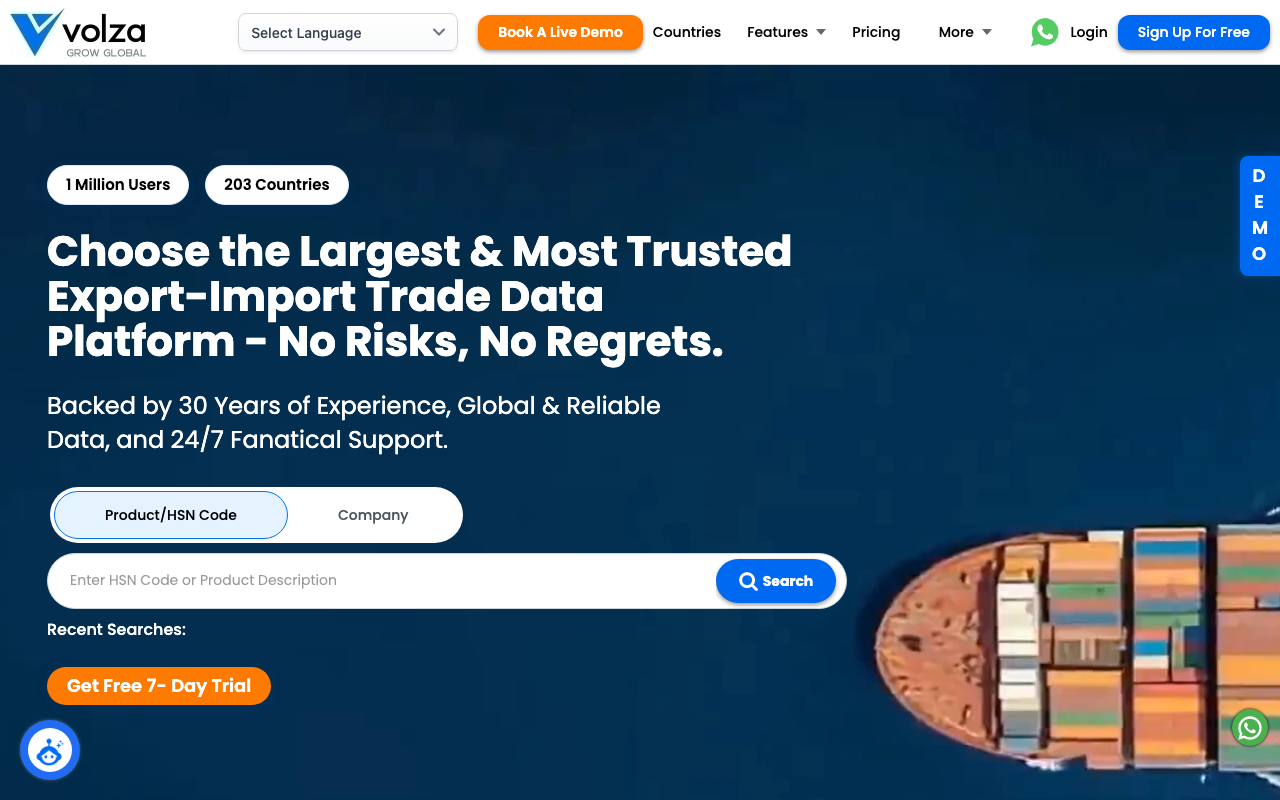
Volza is the import/export trade data platform that aggregates shipment-level customs records from 80+ countries to help businesses find suppliers, identify buyers, and analyze international trade flows. The product covers over 7 billion shipment records globally.
The pitch is sales intelligence for international trade. Exporters use Volza to identify potential buyers in target markets. Importers use it to find suppliers and benchmark prices. Trading houses use it to understand commodity flows. The data comes from public customs records that countries make available with varying lag times.
The product competes with ImportGenius, Panjiva (S&P Global), TradeAtlas, and similar trade data platforms. Volza positions on global coverage and self-serve pricing transparency where competitors are often opaque and enterprise-only.
Try VolzaHow Volza Works
Search by HS code (Harmonized System product code), product description, importer/exporter name, country, or port. Volza returns matching shipment records with details: parties involved, product description, quantity, value, port, date, container info.
Filter results to narrow down to specific markets or competitors. See who imports a specific product into the US, what volumes, at what frequency. Identify the top 10 suppliers in a category or the largest buyers in a region.
Export records to CSV for analysis in your tools. Some teams build CRM contact lists from importer records; others use the data for pricing benchmarks or market sizing.
The Trade Intelligence layer adds analytics: top trade lanes, country-level imports/exports trends, growing and declining product categories. Useful for strategic planning rather than tactical sales prospecting.
Subscription tiers vary access depth. Lower tiers cover specific countries or product categories; higher tiers offer global access.
Volza Pricing in 2026
Tiered annual subscriptions.
Starter: $1,500-$3,000/year. Limited country and product coverage.
Professional: $5,000-$8,000/year. Broader country coverage, more searches, analytics layer.
Enterprise: $15,000-$25,000+/year. Full global coverage, API access, dedicated support.
Pricing is more transparent than competitors but still varies significantly by use case. Sales call typical for accurate quotes.
Get Volza PricingWhere Volza Wins
- Global coverage: 80+ countries, broader than many US-centric competitors.
- Shipment-level detail: actual transaction records, not aggregated stats.
- Analytics layer: trade lane analysis and trends beyond raw records.
- Reasonable self-serve entry: Starter tier accessible to SMBs.
Where It Falls Short
- Data lag varies by country: some countries report monthly, others quarterly, some annually.
- Data accuracy varies: customs records have inherent uncertainty (anti-dumping rules, freight forwarders as record holders, etc.).
- Pricing climbs for global access: enterprise tiers reach $25K+/year.
- Sales-led purchase process: not fully self-serve.
Volza vs ImportGenius vs Panjiva vs TradeAtlas
ImportGenius targets US imports primarily. Better US data, smaller global coverage.
Panjiva (S&P Global) is the enterprise leader with deepest data but enterprise-only pricing.
TradeAtlas covers Europe deeper. Pick TradeAtlas for European-focused operations.
Datamyne targets specific regional and product depths.
Who Should Use Volza
Exporters identifying buyers in new markets: shipment data reveals who is buying what.
Importers finding suppliers: see who exports specific products and at what volumes.
Trading houses analyzing commodity flows: market intelligence beyond pricing data.
Skip it if: you sell only domestically (no international trade), need US-only data (ImportGenius is cheaper), or have enterprise budget for Panjiva.
Frequently Asked Questions
How fresh is the data?
Country-dependent. US data 30-60 days lag; some countries 90+ days; India publishes near-real-time.
Can I export data?
Yes via CSV on most plans.
What countries are covered?
80+ including US, EU members, India, Brazil, Vietnam, Thailand, Indonesia, and more.
Is there an API?
Yes on Enterprise tier.
Can I use this for ABM?
Yes. Identify importing companies, find decision-makers separately, build account lists.