Last updated: April 2026
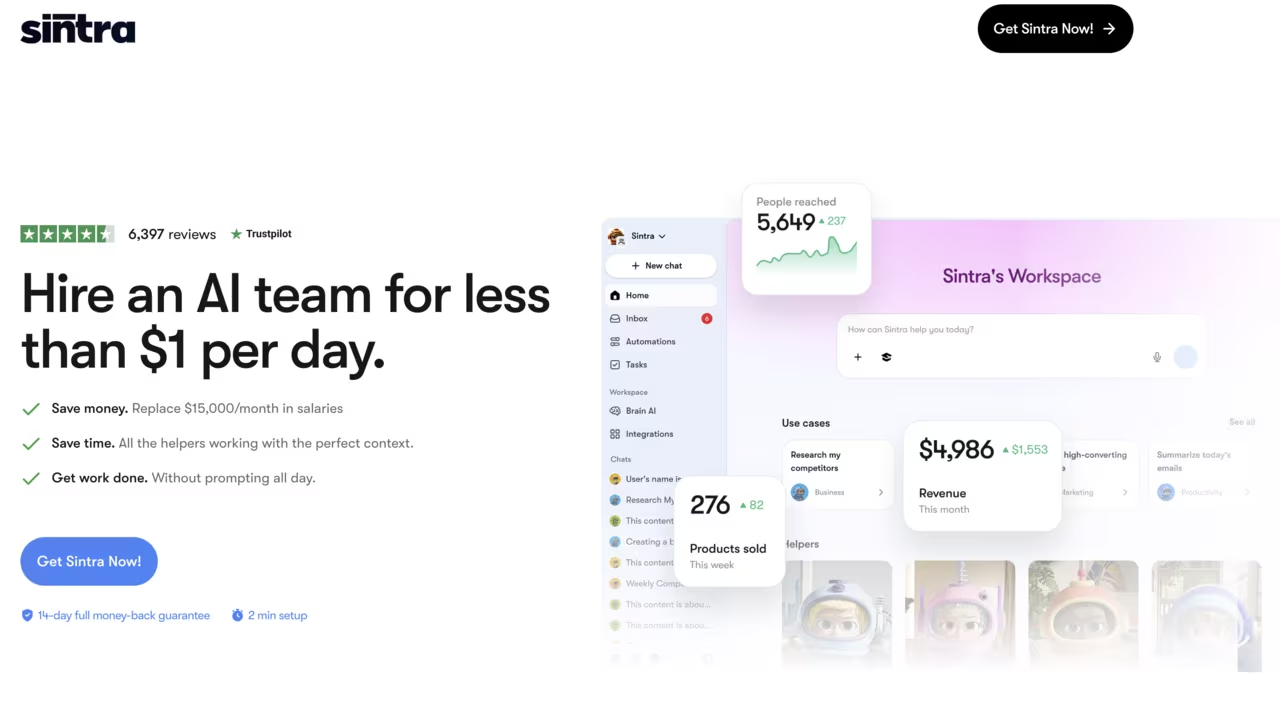
Sintra sells you an AI staff rather than an AI tool. You get twelve named "Helpers," each aimed at a specific business function, plus a shared memory layer the company calls Brain AI. For a solopreneur running a Shopify store, a coach with a mailing list, or a two-person marketing agency, that framing actually makes buying easier. You stop shopping for ChatGPT wrappers and start thinking in terms of who handles your social, who handles your support, and who writes your newsletters.
The pitch sounds gimmicky until you use it. Once you realise "ask Soshie to plan next week's Instagram grid" is faster than "open ChatGPT, paste a 400-word system prompt, remember what brand tone you agreed on last week," the personas earn their keep.
The Twelve Helpers, in Plain English
Each Helper is a specialised assistant with its own personality and a library of Use Cases (one-click workflows tailored to its job). The full lineup:
- Soshie: social media planning, captions, grid layouts
- Penn: blog posts and long-form copy
- Emmie: email marketing, subject lines, campaigns
- Seomi: SEO research, keyword clusters, meta descriptions
- Cassie: customer support replies and macros
- Milli: sales messaging, cold outreach, proposals
- Dexter: data analysis and reporting summaries
- Buddy: business strategy and planning
- Vizzy: admin, scheduling, meeting prep
- Scouty: recruiting, job descriptions, candidate screening
- Gigi: graphic design, visuals, ad creatives
- Commet: web building , landing pages, sites, on-page conversion
You don't pick one Helper. Every plan gives you access to all twelve. The personas are a UI choice, not a pricing tier.
Brain AI: Why This Feels Different From ChatGPT
The part that separates Sintra from "I could just build this in ChatGPT" is Brain AI. It is a persistent memory layer where you train your team on your brand: tone of voice, product catalogue, ideal customer profile, competitor list, past campaigns. Every Helper pulls from it.
The practical result: when Soshie writes an Instagram caption, it sounds like your brand instead of generic AI output. When Cassie drafts a support reply, she knows your refund policy. When Penn writes a blog intro, it fits the editorial style you've built. You set the brand context once, not every session.
Is this revolutionary? No. You could replicate a chunk of it with ChatGPT Projects or Claude Projects. What Sintra sells you is the packaging: guided setup, templates, and the team metaphor so non-technical users don't give up during onboarding.
Use Cases: The Actual Time-Saver
Each Helper ships with a library of Use Cases , pre-built workflows triggered with one click and a couple of fields. Examples: "Write 30 days of social posts from these 5 topics," "Turn this podcast transcript into 10 LinkedIn carousel slides," "Draft a 5-email welcome sequence for this lead magnet," "Summarise this customer support transcript and flag churn risk."
You pick a Use Case, fill in two or three fields, and get an output. For someone who doesn't want to learn prompt engineering, this is the whole product. The quality of those workflows is Sintra's actual competitive moat, not the chat interface.
What You Actually Pay
Sintra consolidated its pricing. One plan, three payment cadences:
- Monthly: $97/month
- Quarterly (3-month prepay): $177 total, roughly $59/month
- Annual (12-month prepay): $624 total, roughly $54/month
Every plan includes all 12 Helpers, unlimited workspaces, integrations with Shopify, Slack, Gmail, HubSpot, Zapier and a growing list of others, plus 250 monthly credits. Credits reset each month regardless of which billing cadence you picked. A 14-day money-back guarantee covers the first term.
The 250-credit allowance is the clause to read carefully. Basic chat and most text generation don't consume credits. Heavier actions (image generation, long-running automations, certain Use Cases) do. If you run a content-heavy operation or use image generation daily, you will hit the ceiling and need credit top-ups, which are priced per pack. Sintra does not publish those rates prominently, which is a mild annoyance.
Promo: use DUPPLE70 at checkout for the Dupple reader discount on any plan.
Where Sintra Delivers
- Zero prompt-engineering required: Use Cases turn "I don't know what to ask ChatGPT" into clickable workflows. For non-technical founders this is the whole value proposition.
- Real brand memory: Brain AI beats vanilla ChatGPT on tone consistency once you've spent 30 minutes setting it up. Outputs stop sounding like AI.
- Multilingual out of the box: The Helpers handle 100+ languages. Useful if you run stores in several countries.
- Consolidates subscriptions: A small business replacing Jasper, a VA retainer, and a social scheduling tool can come out ahead even at $97/month.
Where It Falls Short
- The 250-credit cap bites faster than you'd expect: Heavy users burn through credits by mid-month. Top-up pricing is opaque until you hit the wall.
- Helper overlap: Penn, Emmie, and Soshie all write copy. In practice you end up using two or three Helpers constantly and ignoring the rest. Twelve is marketing, not utility.
- Not true automation: Despite the "AI employee" branding, Helpers don't run autonomously. You initiate each task. If you expected agents that monitor your inbox and reply without you, adjust expectations.
- No per-Helper pricing: If you only need one persona you are still paying the full $97/month, $59/month, or $54/month. There's no solopreneur-lite tier now that the Individual Helper plan has been retired.
How It Compares
Sintra competes with two kinds of products. Against ChatGPT Plus and Claude Pro at $20/month, Sintra costs roughly 3-5x more but saves you the work of building your own prompt library and brand context. Worth it if your time is worth more than the delta.
Against specialised tools (Jasper for copy, Buffer for social, Intercom Fin for support), Sintra is broader and lighter. You trade the depth of any single tool for the convenience of one dashboard. For a sub-10-person business this trade is usually right. Past that size, specialists win.
The most honest alternative comparison: Lindy and Relevance AI build custom AI agents that actually run tasks on a schedule. Sintra does not. If you need true automation, look there.
Who Should Buy Sintra
Buy it if you are: a solo founder or 2-5 person team, you do your own marketing and support, you want AI help but don't want to build prompts, and you run a business where brand consistency matters (e-commerce, coaching, agency, creator). The 14-day money back lets you test this honestly.
Skip it if you are: a single heavy ChatGPT power user who already has prompt libraries, a mid-market company with specialised teams, or anyone expecting autonomous agents rather than assistants you trigger.
The Verdict
Sintra is a sharp product pretending to be revolutionary. The 12-Helpers framing is a marketing wrapper around a solid prompt-library-plus-brand-memory system. But the wrapper works. It converts "AI is too complicated" into "click Soshie and you get a social post," which is genuinely the gap most small business owners need filled.
The $54-$97/month range is fair for what you get, especially if you would otherwise pay for Jasper plus Buffer plus a VA. The 250-credit ceiling is the one real friction point to watch. Start with the monthly plan, stress-test your credit usage for two weeks, then decide whether to commit to the annual deal for the 44% discount.
Start Your Sintra Trial