Last updated: April 2026
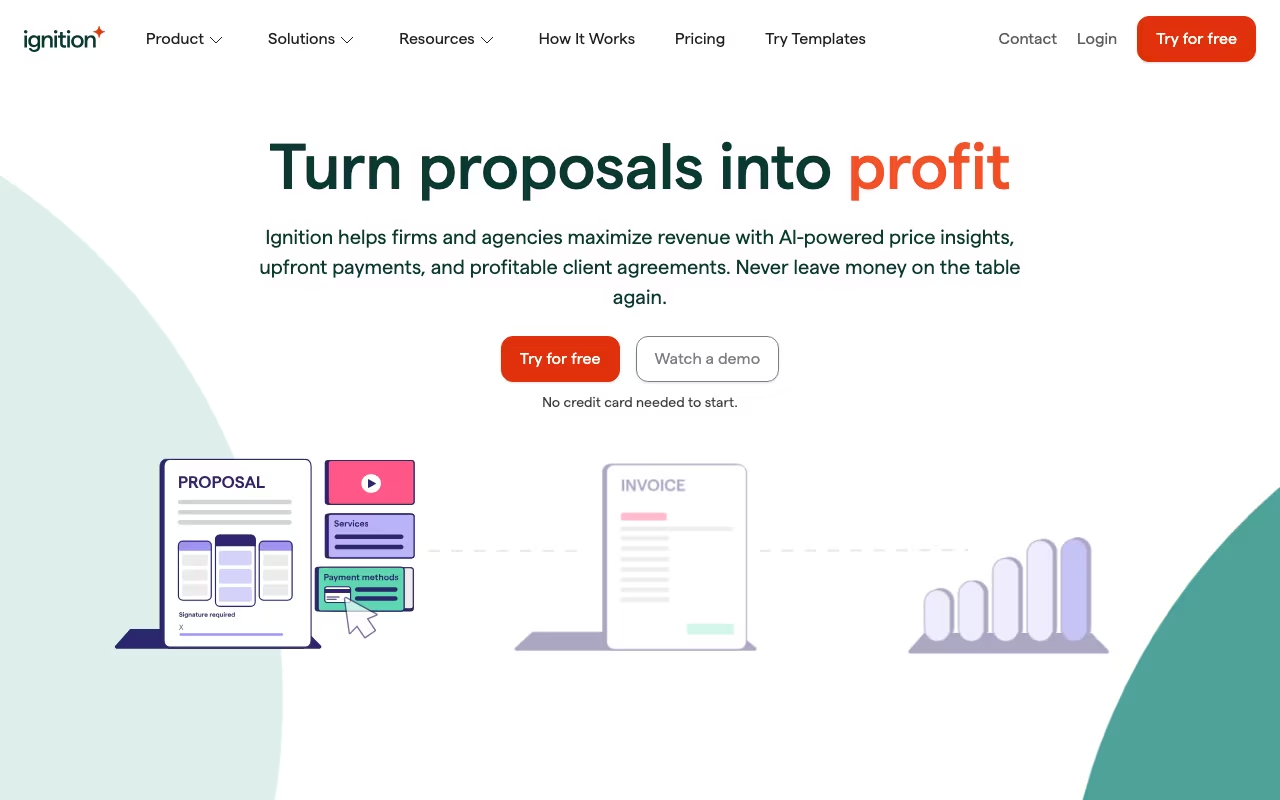
If you run an accounting firm, you know the cycle: spend an hour writing a proposal, email it as a PDF, wait for the client to print, sign, scan, and email it back. Then send an invoice. Then follow up when they don't pay. Then follow up again. Ignition (formerly Practice Ignition) collapses that entire process into a single flow. The client receives your proposal, e-signs it, enters their payment method, and from that moment forward, Ignition bills them automatically on schedule. No invoices to send. No follow-ups to chase. The platform reports a 91% auto-collection rate across its user base.
I tested Ignition with a mock accounting practice workflow. From template to client-ready proposal took 8 minutes. The client-facing experience is clean: they see the scope of work, pricing, engagement letter, and payment form on one page. One click to accept. The whole interaction feels more professional than emailing a Word document.
Try Ignition Free Get started →The Proposal Builder
Ignition starts with about 25 industry-specific templates covering tax preparation, bookkeeping, advisory, audit, and general consulting. Pick a template, customize the scope of work, add your pricing (fixed fee, hourly, or recurring), and embed your engagement letter. The pricing section supports line items with optional add-ons that clients can select themselves, like adding payroll management to a bookkeeping package.
What makes this different from PandaDoc or Proposify: the engagement letter and payment collection are built into the same flow. In PandaDoc, you send a proposal, get it signed, then separately invoice through QuickBooks or Xero. In Ignition, the client signs and enters their credit card or ACH details in the same action. The moment they accept, billing starts automatically.
For recurring services like monthly bookkeeping, this is where Ignition pays for itself. You set the billing schedule once. The client gets charged every month. No manual invoicing, no payment reminders, no awkward conversations. I've talked to firm owners who say they recovered 5-15 hours per week just from eliminating invoice chasing.
Bulk Renewals and Price Increases
Every year, accounting firms need to renew client engagements and adjust pricing. Doing this manually for 100+ clients is painful. Ignition's bulk renewal feature lets you select all clients on a specific service, apply a percentage price increase (say 5%), and send renewed proposals in one batch. Clients receive a clean renewal email, review the updated scope and pricing, and accept with one click.
The "Instant Bill" feature handles out-of-scope work. Client asks for something not in the original engagement? Create an instant bill from the Ignition dashboard, send it, and the client's stored payment method gets charged upon approval. No new proposal needed, no payment details to re-enter.
AI Price Insights
The AI Price Insights add-on ($349/year) is unique in the market. It benchmarks your service pricing against anonymized data from thousands of other firms on the Ignition platform. You can see whether your monthly bookkeeping fee of $800 is above or below the median for firms of your size in your region. Whether your tax prep pricing is competitive. Whether you're leaving money on the table on advisory services.
This kind of benchmarking data is normally locked behind expensive industry surveys or consulting engagements. At $349/year, it's accessible to small firms. The catch: the data is only as good as the firms using Ignition. If your niche or region has few Ignition users, the benchmarks may not be representative.
See Ignition Pricing See plans →Pricing and Transaction Fees
- Solo ($49/month): 1 user, 20 active clients. Proposals, e-signatures, automated payments, basic workflows.
- Core ($149/month): 3 users, 50 active clients. Zapier integration, advanced workflow automations, payment scheduling.
- Pro ($279/month): 13 users, 350 active clients. Custom domain branding on proposals, advanced reporting, API access.
- Pro+ ($499/month): Unlimited users, 600 active clients. Everything in Pro plus dedicated account management.
Annual billing saves up to 30%. There's also a transaction fee: 1% + $0.30 per payment, capped at $5 per transaction, plus 0.3% on amounts above $3,000. For a firm collecting $50,000/month in client payments, the transaction fees alone are $150-200/month. Factor this into your cost calculation. For some high-volume firms, the transaction fees exceed the subscription cost.
Integrations That Matter for Accountants
Native integrations: Xero, QuickBooks Online, MYOB, Sage, Gusto (payroll), Karbon (practice management), Slack, Financial Cents, Xero Practice Manager, Practice CS, ProConnect, UltraTax CS, CCH Axcess, Onvio. When a client accepts a proposal, Ignition can automatically create the client in your accounting software, set up recurring invoices, and sync payment data.
Via Zapier (4,000+ apps): HubSpot, Salesforce, Asana, Mailchimp, Calendly, TaxDome, Canopy, Trello. The Zapier connection opens up workflow possibilities like: client accepts proposal > create project in Asana > send welcome email via Mailchimp > schedule onboarding call via Calendly.
What Frustrates Ignition Users
- Transaction fees compound: The 1% + $0.30 adds up fast for firms processing high-value payments. A $10,000 monthly retainer costs $100.30 in fees per year just for that one client. Some firms find this exceeds the subscription cost, especially on the Solo plan.
- Template library is thin: 25 templates sounds like enough until you have a niche practice (forensic accounting, nonprofit audit, cannabis industry compliance). You'll likely build custom proposals from scratch for specialized services.
- Custom branding costs $279/month: Using your own domain on the proposal URL (proposals.yourfirm.com instead of app.ignitionapp.com) requires the Pro plan. For a 3-person firm, that's a steep premium for a vanity URL.
- Client active limits feel arbitrary: 20 active clients on the $49 Solo plan is tight for even a small practice. If you have 25 recurring clients, you're forced to Core at $149/month. The jump from $49 to $149 is steep for just 5 more clients.
Ignition vs. PandaDoc vs. HoneyBook
Finance tools, published pricing
| Tool | Pricing | Model |
|---|---|---|
| Ignition | $49/mo (Solo), $149/mo (Core), $279/mo (Pro), $499/mo (Pro+) | Paid |
| Xero | $15/mo (Early), $42/mo (Growing), $78/mo (Established) | Subscription |
| Aplos | $59/mo (Lite), $99/mo (Core), $189/mo (Advanced) | Subscription |
| Heard | $149/mo (lowest published recurring price) | Subscription |
| Aspire | $200/mo (lowest published recurring price) | Subscription |
| Compliancely | $200/mo (lowest published recurring price) | Subscription |
Ignition vs. PandaDoc: PandaDoc ($35/month) is a better general-purpose proposal tool with more templates, better document design, and content library features. Ignition is better for accounting firms specifically because of the engagement letter integration, automated billing, and accounting software connections. PandaDoc if you're a marketing agency. Ignition if you're a CPA firm.
Ignition vs. HoneyBook: HoneyBook ($19/month) covers proposals, contracts, invoicing, and scheduling for creative professionals. Cheaper than Ignition but lacks the accounting-specific features: engagement letters, Xero/QBO sync, tax software integrations, and the AI pricing benchmarks. HoneyBook for photographers and designers. Ignition for accountants and bookkeepers.
Ignition vs. GoProposal: GoProposal is the closest competitor in the accounting space. It focuses on pricing standardization and proposal generation for accounting firms. Ignition adds automated payment collection and a broader integration ecosystem. GoProposal if pricing strategy is your main problem. Ignition if you want proposal-to-payment automation end to end.
Ignition makes the most sense for accounting firms, bookkeepers, and professional services businesses with 20+ recurring clients where invoice chasing eats real time. The 91% auto-collection rate and the proposal-to-payment flow eliminate the administrative loop that most firms accept as normal. If you have fewer than 10 clients, QuickBooks invoicing and a DocuSign subscription cover the basics for less. But once you're managing recurring engagements at scale, Ignition's automation earns back its cost in recovered hours within the first month.
Start Your Ignition Trial Get started →