

Last updated: March 2026
Voice AI has a problem: it sounds like a robot reading a script. Hume AI is building the fix. Their Empathic Voice Interface (EVI) is an API that creates real-time voice conversations where the AI detects emotional cues in speech (tone, pace, pitch) and responds with matching emotional nuance. When a caller sounds frustrated, the AI shifts to a calmer tone. When someone is excited, it matches that energy. This happens in real-time, not as a post-processing step.
Hume started as a research lab focused on the science of emotion and has evolved into a developer platform. In early 2026, Google DeepMind entered a major licensing agreement with Hume, which is about as strong a signal of technological validation as you can get. EVI 3, the latest version, responds in under 300 milliseconds and supports 11 languages.
Try Hume AI FreeEVI: The Empathic Voice Interface
EVI combines speech recognition, natural language processing, emotion detection, and text-to-speech into a single real-time pipeline. What separates it from ElevenLabs or OpenAI's voice API is the emotion layer. EVI does not just process what someone says. It analyzes how they say it and adjusts accordingly.
In blind preference tests, ElevenLabs wins on pure voice quality for pre-recorded content. Hume leads decisively in nuanced emotional delivery, particularly for content requiring authentic empathy, tension, or subtle mood shifts. For one-way content (audiobooks, podcasts), ElevenLabs is still the better choice. For two-way conversation where emotional awareness matters, Hume has no real competitor.
Practical applications include customer support bots that handle frustrated callers gracefully, therapy and coaching platforms, interactive gaming characters, accessibility tools, and branded voice experiences. The sub-300ms latency makes conversations feel responsive enough that users forget they are talking to an AI.
Octave: Text-to-Speech with Emotion
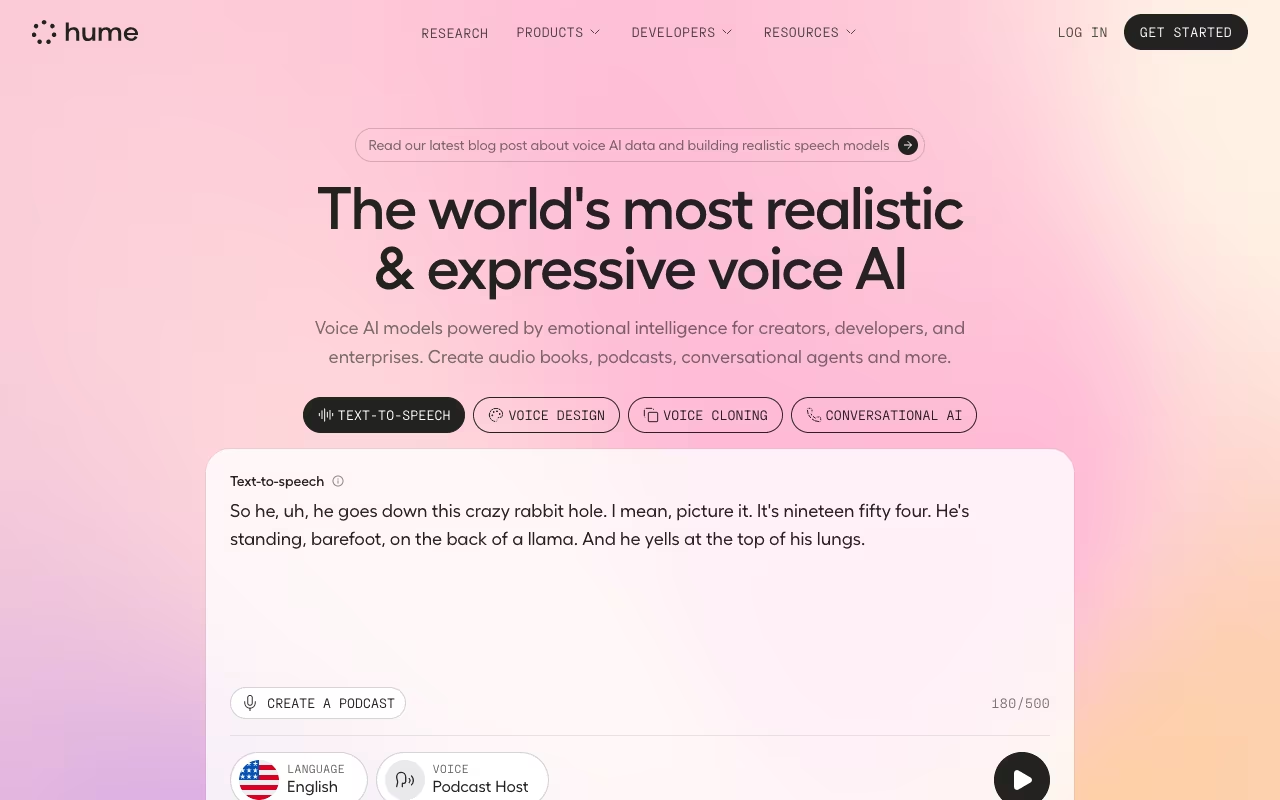
Hume's TTS engine, Octave, generates emotionally expressive speech from text. Octave 2 launched in October 2025 with a 50% cost reduction from the previous generation and multilingual capabilities covering 11 major languages. You control emotional expression parameters, speaking style, and pace. Voice cloning is available from the Creator plan ($7/month introductory, normally $14/month) with unlimited clone creation.
The voice quality is good, not quite ElevenLabs-tier for pure narration, but the emotional range is wider. For building conversational agents, customer-facing bots, or interactive experiences, Octave's expressiveness matters more than raw audio fidelity.
Start Building with Hume AIExpression Measurement API
Separate from the voice products, Hume offers an API that analyzes facial expressions, vocal tone, and text for emotional content. It processes video, audio, images, and text. The pricing is pay-as-you-go: $0.0828/minute for video plus audio, $0.0639/minute for audio only, $0.00204 per image, and $0.00024 per word.
Use cases include market research (testing ad emotional impact), content testing (does this video make viewers feel what we intended?), telehealth platforms (tracking patient emotional state over sessions), and academic research. The API returns detailed emotion breakdowns across multiple categories, not just positive/negative sentiment.
Custom Voices and Personalities
Developers can create custom AI personalities with specific speaking styles, emotional ranges, and behavioral guidelines. You define system prompts that shape how the AI responds, and the voice adapts accordingly. This goes beyond simple voice selection. You are shaping the AI's conversational personality, which matters enormously for branded customer experiences. A luxury brand's voice agent should sound different from a casual gaming companion, and Hume gives you the controls to make that happen.
Pricing
Free ($0/month): 10,000 TTS characters, 5 EVI minutes, 15 requests per minute. Enough to build a prototype and test the emotional intelligence layer.
Starter ($3/month): 30,000 characters, 40 EVI minutes, 20 projects. Good for early development.
Creator ($14/month): 140,000 characters, 200 EVI minutes, voice cloning, commercial license. The entry point for production applications.
Pro ($70/month): 1,000,000 characters, 1,200 EVI minutes, 75 RPM. Where most growing applications land.
Scale ($200/month): 3,300,000 characters, 5,000 EVI minutes, 3 team seats.
Business ($500/month): 10,000,000 characters, 12,500 EVI minutes, 5 team seats.
Enterprise (Custom): Unlimited everything, SLA, Slack support, compliance features.
Overage rates for EVI range from $0.06/minute on Pro to $0.04/minute on Business. Be warned: usage-based pricing means your monthly bill can spike if your application gets sudden traffic. Set up usage alerts in the dashboard.
Hume vs. ElevenLabs vs. OpenAI Voice
ElevenLabs produces the highest quality synthetic voices available for pre-recorded content. Industry-leading naturalness for audiobooks, podcasts, and voiceovers. No real-time emotion detection.
OpenAI's voice API integrates tightly with GPT models, making it easy to build conversational AI with strong reasoning. Voice quality is good, emotional range is limited compared to Hume.
Hume wins on emotional intelligence and real-time conversational adaptability. Some teams use both: ElevenLabs for content production and Hume for interactive conversations. The right choice depends on whether your application talks at people or talks with people.
Limitations Worth Knowing
- Usage-based pricing makes monthly costs hard to predict at scale
- ElevenLabs still produces higher raw voice quality for pure TTS
- Team seats are limited (3 on Scale, 5 on Business)
- Expression Measurement API is billed separately from voice products
- No self-hosted option for strict data residency requirements
- API-first product with no no-code interface: you need developers
- Still a young company navigating leadership transitions in 2026
Our Take
Hume AI is doing something genuinely novel. Emotion-aware voice interaction is not a gimmick. It is the difference between a robotic phone bot that frustrates callers and an AI assistant that actually feels helpful. EVI 3's sub-300ms latency, multilingual support, and expressive voice generation put it at the forefront of conversational AI. The pricing is accessible for prototyping and reasonable for moderate usage, though high-volume applications can rack up significant overage charges. For developers building the next generation of voice-powered products, Hume is the platform to watch.
Start Building with Hume AI