
Last updated: March 2026
Campaign Monitor Review: Beautiful Email Marketing for Teams That Value Design Over Complexity
The email marketing landscape is crowded with tools that try to do everything: CRM, landing pages, SMS, social media, AI chatbots, and oh yes, email too. Campaign Monitor (now part of the Marigold family) takes the opposite approach. It focuses on doing email marketing exceptionally well, with an emphasis on beautiful design, ease of use, and reliable deliverability.
Since its founding in 2004, Campaign Monitor has grown to serve over 250,000 businesses worldwide. It earned its reputation by offering one of the best drag-and-drop email builders in the industry, paired with solid automation and segmentation features. The 2024 acquisition by Marigold brought it under the same umbrella as Sailthru and Cheetah Digital, adding enterprise capabilities to the mix. But Campaign Monitor's sweet spot remains small-to-mid-sized teams that want professional-looking emails without a steep learning curve. Here is the complete picture.
Try Campaign MonitorKey Features
Drag-and-Drop Email Builder
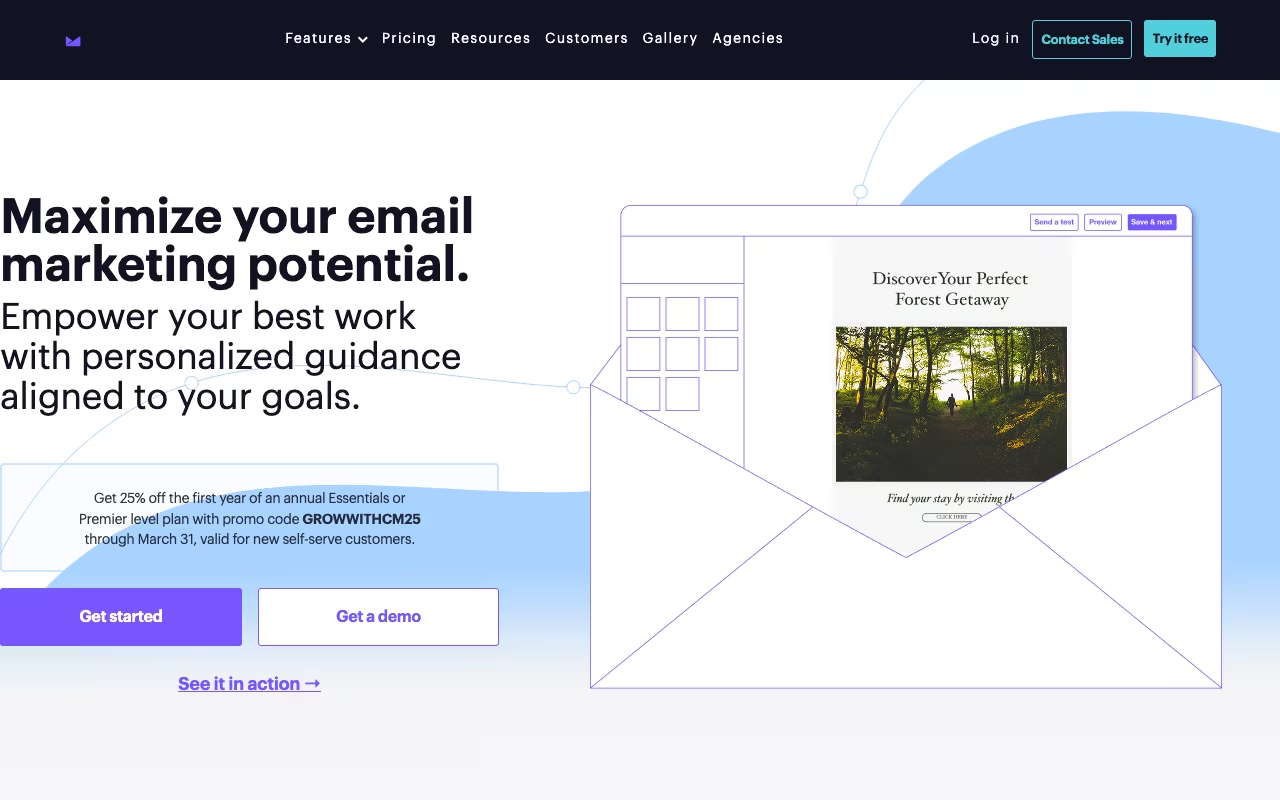
Campaign Monitor's email builder is genuinely one of the best in the industry. The drag-and-drop interface is smooth, responsive, and intuitive. You can build a professional email in 15 minutes without touching any code. The builder supports custom fonts, background images, button styling, spacing controls, and mobile preview. For teams with designers, the custom HTML editor gives complete control. What sets it apart from competitors like Mailchimp is the visual polish: Campaign Monitor templates look better out of the box, with cleaner typography and more thoughtful default layouts.
Automation and Journeys
The visual journey designer lets you create automated email sequences triggered by subscriber actions. Welcome series, re-engagement campaigns, birthday emails, post-purchase follow-ups, and date-based reminders are all supported. The journey builder uses a flowchart-style interface where you set triggers, add delays, apply conditions, and branch paths based on subscriber behavior. It is not as powerful as ActiveCampaign's automation (which supports more complex branching and scoring), but it covers the workflows that 90% of email marketers actually use.
Segmentation
Campaign Monitor offers both manual segments (based on custom fields and list data) and automatic engagement segments. The engagement segments feature is particularly useful: it automatically categorizes subscribers into six groups based on their interaction history, from "Active" (recently engaged) to "Ghosts" (never opened or clicked after 12+ months). This makes it easy to target re-engagement campaigns or clean your list without building complex segment rules manually. Dynamic content lets you personalize email sections based on subscriber data, so one email can show different content to different audience segments.
Analytics and Reporting
Every campaign gets detailed reporting on opens, clicks, bounces, unsubscribes, and geographic distribution. The click map shows exactly which links subscribers clicked and how often. You can compare campaigns side by side and track trends over time. The real-time analytics during sends show opens and clicks as they happen, which is useful for time-sensitive campaigns. The reporting is clean and visual, though it lacks the depth of tools like Klaviyo that offer revenue attribution and predictive analytics.
Integrations
Campaign Monitor connects with 100+ tools including Shopify, WordPress, Salesforce, WooCommerce, Google Analytics, Unbounce, and Zapier. The Shopify integration is solid for ecommerce businesses, syncing customer and order data for targeted campaigns. The WordPress plugin lets you embed signup forms easily. For tools not directly supported, Zapier fills the gap. The integration ecosystem is adequate for most small businesses, though it does not match Mailchimp's breadth.
Campaign Monitor Pricing in 2026
Campaign Monitor uses contact-based pricing with three tiers. Prices shown are for 500 contacts and increase as your list grows:
- Lite ($12/month for 500 contacts): Send up to 5x your contact limit per month (2,500 emails for 500 contacts). Includes the drag-and-drop builder, templates, segmentation, A/B testing, basic automation, and the AI Writer tool. Standard email support only.
- Essentials ($29/month for 500 contacts): Unlimited email sends per month. Everything in Lite plus priority email support, inbox previews, and access to all core features. This is the best value for most teams.
- Premier ($159/month for 500 contacts): Unlimited sends plus phone support, advanced engagement segments, email section locking (great for brand-controlled agencies), and send time optimization. Designed for agencies and larger teams.
All plans offer a 10% discount for annual billing. Nonprofits get an additional 15% off. There is also a limited free plan that allows up to 500 contacts and 500 emails, with no credit card required, though it restricts access to automation and advanced features.
The pricing is competitive at the 500-contact level, but it scales steeply. At 10,000 contacts, Lite jumps to around $59/month, Essentials to $99/month, and Premier to $329/month. For comparison, Mailchimp's Standard plan covers 10,000 contacts for $115/month with more features included.
What Campaign Monitor Gets Right
- Best-in-class email builder: The drag-and-drop editor produces emails that look professionally designed without requiring any design skills. Templates are modern and clean, not the dated layouts you find in many competing tools.
- Genuinely easy to use: From account setup to sending your first campaign, Campaign Monitor has one of the smoothest onboarding experiences in email marketing. Non-technical users can be productive within an hour.
- Engagement segments save time: Automatic categorization of subscribers by engagement level eliminates the guesswork of manual segmentation and makes list hygiene a default behavior rather than a chore.
- Strong deliverability: Campaign Monitor has a solid sender reputation, and emails reliably land in inboxes rather than spam folders. For businesses where deliverability is the top priority, this matters more than any feature list.
- Responsive customer support: Users consistently rate Campaign Monitor's support team as helpful, knowledgeable, and fast to respond, especially on the Essentials and Premier plans.
Where Campaign Monitor Falls Short
- Limited automation depth: The journey builder covers basic workflows well, but it lacks the conditional logic, lead scoring, and multi-channel automation that ActiveCampaign and HubSpot offer. If automation is your primary need, you will hit the ceiling.
- Pricing scales steeply with contacts: The entry prices look competitive, but costs accelerate as your list grows. At 25,000+ contacts, Campaign Monitor becomes noticeably more expensive than alternatives like Brevo or MailerLite.
- No landing page builder: Unlike Mailchimp, ConvertKit, and MailerLite, Campaign Monitor does not include a landing page builder. You will need a separate tool (Unbounce, Leadpages, etc.) for lead capture pages.
- Template flexibility limits: While the templates look great, users wanting highly custom layouts report running into restrictions. The builder prioritizes consistency and clean design over maximum flexibility.
- Analytics lack revenue tracking: There is no built-in revenue attribution or ecommerce reporting. If you need to track how much revenue each email generates, Klaviyo or Drip are better choices.
Who Should Use Campaign Monitor
Great for: Small businesses and startups that want professional-looking emails without hiring a designer. Marketing agencies managing email campaigns for multiple clients (the Premier plan's section locking is built for this). Nonprofits that benefit from the 15% pricing discount and need simple, reliable email tools. Content creators and publishers sending regular newsletters with clean, readable layouts. Teams that value ease of use over maximum feature depth.
Skip it if: You need advanced marketing automation with complex branching, scoring, and multi-channel workflows (use ActiveCampaign or HubSpot instead). Your contact list exceeds 25,000 and you need cost-effective pricing at scale (Brevo or MailerLite offer better value). You want an all-in-one marketing platform with landing pages, CRM, and social media management built in. You need deep ecommerce integration with revenue attribution (Klaviyo is the better choice). You require SMS marketing alongside email (Campaign Monitor is email-only).
Frequently Asked Questions
How does Campaign Monitor compare to Mailchimp?
Campaign Monitor has a better email builder with more polished templates and a smoother editing experience. Mailchimp offers more features overall: landing pages, social media posting, CRM, postcards, and a broader integration ecosystem. Campaign Monitor is simpler and faster to learn; Mailchimp has a steeper learning curve but more capability. On pricing, Mailchimp is cheaper at higher contact counts but more expensive at the entry level. If email design quality is your top priority, Campaign Monitor wins. If you want an all-in-one marketing platform, Mailchimp is more versatile.
Can I use Campaign Monitor for transactional emails?
Yes. Campaign Monitor supports transactional emails (order confirmations, password resets, shipping notifications) through its Transactional Email API. This is available on all paid plans. Transactional emails use separate sending infrastructure to ensure high deliverability and are not counted against your campaign send limits. You can design transactional email templates in the same drag-and-drop builder used for marketing campaigns, ensuring brand consistency across all customer communications.
Does Campaign Monitor offer a free plan?
Yes, but it is very limited. The free plan allows up to 500 contacts and 500 total emails (not per month, but total during the trial period). It does not include automation, and some features are restricted. It is useful for testing the interface and email builder, but not practical for ongoing email marketing. No credit card is required to sign up. For actual use, you will need at least the Lite plan at $12/month.
Is Campaign Monitor good for ecommerce?
It works for basic ecommerce email marketing through its Shopify and WooCommerce integrations. You can sync customer data, create segments based on purchase behavior, and trigger automated emails for abandoned carts and post-purchase follow-ups. However, it lacks the deep ecommerce features that Klaviyo offers: revenue attribution per email, predictive analytics, product recommendations, and advanced ecommerce reporting. If email marketing is a core revenue driver for your online store, Klaviyo is the better investment. If you just need to send occasional promotions and order-related emails, Campaign Monitor handles it fine.
Final Verdict
Campaign Monitor remains one of the most elegant email marketing tools available in 2026. The email builder sets the standard for visual quality and ease of use, the engagement segments automate list management intelligently, and the deliverability is rock-solid. The platform's limitations are clear: shallow automation, no landing pages, steep pricing at scale, and no revenue tracking for ecommerce. But for teams that prioritize beautiful, reliable email campaigns over feature maximalism, Campaign Monitor delivers exactly what it promises. Start with the free plan to test the builder, then move to Essentials ($29/month) when you are ready for unlimited sends and priority support.
Try Campaign Monitor