Last updated: March 2026
Bright Data Review: The Enterprise Proxy and Web Scraping Platform That Powers AI
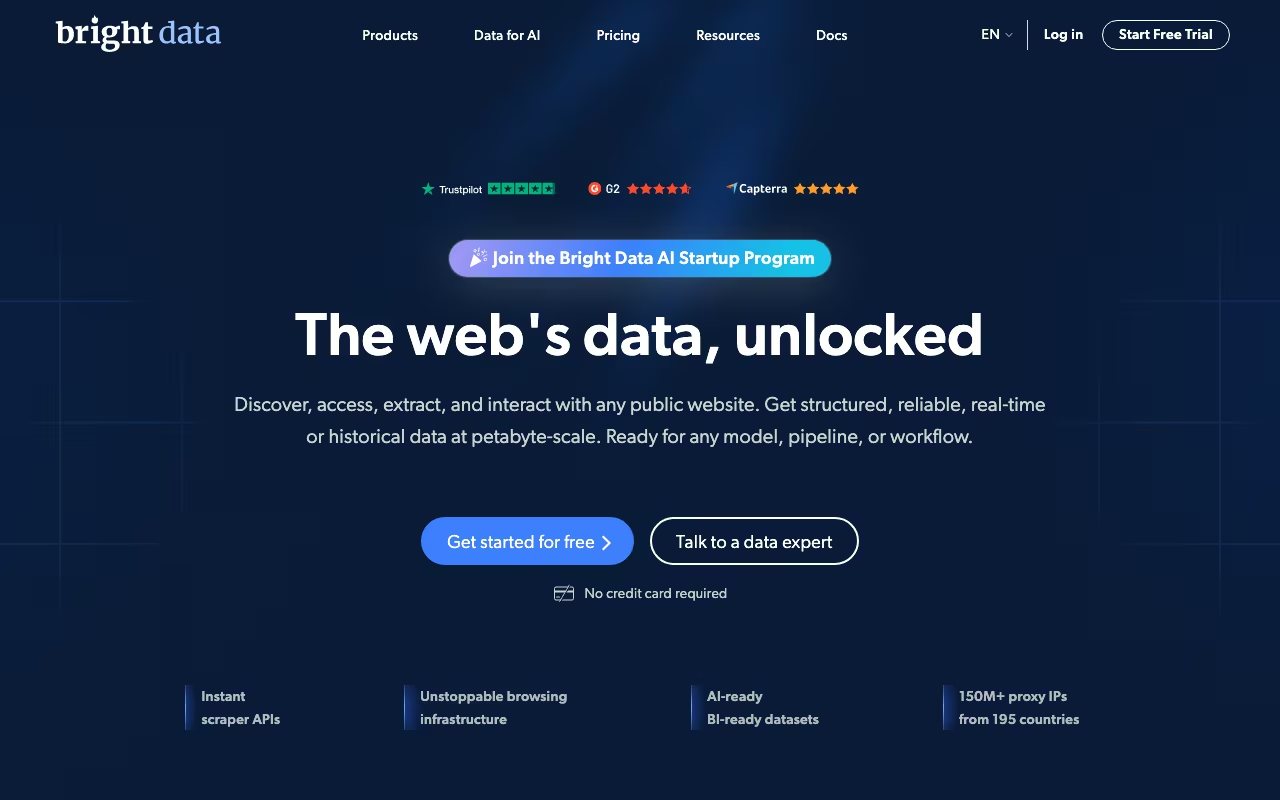
Web data collection is messy. Sites block scrapers, rotate their HTML structures, throw CAPTCHAs at bots, and rate-limit API calls. Bright Data exists to solve all of these problems at scale. It is the largest proxy and web data infrastructure platform in the world, with over 150 million IP addresses across 195 countries, serving 20,000+ organizations including 14 of the top 20 global LLM labs.
The company crossed $300 million in annual recurring revenue in 2025 and is growing 50%+ year over year. That growth is driven largely by AI companies that need massive amounts of web data to train and ground their models. If you need to collect web data at any meaningful scale, whether for market research, price monitoring, SEO tracking, ad verification, or AI training, Bright Data is the industry standard.
Try Bright Data Free Get started →Key Features
Proxy Network (150M+ IPs)
Bright Data's proxy infrastructure is the backbone of everything else. The network includes four proxy types:
- Residential proxies: 72M+ real residential IPs. These are the hardest to detect and block because the traffic looks like regular home internet users. Best for scraping sites with aggressive bot detection.
- Datacenter proxies: 770,000+ IPs. Fastest and cheapest option, but easier for sites to detect and block. Good for high-volume, low-sensitivity scraping.
- ISP proxies (static residential): Combine the speed of datacenter proxies with the legitimacy of residential IPs. Ideal for accounts that need persistent, long-lived sessions.
- Mobile proxies: Real 3G/4G/5G mobile IPs. Used when you need to see content exactly as mobile users see it, including mobile-specific pricing and geo-targeted content.
The network maintains 99.99% uptime and supports automatic IP rotation, geo-targeting at the city level, and session persistence. The infrastructure is genuinely impressive and miles ahead of smaller proxy providers.
Web Scraper API
The Web Scraper API handles the full scraping pipeline: proxy rotation, anti-bot bypass, JavaScript rendering, and data extraction. You send a URL and parameters, and get structured data back. There are 120+ ready-made scrapers for popular platforms (Amazon, LinkedIn, Google, social media sites), plus a Web Scraper IDE for building custom scrapers.
The API handles CAPTCHAs, browser fingerprinting, and rate limiting automatically. For developers, this eliminates months of infrastructure work. For non-developers, the ready-made scrapers provide point-and-click data collection.
SERP API
The SERP API retrieves search engine results from Google, Bing, DuckDuckGo, Yandex, Baidu, Yahoo, and Naver. You can specify search type (web, images, shopping, maps, news, videos), location, language, and device type. Results come back as structured JSON. You can pull up to 100 Google results in a single API call.
SEO agencies, rank tracking tools, and market research teams use this heavily. The data accuracy is consistently high, and the geo-targeting is granular enough for local SEO work.
Scraping Browser
The Scraping Browser is a hosted headless browser that handles JavaScript rendering, CAPTCHAs, and browser fingerprinting automatically. You connect via Puppeteer, Playwright, or Selenium, and the browser handles all the anti-detection work. This is essential for scraping single-page applications and sites that require JavaScript execution to load content.
Ready-Made Datasets
If you do not want to build scrapers at all, Bright Data offers pre-collected datasets from popular platforms. These are updated regularly and delivered in structured formats (CSV, JSON, Parquet). Common datasets include product listings, company information, job postings, and real estate data.
Bright Data Pricing in 2026
Bright Data uses consumption-based pricing that varies by product. New accounts get $25-$50 in free credits with 7-day trials on most products. Enterprise pricing is custom for high-volume users.
Residential Proxies
| Tier | Monthly | Bandwidth | Per GB |
|---|---|---|---|
| Pay As You Go | $0 commit | Metered | $8 ($4 new-account discount) |
| Starter | $499 | 141 GB | $3.50 |
| Advanced | $999 | 332 GB | $3.00 |
| Enterprise | $1,999 | 798 GB | $2.50 |
Web Scraper API + SERP API
| Product / Tier | Monthly | CPM (standard / premium) |
|---|---|---|
| Web Scraper, Pay As You Go | $0 commit | $4 / $8 |
| Web Scraper, Growth | $499 | $3.06 / $6.12 |
| Web Scraper, Business | $999 | $2.70 / $5.40 |
| SERP API, Pay As You Go | $0 commit | $3 |
| SERP API, Growth (~217K req) | $499 | $2.30 |
| SERP API, Business (~492K req) | $999 | $2.03 |
Datacenter Proxies
Starting from $0.066/GB. Significantly cheaper than residential proxies but with lower success rates on sites with sophisticated bot detection. Use datacenter for unprotected APIs and public data, residential for blocked or rate-limited targets.
What We Like
- Unmatched proxy network: 150M+ IPs across 195 countries with 99.99% uptime. No competitor comes close to this scale or geographic coverage. The residential proxy pool is the largest in the industry.
- Anti-detection that actually works: The automatic CAPTCHA solving, browser fingerprint rotation, and request throttling handle sites that block every other scraping tool. Success rates on difficult targets are consistently high.
- Excellent customer support: Response times average 14 minutes during business hours. Dedicated account managers for paid plans provide hands-on help with complex scraping projects.
- Flexible pricing: Pay-as-you-go options mean you do not need a monthly commitment to start. The tiered pricing rewards volume with significant per-unit discounts.
- Ready-made scrapers save development time: The 120+ pre-built scrapers for popular platforms eliminate weeks of development work. Point, click, and get structured data.
What We Don't Like
- Premium pricing: Bright Data is the most expensive proxy provider in the market. Residential proxies at $2.50-8.00/GB are 2-4x more expensive than competitors like Oxylabs, IPRoyal, or SmartProxy. You pay for quality, but the premium is real.
- Complexity for beginners: The platform has a steep learning curve. Documentation covers the basics but lacks clear example use cases for common scenarios. Non-technical users will struggle without developer support.
- Billing for failed requests: Some users report being charged for requests that returned errors or incomplete data. The "success-based billing" promise does not always hold up in practice, especially with the Web Unlocker product.
- Performance degradation reports: Several users on G2 and Trustpilot report that proxy quality has degraded over time, with increasing error rates on previously stable targets. This may reflect increased anti-bot measures from target sites rather than Bright Data's infrastructure, but it is a real concern.
- Overkill for simple use cases: If you only need to scrape a few hundred pages per month, Bright Data's pricing and complexity are excessive. Simpler tools like ScraperAPI or Apify offer better value for small-scale projects.
Who Should Use Bright Data
Great for: AI companies that need large-scale web data for model training, ecommerce businesses monitoring competitor pricing across thousands of SKUs, SEO agencies tracking rankings across multiple geographies, market research firms collecting structured data from diverse sources, and any team that has hit the limits of simpler scraping tools.
Skip it if: Your scraping needs are under 1,000 pages per month (use ScraperAPI or a simple Python script). Skip it if you do not have technical resources to manage the platform, if budget is your primary concern (cheaper alternatives exist), or if you only need SERP data (standalone SERP APIs from SerpApi or DataForSEO are simpler and cheaper).
Is web scraping with Bright Data legal?
Web scraping itself is generally legal for publicly available data, as confirmed by multiple court rulings (including HiQ v. LinkedIn). However, legality depends on what you scrape, how you use it, and which jurisdiction you operate in. Bright Data provides the infrastructure; compliance with terms of service and data protection laws is your responsibility. Consult legal counsel for your specific use case.
How does Bright Data compare to Oxylabs?
Oxylabs is Bright Data's closest competitor. Bright Data has a larger proxy pool (150M+ vs. 100M+), more proxy types, and a more complete product suite (SERP API, datasets, scraping browser). Oxylabs is typically 15-30% cheaper and has a cleaner, more developer-friendly interface. For most use cases, the difference comes down to price vs. scale. Choose Bright Data for maximum reliability on difficult targets. Choose Oxylabs for better value on standard scraping tasks.
Can Bright Data handle JavaScript-heavy websites?
Yes. The Scraping Browser product is specifically built for JavaScript-rendered sites. It runs a full headless browser (compatible with Puppeteer, Playwright, and Selenium) with automatic anti-detection. Single-page applications, dynamically loaded content, and infinite scroll pages are all supported. This is one of Bright Data's strongest capabilities.
What are Bright Data's free credits for?
New accounts receive $25 to $50 in free credits that can be used across any Bright Data product (proxies, scraper API, SERP API, scraping browser). The credits are enough to test the platform on a real project before committing to a paid plan. Seven-day trials are also available on most products.
Final Verdict
Bright Data is the best web data infrastructure platform for teams that need scale, reliability, and global coverage. The 150M+ proxy network, automatic anti-detection, and full product suite (proxies, scraping APIs, SERP API, datasets) are unmatched. The trade-offs are real: premium pricing, complexity for beginners, and occasional billing concerns for failed requests. If your data collection needs justify $500+/month in infrastructure costs, Bright Data is the safest choice. For smaller projects, start with the free credits and pay-as-you-go pricing to test before committing.
Try Bright Data Get started →