
Last updated: March 2026
Breezy HR Review: A Solid ATS for Small Teams That Do Not Need Enterprise Complexity
Hiring is messy. Job boards, resume screening, interview scheduling, team feedback, offer letters: the process has a dozen moving parts, and most small businesses manage it through a combination of email, spreadsheets, and crossed fingers. Breezy HR is an applicant tracking system (ATS) built specifically for small and mid-sized teams that want structure without the overhead of enterprise recruiting software.
With AI-powered candidate sourcing, visual drag-and-drop pipelines, integrated video interviews, and a genuinely usable free plan, Breezy has carved out a strong position in the SMB hiring market. But it has clear limits, especially for larger organizations or teams with complex compliance needs. Here is the full picture.
Try Breezy HR Get started →Key Features
Visual Hiring Pipeline
Breezy's pipeline is the heart of the product. Each open position gets a Kanban-style board where candidates move through customizable stages (Applied, Phone Screen, Interview, Offer, etc.) via drag-and-drop. It is intuitive enough that hiring managers who have never used an ATS can figure it out in minutes. You can customize stages per position, add scorecards, and set up automated actions when candidates move between stages.
Job Distribution
Breezy posts your job openings to 50+ job boards simultaneously, including Indeed, LinkedIn, Glassdoor, ZipRecruiter, and niche boards. This alone saves significant time compared to manually posting to each platform. The system also generates a branded career page that you can host on your website or use Breezy's hosted version.
AI-Powered Candidate Sourcing
Breezy includes a Chrome browser extension that lets you source candidates from LinkedIn and other platforms with a single click. The AI matching feature analyzes job requirements and suggests candidates from your existing database who might be a good fit for new positions. It is not as powerful as dedicated sourcing tools like LinkedIn Recruiter, but it is a useful addition for teams that cannot justify a separate sourcing subscription.
Video Interviews
Built-in asynchronous video interviews let candidates record responses to your questions on their own time. This is a genuine time-saver for initial screening: instead of scheduling 30-minute calls with 20 candidates, you send a video interview link and review responses when it suits you. Live video interviews are also supported for later-stage conversations.
Automation and Workflows
Breezy lets you automate repetitive tasks: sending follow-up emails, moving candidates between stages based on triggers, scheduling interviews through calendar integrations (Google Calendar, Outlook), and sending rejection notifications. The automation builder uses an if-this-then-that logic that is straightforward to set up, though some users report that managing multiple active triggers can get confusing.
Team Collaboration
Every candidate profile includes a discussion thread where team members can leave comments, ratings, and scorecards. Mentions and notifications keep everyone aligned without side-channel conversations in Slack or email. The platform also supports role-based permissions so you can control who sees what.
Pricing
Breezy offers five plans:
- Bootstrap (Free): One active position, unlimited users, unlimited candidates. Includes basic pipeline, career page, and email support. This is a real free plan, not a 14-day trial. Genuinely useful for companies that hire one role at a time.
- Startup ($157/month billed annually, $189 month-to-month): Unlimited positions, candidate sourcing, job board distribution, video assessments, and basic automation. Good starting point for teams hiring 5-15 people per year.
- Growth ($273/month billed annually, $329 month-to-month): Adds advanced pipeline automation, offer management, candidate comparison, and enhanced reporting. The sweet spot for growing companies with 25-200 employees.
- Business ($439/month billed annually, $529 month-to-month): Adds job and offer approvals, advanced governance controls, HRIS integrations, and priority support. Built for companies with formal hiring processes and compliance requirements.
- Custom Pro (contact sales): Tailored for enterprise needs with custom integrations, dedicated support, and SLAs.
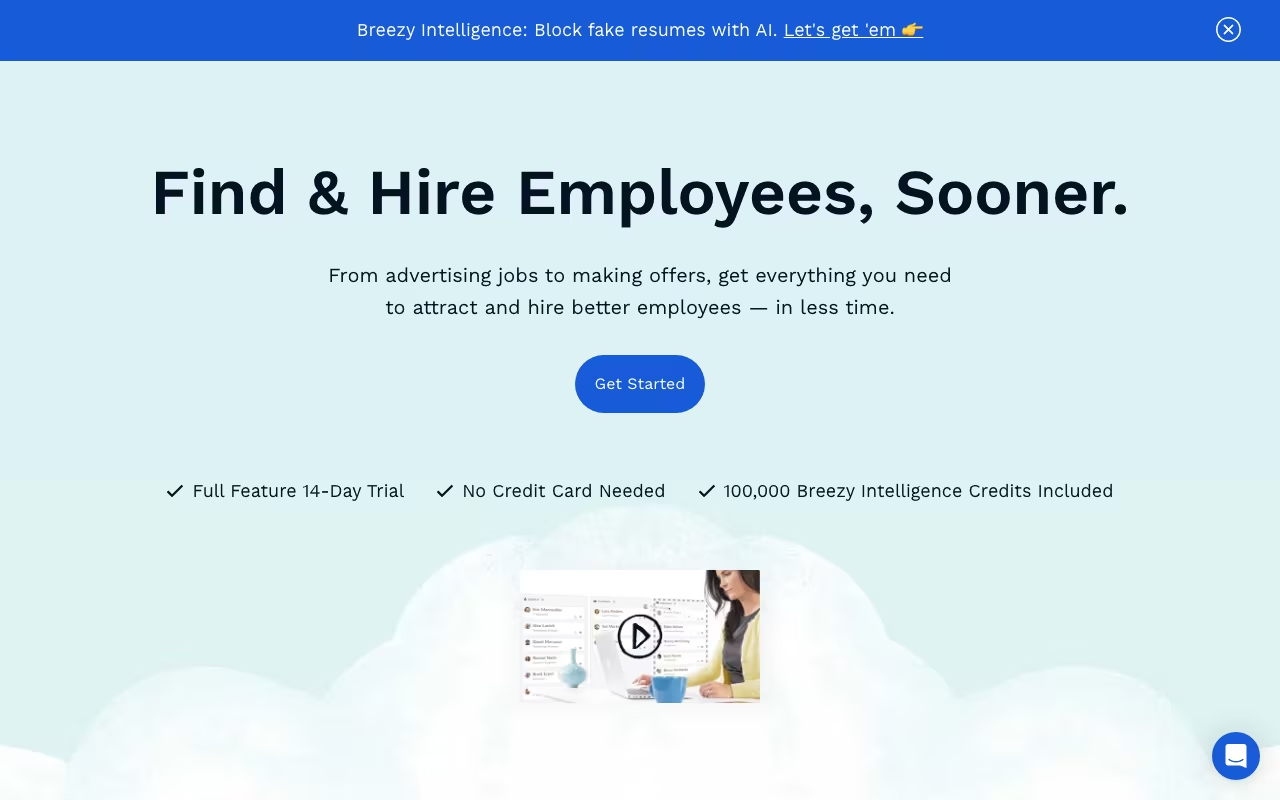
All paid plans include a 14-day free trial with no credit card required, plus 100,000 Breezy Intelligence credits for AI-powered features. Optional add-ons include SMS messaging, Breezy Intelligence (additional AI credits), Onboard (onboarding workflows), and Expert Training.
Pros
- Genuinely usable free plan: Unlimited users and candidates on the Bootstrap plan is rare in the ATS market. Most competitors limit free plans to a handful of candidates or a very short trial.
- Intuitive interface: The drag-and-drop pipeline is clean and requires minimal training. Hiring managers who are not tech-savvy can use it immediately.
- 50+ job board integrations: Posting to Indeed, LinkedIn, Glassdoor, and more from one place saves hours per job opening.
- Built-in video interviews: Async video screening is a genuine time-saver that eliminates dozens of phone screens per position. Many competing ATS tools charge extra for this or require a third-party integration.
- Good automation for the price: Automated emails, stage transitions, and interview scheduling work well and reduce manual overhead significantly.
- Strong candidate experience: The application process is clean, mobile-friendly, and does not frustrate candidates with unnecessary friction.
Cons
- Reporting is basic: The analytics and reporting features lack depth compared to enterprise ATS tools like Greenhouse or Lever. You get hiring funnel metrics, but advanced workforce analytics, diversity reporting, and custom report builders are limited.
- Automation triggers can be confusing: Setting up automations is straightforward, but managing multiple active triggers across positions gets messy. There is no clear overview of all active automations, which can lead to unexpected behavior.
- Mobile app is limited: The mobile experience does not match the desktop version. Reviewing candidates and leaving feedback on mobile works, but managing positions and automations is clunky.
- Not built for high-volume hiring: If you are hiring 50+ people per month, Breezy's pipeline will feel cramped. Enterprise tools like Greenhouse, Lever, or Workday are better suited for that scale.
- Limited compliance features: EEO reporting, OFCCP compliance tracking, and advanced audit trails are either basic or missing. Regulated industries may need a more specialized solution.
Who Should Use Breezy HR
Great for: Small and mid-sized companies (10-500 employees) that hire 5-50 people per year. Startups that want an ATS without a large software budget (the free plan is real). Hiring managers who are not recruiters by trade and need something intuitive. Teams that want built-in video interviews without a separate subscription. Companies posting to multiple job boards and tired of doing it manually.
Skip it if: You are an enterprise with 1,000+ employees and need deep compliance, custom workflows, and advanced analytics (look at Greenhouse, Lever, or Workday). You hire 50+ people per month and need high-volume processing. You need strong HRIS integration beyond basic syncing (Breezy connects to some HRIS tools but is not a replacement for one). You need advanced diversity and EEO reporting built into the platform.
Frequently Asked Questions
Is the Breezy HR free plan actually useful?
Yes, surprisingly so. The Bootstrap plan gives you one active position at a time with unlimited users and unlimited candidates. You get the visual pipeline, a branded career page, and email support. For a small business that hires one role every few months, it covers the basics without any cost. The limitation is that you can only have one active position, so if you are hiring for multiple roles simultaneously, you will need to upgrade.
How does Breezy HR compare to Greenhouse and Lever?
Greenhouse and Lever are enterprise-grade ATS platforms with deeper reporting, compliance features, and customization. They also cost significantly more (typically $6,000-$15,000+ per year). Breezy is designed for SMBs and trades some advanced functionality for ease of use and affordability. If you have a dedicated recruiting team and hire at scale, Greenhouse or Lever is the better fit. If you are a growing company where hiring managers handle their own recruiting, Breezy is more practical.
Can Breezy HR handle remote hiring across multiple countries?
Breezy supports multi-language career pages and posting to international job boards. However, it does not handle country-specific compliance (work permits, local labor laws, tax documentation). For truly global hiring, you would pair Breezy with an Employer of Record service like Multiplier or Deel for the compliance and payroll side.
Does Breezy HR integrate with my existing HR tools?
Breezy integrates with popular tools including Slack, Microsoft Teams, Google Workspace, Outlook, BambooHR, Namely, Zenefits, and more. The Business plan adds deeper HRIS integrations. For tools not directly supported, Breezy connects with Zapier, which opens up integrations with thousands of additional platforms. The API is also available for custom integrations on higher-tier plans.
Final Verdict
Breezy HR is one of the best applicant tracking systems for small and mid-sized teams in 2026. The free plan is genuinely useful (not just a teaser), the visual pipeline is intuitive, and the built-in video interviews save real time during screening. At $157-$439/month for paid plans, it is significantly cheaper than enterprise alternatives while covering 80% of what most growing companies need. The weak spots are reporting depth, mobile experience, and compliance features. If those are priorities, budget for Greenhouse or Lever. For everyone else, Breezy is the sweet spot of functionality and affordability. Start with the free Bootstrap plan or the 14-day trial on a paid plan to see if it fits your workflow.
Try Breezy HR Get started →