
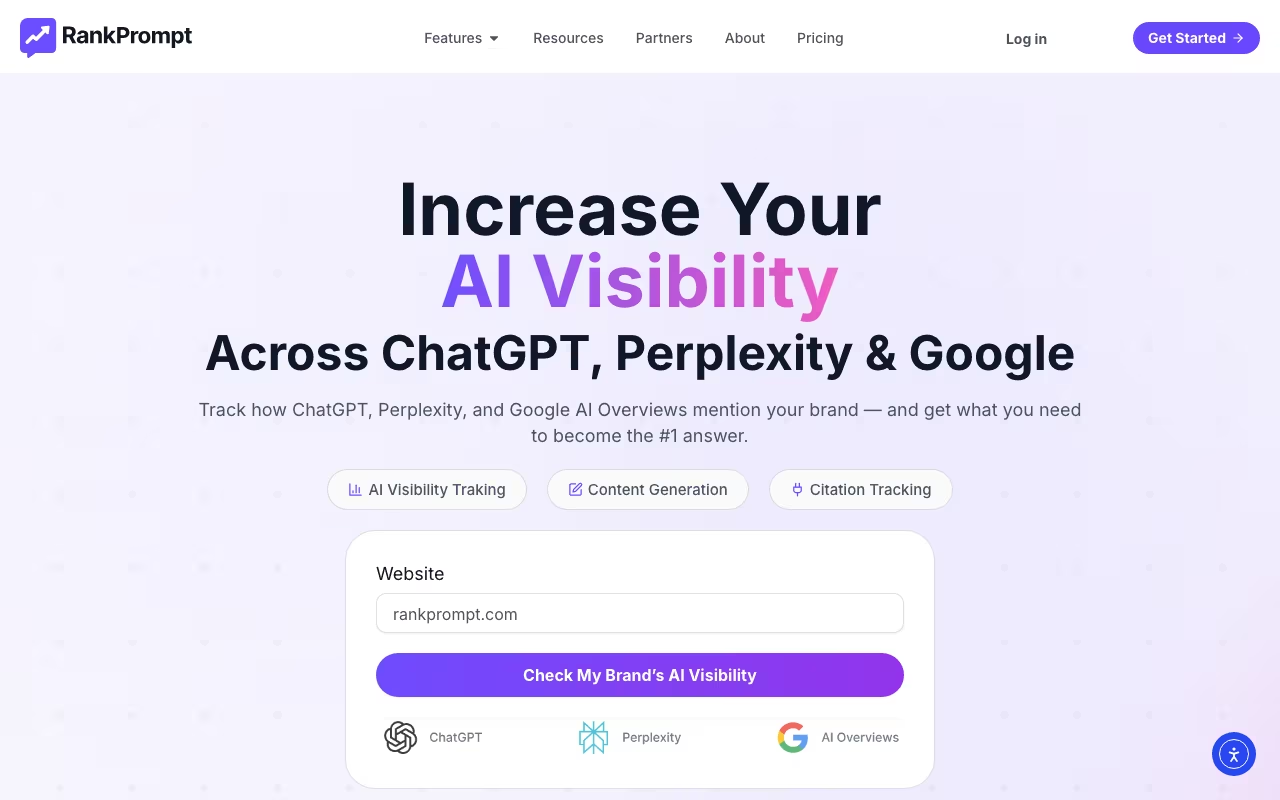
RankPrompt tackles a problem that did not exist two years ago: tracking how your brand appears in AI-generated answers. When someone asks ChatGPT, Gemini, Perplexity, Claude, or Grok "What is the best project management tool?" does your product get mentioned? RankPrompt monitors all five platforms simultaneously and tells you where you stand.
Answer Engine Optimization
Traditional SEO tools track Google rankings. RankPrompt tracks AI rankings. You enter prompts related to your industry and brand, and the platform scans those prompts across ChatGPT, Gemini, Perplexity, Claude, and Grok using browser-based front-end capture (not just API calls). It reports whether your brand is mentioned, how you rank against competitors, which sources the AI is citing, and what content would improve your visibility.
The metrics framework includes Mention Rate, Citation Share, Share of Voice, and Absolute Prominence Score. A Citation Audit reveals which sources (blog posts, reviews, Wikipedia entries) the AI engines trust and cite when generating answers. This is genuinely useful information because it tells you exactly what content to create or improve to influence AI responses about your category.
Competitive benchmarking lets you track up to 5 competitors side by side across all monitored AI engines. You can see not just who gets mentioned, but which source domains drive their visibility. For SaaS companies and B2B brands, this competitive intelligence is increasingly important as more buyer research shifts from Google to AI assistants.
Try RankPrompt Free for 7 Days Get started →Credit-Based Pricing
RankPrompt uses credits rather than fixed feature tiers:
- Starter ($49/month): 150 credits, best for solopreneurs and early-stage founders
- Pro ($89/month): 500 credits, best for marketers and small teams
- Agency ($149/month): 1,000 credits, multi-project management for up to 500 brands and 10 seats, white-label reporting
One credit equals one prompt scanned across all 5 AI platforms. Ten credits produce one AI-generated article optimized for AEO. Ten credits run one Brand Audit. Additional credits are sold as top-ups: $18 for 50, $35 for 100 or $65 for 200. All plans include full platform access, trend tracking, and competitor benchmarking. A 7-day free trial with 50 credits requires a credit card.
The credit model requires planning. If you scan 10 prompts daily, you use 300 credits monthly, which exceeds the Starter plan. Content generation eats credits fast at 10 per article. Budget-conscious users need to calculate their expected usage before choosing a plan.
See RankPrompt Pricing See plans →Prices checked on the Rank Prompt pricing page in September 2026. Plans and limits change, so confirm before you buy.
Content Generation Built In
RankPrompt generates six content types optimized for LLM readability: comparison articles, ranked lists, location pages, case studies, product deep-dives, and FAQ articles. The idea is that these formats are what AI engines tend to cite when answering questions. If your blog posts follow these structures with proper schema markup, the AI models are more likely to reference them.
WordPress integration allows one-click publishing via application passwords. If you do not have a website, RankPrompt offers hosted blogs. Hyper-local tracking with neighborhood-level precision serves multi-location businesses and franchises that need to monitor AI visibility across different geographic markets.
Very Early Stage
RankPrompt was founded in June 2025 in Miami by marketing agency founders who built it as an internal tool before opening it to the public. It has just 2 reviews on G2 (4.3/5) and no presence on Capterra or Trustpilot. The product is less than a year old, which means features are still developing, stability is still being proven, and the long-term viability of the company is not yet established.
Current limitations include no GA4 or Google Search Console integration (making traffic attribution impossible), desktop-only access with no mobile app, and US-centric support from their Miami headquarters. The metrics are estimates based on simulation, not actual query volumes, which is an inherent limitation of any tool trying to measure AI visibility from outside the AI platforms themselves.
Competitors in this emerging category include Otterly.AI, Peec AI, Scrunch AI, AthenaHQ, and enterprise solutions like BrightEdge and Profound ($400+/month). RankPrompt differentiates by combining monitoring and content generation in one platform at mid-market pricing.
If you are an SEO professional, agency, or SaaS company that recognizes AI search as a growing channel and wants to start tracking and optimizing for it now, RankPrompt is worth testing with the free trial. If you are waiting for the category to mature before investing, that is a reasonable position too. This is a new category with new tools, and the landscape will look different in a year.
For agencies specifically, the economics are interesting. The Agency plan at $149/month lets you manage up to 500 brands with white-label PDF reports. If you charge clients $500-1,000/month for AEO services, the margin on each client is substantial. The automated scheduling and multi-project management features are built for this use case. As more businesses recognize that AI search is consuming traditional search traffic, agency demand for specialized AEO monitoring and optimization tools will likely grow significantly over the coming years.
Start Tracking Your AI Visibility Get started →How Rank Prompt works
Rank Prompt is a GEO (generative engine optimization) platform. It measures how often and how favorably a brand appears in AI assistant answers across ChatGPT, Perplexity, Google AI Mode/Overviews, Claude, Gemini and Grok, scoring visibility from 0 to 100% per engine and per prompt, tracking competitor movement over time, and surfacing which sources the engines cite when they recommend brands in your category.
Setup starts with a brand, its industry, and its customer search patterns. From there the platform queries 6 AI platforms with automatically generated prompts tailored to your brand, industry, and customer search patterns, so you are not hand-writing a prompt set. Tracking can be scoped by language (50+ supported) and by location down to country, city or neighborhood.
Everything runs on a monthly credit pool with no rollover: 1 credit per prompt analysis, 10 per AI-generated article, 10 per Brand Audit. Content Studio generates six formats (comparison articles, ranked lists, location pages, case studies, product deep-dives, FAQ articles) and publishes straight to WordPress. GA4 and Google Search Console connect for AI-referral traffic analytics. There is a REST /v1 API, webhooks, and an MCP server so Claude Code, Cursor and ChatGPT can query your visibility data directly. Reports go out daily, weekly or monthly by email, and Agency tiers add white-label reports and a client portal. Agent Mode, the natural-language query layer, runs on a separate dollar budget ($5 to $25 per month) on top of credits.
Where Rank Prompt wins
- Six engines, including Claude and Grok, not just the ChatGPT and Perplexity pair most trackers stop at, and with a per-engine breakdown rather than one blended number.
- Citation network mapping tells you which domains the models actually pull from. That is the actionable half of GEO; a visibility score on its own is not.
- Auto-generated prompt sets remove the main setup chore, and location targeting goes down to neighborhood level across 50+ languages.
- An MCP server plus a public REST API means the data is usable inside dev and agent workflows instead of being locked in a dashboard.
- The agency tiering is real: white-label reports, a client portal, and up to 1,000 brands and 25 seats on Agency Plus.
Where it falls short
- No free tier at all. The trial is 7 days and 50 prompts and requires a credit card, after which plans run from $49/month up to $299/month, or $470/year up to $2,870/year billed annually.
- The credit model gates everything and does not roll over. 150 credits on Starter is 150 prompt checks a month, or 15 articles, not both.
- Real monthly cost is hard to predict. Agent Mode is billed on a separate USD budget on top of credits, and extra credits are pay-as-you-go top-ups ($18 for 50, $35 for 100, $65 for 200).
- Only six major assistants are covered, so smaller or regional models are not tracked. Starter also has no email or outreach campaigns and caps you at 10 brands.
- Publishing is WordPress-only, which makes headless CMS, Webflow, Shopify and similar stacks an export-and-paste job.
Who should use Rank Prompt
This fits SEO teams and agencies that have already accepted AI assistants as a traffic channel and want per-engine measurement plus a citation-building workflow in the same tool. Agencies get the most out of it, because multi-brand tracking, white-label reports and the client portal are built in rather than bolted on, and the API and MCP server let you pipe visibility data into whatever reporting you already run.
It is a poor fit for a solo site owner or anyone wanting to test the water. There is no free plan, paid plans start at $49/month, and the Starter credit ceiling is tight enough that any serious prompt coverage pushes you up to Pro or higher. If your stack is not WordPress, treat Content Studio as a drafting tool rather than a publishing pipeline, and budget separately for Agent Mode if you expect to use it.