

AI Phone Agents for Businesses That Miss Too Many Calls
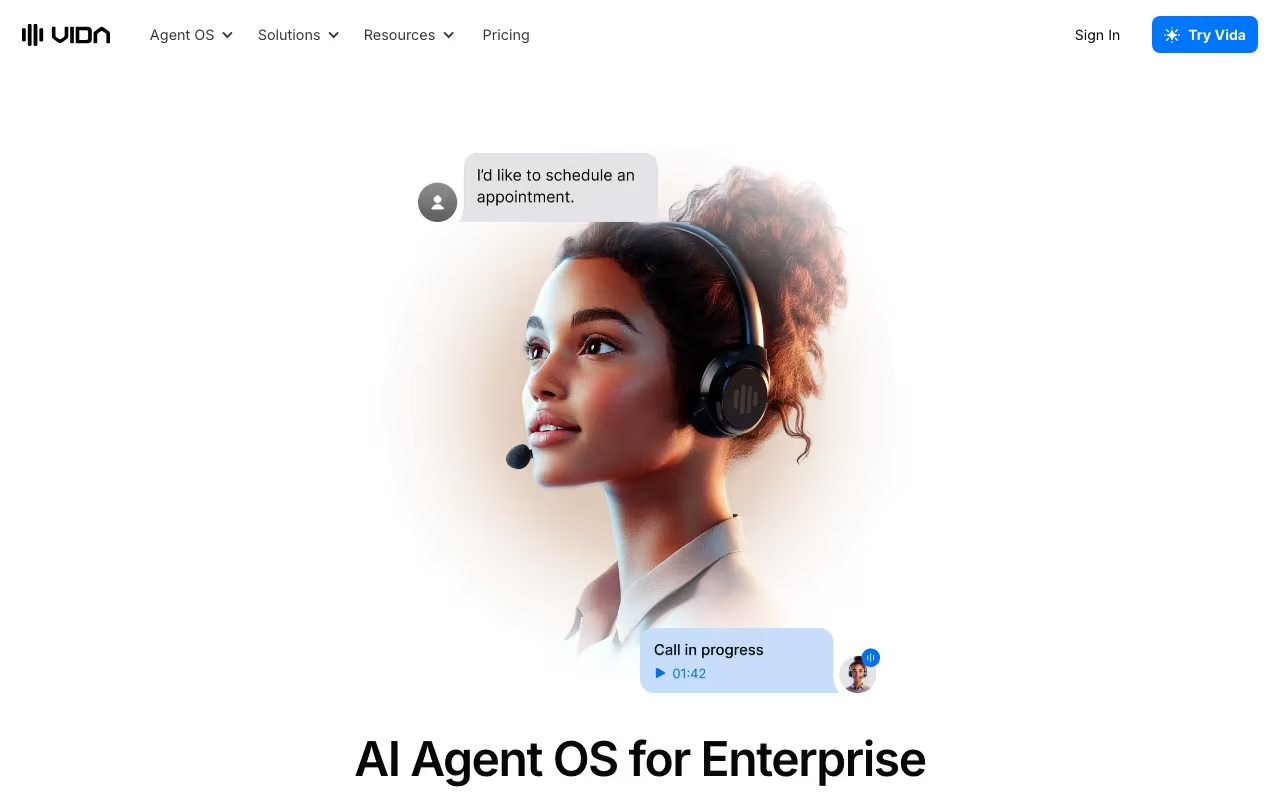
Vida is an AI phone agent platform that answers calls, qualifies leads, schedules appointments, and handles FAQ responses across voice, SMS, email, and web chat. Think of it as a virtual receptionist that works 24/7, speaks 10+ languages, and never puts anyone on hold. The San Francisco-based company raised a $4 million Series A in November 2025 and claims to have powered over 100 million customer interactions across tens of thousands of deployed agents.
The core pitch is straightforward: small businesses and professional services firms miss 20-40% of incoming calls. Each missed call is a lost customer. Vida's AI answers every call instantly, collects the caller's information, qualifies whether they're a good lead, books appointments directly into your calendar, and sends you a summary. The system runs on multiple large language models simultaneously, selecting the best one for each interaction type, so you don't have to think about model management.
Set Up Your AI Phone Agent with VidaWhat the Platform Actually Does
The no-code agent builder lets you configure your AI receptionist with pre-built templates for industries like healthcare, automotive, legal, and real estate. You define how the agent should greet callers, what questions to ask, when to escalate, and what information to collect. The setup process takes 15-30 minutes for a basic agent. More complex workflows with conditional routing take longer but don't require any technical skills.
Beyond answering inbound calls, Vida handles outbound campaigns via voice, SMS, and email. You upload a contact list, define the message sequence, and the AI makes calls or sends texts on your behalf. The platform claims 80% faster resolution times compared to human-handled calls, averaging 1 minute 14 seconds versus roughly 6 minutes for a human agent. Custom voice cloning lets you create a branded voice for your agent rather than using generic AI voices.
Integrations connect through Zapier (7,000+ apps), plus native connections to Google Calendar, SIP trunking providers, and select CRM platforms. HIPAA compliance, SOC 2 Type II certification, and STIR/SHAKEN call authentication make Vida viable for regulated industries like healthcare where data handling matters.
Pricing Reality Check
This is where Vida gets interesting and potentially problematic. The current pricing starts at $500/month for the Core plan, which includes 5 agents and 2,500 voice minutes. The Growth plan is $750/month with unlimited minutes and messages. Expand runs $2,500/month with whitelabel capabilities and custom integrations. Enterprise is custom-priced with HIPAA/BAA agreements and zero data retention options.
Older sources reference a $100/month entry tier that no longer appears on Vida's pricing page. If the company recently raised prices 5x on the entry plan, that's a significant shift worth noting. At $500/month minimum, Vida is priced for businesses where missed calls cost hundreds of dollars each, meaning medical practices, law firms, and service contractors. A solo freelancer answering 10 calls a week doesn't need to spend $6,000/year on an AI receptionist.
Overage rates add up too: roughly $0.15 per minute of voice, $0.09-0.10 per text, and $5/month per additional local number. Spam calls cost you money, since the system charges per minute regardless of whether the caller is a real lead or a robocall.
See Vida's AI Phone Agent PricingThe Trust Problem
Vida's biggest weakness isn't the product itself. It's the near-total absence of independent reviews. The platform has no presence on G2, no reviews on Capterra, and only 3 ratings on the App Store. Vida's own website claims "5-star rating, 1,000 reviews" but this isn't verifiable on any major independent platform. For a product handling your business phone calls, something that directly impacts revenue and customer relationships, that lack of third-party validation is a significant concern.
The other notable gap is no human escalation. Vida is purely AI. If a caller has a complex issue that the AI can't handle, there's no option to route to a live agent. Competitors like Smith.ai offer hybrid AI-plus-human models where the AI handles routine calls and a real person steps in for anything complicated. Calendar integration is limited to Google Calendar only, which rules out teams using Outlook or Calendly natively.
Who Should Consider This
Vida makes financial sense for service businesses where each missed call represents $200+ in potential revenue. A dental practice, plumbing company, or law firm that misses 5 calls per day is leaving $1,000+ on the table daily. At $500-750/month, Vida pays for itself if it captures even 2-3 additional clients per month. For businesses with lower call volumes or lower per-customer value, cheaper alternatives like My AI Front Desk or Goodcall offer similar AI receptionist features at lower price points. And if you want the safety net of human backup, Smith.ai's hybrid approach is worth the premium.
Try Vida's AI Receptionist for Your Business