Last updated: May 2026
What Is Recruitment Intelligence?
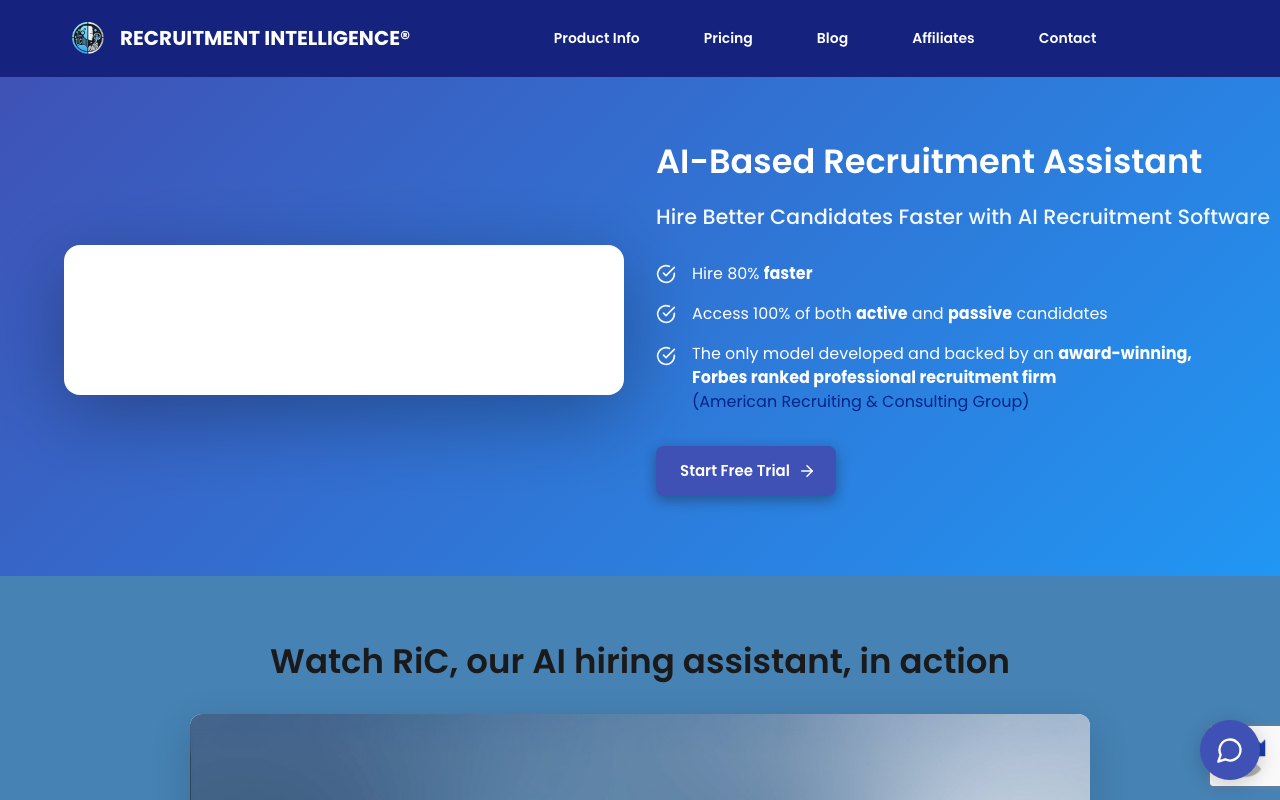
Recruitment Intelligence is the AI-powered hiring platform that combines candidate sourcing, applicant tracking, screening, and interview scheduling for mid-market companies. The product uses AI to surface passive candidates from public profiles, score active applicants against role requirements, and automate the early stages of the hiring funnel.
The pitch addresses the time tax of modern recruiting. Recruiters spend 13+ hours per role on average doing manual search, screening, and scheduling. Recruitment Intelligence promises to cut that to 3-5 hours by automating the repetitive parts and surfacing the candidates most likely to fit.
The product fits companies with formal hiring processes that need to scale beyond what a single recruiter can manage manually. Typical customers run 20-200 active requisitions per year and have outgrown LinkedIn Recruiter as a single-source tool.
See Recruitment Intelligence DemoHow Recruitment Intelligence Works
Define role criteria: required skills, years of experience, location, education, target companies (or anti-target companies). The AI searches across public profiles (LinkedIn, GitHub for technical roles, Behance for designers, conference speaker lists) and your existing ATS for matching candidates.
Each candidate receives a fit score based on role criteria. The AI surfaces both active applicants and passive prospects (people not currently job hunting but who fit the role). Recruiters review the top scores, send personalized outreach, and track responses.
For active applicants, the AI screens applications against requirements and ranks them. Resumes with explicit qualifying signals (specific technologies, certifications, prior employers) score higher; those missing key requirements drop down. Recruiters spend time on the top 20% rather than reading every resume.
Interview scheduling integrates with calendars. Once a recruiter approves a candidate for screening, the system sends a self-scheduling link that respects everyone's availability. Reschedules and reminders happen automatically.
Integrations push qualified candidates to your existing ATS (Greenhouse, Workday, SmartRecruiters, Lever). Recruitment Intelligence sits ahead of the ATS as a sourcing and screening layer, not replacing the system of record.
Recruitment Intelligence Pricing in 2026
Enterprise pricing model. Annual contracts typical, starting at $25,000-$50,000/year depending on user count, integration depth, and AI feature usage. Custom pricing for high-volume hiring orgs.
Pricing typically scales with recruiter seats (5-50 seats) plus feature tier. Sourcing-only deployments cost less than full sourcing-plus-scheduling-plus-screening engagements.
Get Recruitment Intelligence PricingWhere Recruitment Intelligence Wins
- AI candidate sourcing: surfaces passive candidates that pure inbound recruiting misses.
- Resume screening at scale: handles 500-applicant requisitions without losing top candidates in the noise.
- Calendar automation: scheduling friction reduced significantly when interview coordination crosses 5+ panel members.
- ATS-agnostic: works alongside existing ATS rather than forcing a switch.
- Bias mitigation tooling: standardized scoring reduces (but does not eliminate) human bias in early-stage screening.
Where It Falls Short
- Pricing: enterprise-only. SMBs cannot easily justify $25K+ annual commits.
- AI bias risks: any AI-based screening tool has potential for embedded bias. Companies need to monitor outcomes carefully.
- Long sales cycle: typical contract takes 8-16 weeks from first call.
- Less brand recognition: LinkedIn Recruiter and SeekOut have more name recognition with experienced recruiters.
- Best for high-volume hiring: low-volume hiring orgs do not see ROI from sourcing automation.
Recruitment Intelligence vs LinkedIn Recruiter vs SeekOut vs HireEZ
LinkedIn Recruiter is the category default for sourcing. Largest candidate pool, weakest screening and scheduling features. Most teams use LinkedIn Recruiter alongside another tool that handles workflow.
SeekOut targets technical sourcing with stronger GitHub and academic data. Pick SeekOut if you primarily hire engineers and researchers.
HireEZ (formerly Hiretual) is the closest direct competitor on AI sourcing and screening. Comparable scope, slightly different feature mix.
Greenhouse + LinkedIn represents the traditional stack: ATS plus sourcing tool. Cheaper, more familiar, less unified.
Who Should Use Recruitment Intelligence
Mid-market companies hiring 50-500 roles/year: enough volume to justify automation investment.
Recruiting teams without enough headcount: 3-10 recruiters trying to fill 100+ roles per year benefit most from automation gains.
Companies competing for talent in tight markets: passive candidate sourcing matters when active applicant pools run dry.
Skip it if: you hire under 20 roles/year (use LinkedIn Recruiter alone), have a strong existing sourcing engine (no need to add tooling), or operate in heavily regulated industries with restrictions on AI screening.
Frequently Asked Questions
Does it integrate with my ATS?
Yes. Native integrations with Greenhouse, Workday, SmartRecruiters, Lever, BambooHR, and others.
How does AI screening work?
Resumes parse into structured data. The AI compares against role requirements and assigns fit scores. Recruiters configure scoring criteria.
Is the AI biased?
Like all AI tools, there is potential for embedded bias. The platform includes bias monitoring; companies should also audit outcomes by demographic to ensure compliance with EEO rules.
Can I source international candidates?
Yes. Coverage strongest in North America and Europe; APAC coverage growing.
What is the typical onboarding time?
4-8 weeks from contract signing to fully operational, depending on ATS integration complexity.