
Last updated: March 2026
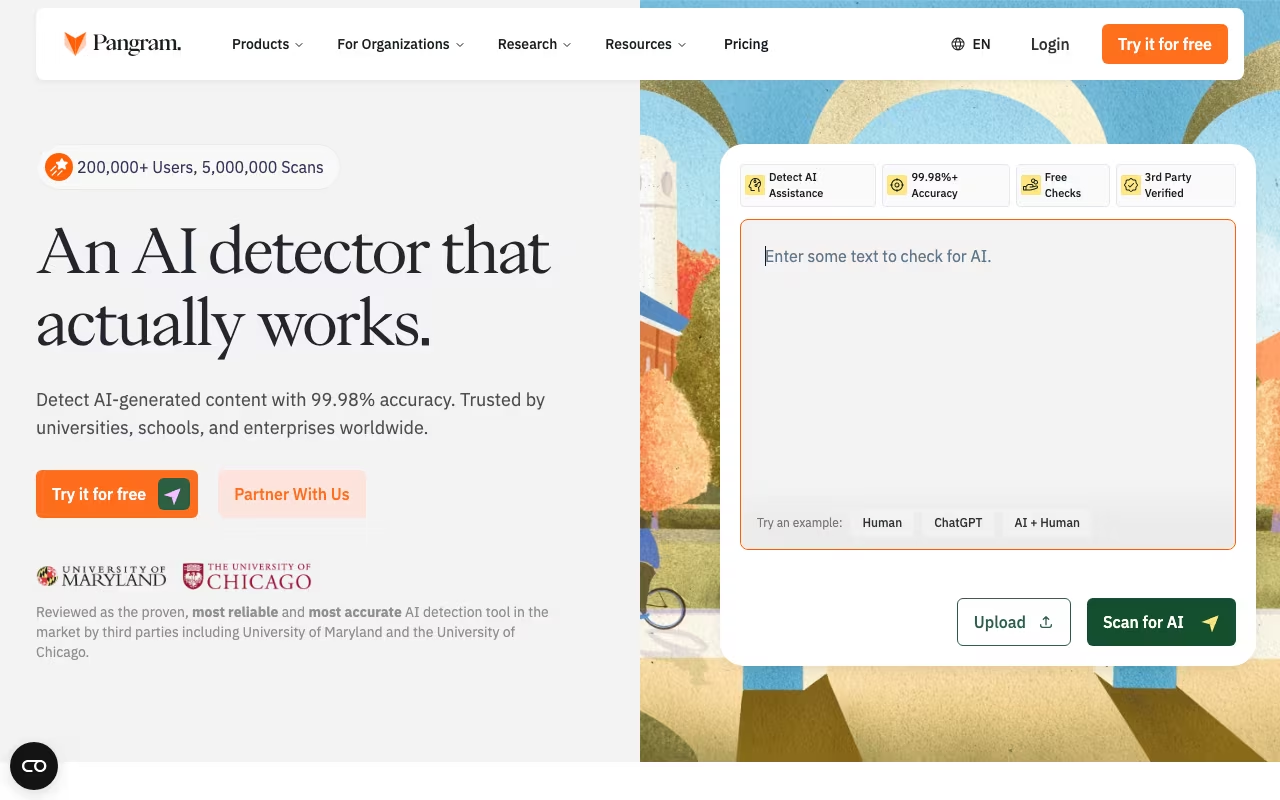
The explosion of AI-generated text from ChatGPT, Claude, Gemini, and dozens of other models has created a massive problem for educators, publishers, HR teams, and anyone who needs to verify that content was written by a human. Pangram Labs is one of the leading AI detection platforms built to solve this. Unlike simpler detectors that slap a "human" or "AI" label on an entire document, Pangram breaks text down segment by segment, showing you exactly which parts were likely AI-generated and which appear genuinely human.
This granular approach matters because real-world content is rarely 100% one or the other. Students use AI to draft sections and then edit. Marketers run copy through ChatGPT for polish. Writers use AI for research and outlines. Pangram's segment-level analysis catches these hybrid cases that binary detectors miss. It supports detection across 20+ languages and identifies content from GPT-4, GPT-4o, Claude 3.5 Sonnet, Gemini, Llama 3, DeepSeek, and other major models.
Try Pangram LabsSegment-Level Detection
This is Pangram's core differentiator. Rather than a single percentage score for an entire document, the sliding-window analysis highlights individual segments with their AI likelihood. You can visually see which sentences and paragraphs triggered the detector. This makes evidence-based conversations possible: instead of blanket accusations ("this paper was written by AI"), you can point to specific sections and ask about them.
Pangram 3.0 (December 2025) introduced a four-tier classification: Fully Human, Lightly AI-Assisted, Moderately AI-Assisted, and Fully AI-Generated. This spectrum acknowledges reality: a student who used ChatGPT for an outline but wrote the content themselves is different from one who pasted in a fully generated essay. Most competing detectors cannot make this distinction.
Accuracy and False Positives
In independent benchmarks, Pangram consistently achieves 95%+ detection accuracy on purely AI-generated text. More importantly, its false positive rate (flagging human-written text as AI) is under 2%, which is critical for any detector used in academic or professional settings. A high false positive rate means innocent people get accused. Pangram takes this seriously.
Detection works across GPT-5, GPT-4o, Claude 4, Gemini 3, Llama 4, DeepSeek, and other major models. The multi-language support covers 20+ languages, though accuracy is highest for English content. Non-English detection is improving but still less reliable for languages with smaller training datasets.
Detect AI Content with PangramBatch Processing and API
For institutions handling large volumes, batch processing analyzes multiple documents simultaneously. Upload a folder of student papers or content submissions and get results for all of them in one dashboard. The API lets developers integrate Pangram's detection into their own platforms: content management systems, learning management systems, publishing workflows, or hiring platforms that screen writing samples.
The LMS integration connects directly with Canvas, Blackboard, Moodle, and other learning management systems. For universities deploying Pangram across departments, this means professors can check submissions without leaving their existing grading workflow.
Pricing
Free: Limited scans per day. Basic analysis without segment-level detail. Enough to test the platform, not for regular use.
Educator ($20/month or $15/month annual): Unlimited scans. Full segment-level analysis. Four-tier classification. Document history and reporting. LMS integration.
Professional ($35/month or $25/month annual): Everything in Educator plus API access, batch processing, team accounts, and priority support. For publishers, content agencies, and HR teams.
Enterprise (Custom): Volume pricing, SSO, custom integrations, dedicated support, and compliance features. For universities and large organizations.
Pangram vs. Turnitin vs. GPTZero
Turnitin: The established name in academic integrity, now with AI detection built into its plagiarism checker. Advantages: institutional trust, existing LMS integrations, combined plagiarism + AI detection. Disadvantages: expensive institutional licensing, less transparent about detection methodology, and some controversy over false positive rates. If your institution already pays for Turnitin, its AI detection may be good enough. If not, Pangram is more affordable and more transparent.
GPTZero: The earliest AI detector to gain mainstream attention. Similar segment-level analysis. Free tier is more generous than Pangram's. Accuracy is comparable for English content. GPTZero has a slight edge in brand recognition. Pangram has better multi-language support and lower false positive rates in our testing.
Pangram: Best balance of accuracy, low false positives, and segment-level transparency. The four-tier classification is unique and reflects how people actually use AI in practice. Pricing is reasonable for individual educators and professionals.
Limitations
- Free tier is too limited for regular use (basic analysis, no segment detail)
- Non-English detection accuracy lags behind English
- Heavily paraphrased or rewritten AI content can still evade detection
- Detection accuracy may drop as newer AI models improve
- No plagiarism detection (Turnitin combines both; Pangram does AI only)
- Smaller market presence than Turnitin or GPTZero
Our Take
Pangram Labs is the most transparent and nuanced AI detector available in 2026. The segment-level analysis, four-tier classification, and low false positive rate make it the best choice for educators and professionals who need evidence-based detection rather than binary "human or AI" verdicts. The $20/month starting price is reasonable, and the LMS integrations make deployment straightforward for educational institutions. The main limitation is the same one every AI detector faces: this is an arms race, and detection accuracy will fluctuate as AI models evolve. But for right now, Pangram is the detector to beat.
Try Pangram Labs