
Last updated: May 2026
What Is ShipBob?
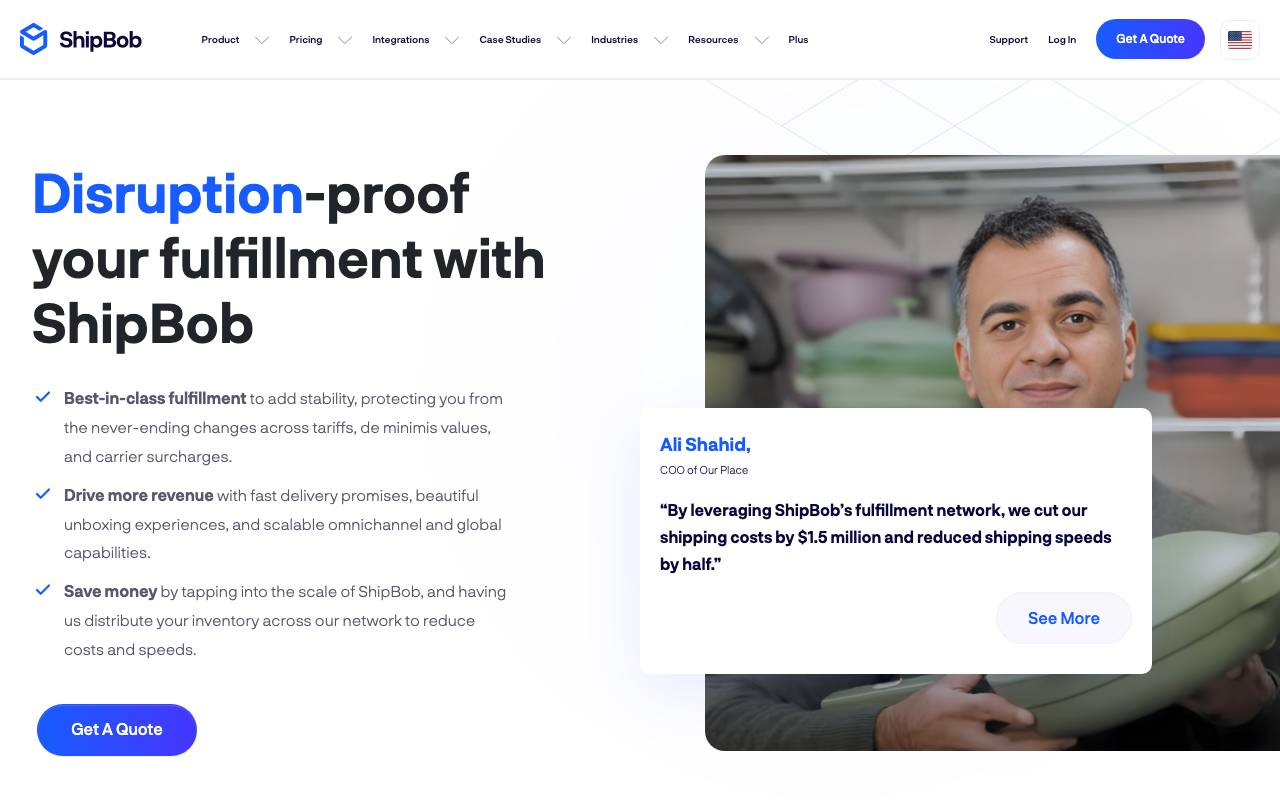
ShipBob is the 3PL (third-party logistics) provider built for direct-to-consumer e-commerce brands. Founded in 2014, ShipBob operates 40+ fulfillment centers across the US, UK, EU, Canada, and Australia, handling pick, pack, and ship for thousands of DTC brands at small to mid-market scale.
The pitch is "Amazon FBA but outside Amazon." Same fast delivery promise (1-2 day delivery to most US destinations), your own brand experience, your own customer relationships. For DTC brands that want to scale fulfillment without warehousing themselves and without ceding the customer relationship to Amazon, ShipBob is one of the leading options.
The technology platform differentiates ShipBob from traditional 3PLs. Real-time inventory visibility, order routing across warehouses, branded tracking, return management, and integration with Shopify, BigCommerce, WooCommerce, and Amazon Seller Central all work through one dashboard.
See ShipBob PricingHow ShipBob Works
Ship inventory to ShipBob warehouses. The software identifies optimal warehouse locations based on your order patterns. Initial inventory distribution may go to 2-3 warehouses to enable fast delivery across regions.
Connect your store. ShipBob integrates with Shopify, BigCommerce, WooCommerce, Amazon Seller Central, eBay, and others. Orders flow into the ShipBob system automatically as customers place them.
Pick, pack, and ship happens at ShipBob warehouses. Standard fulfillment ships orders within 1-2 business days. Premium fulfillment offers same-day shipping for orders placed before cutoff.
The order routing engine chooses which warehouse fulfills each order to minimize delivery time and shipping cost. Customers near Los Angeles get orders from the California warehouse; East Coast customers from the New Jersey or Pennsylvania warehouse.
Branded tracking pages and notifications maintain your customer relationship. Customers receive shipping updates appearing from your brand, not from ShipBob. Custom inserts, packaging, and gift notes possible for an additional fee per order.
Returns processing happens through the same warehouse network. Customers ship returns to the nearest center; ShipBob inspects, restocks, and triggers refunds through your store.
ShipBob Pricing in 2026
No public pricing; custom quotes based on order volume, product mix, storage needs, and warehouse locations.
Typical cost components:
- Storage fees: per cubic foot per month
- Pick and pack fees: per order plus per additional unit
- Shipping rates: ShipBob's negotiated rates pass through to merchants
- Receiving fees: per inbound shipment processed
- Returns: per return processed
For a typical DTC brand shipping 1,000 orders/month at average $25 AOV, total ShipBob cost might run $4-$7 per order all-in (storage + pick + pack + ship). Compared to in-house fulfillment at scale, the math depends heavily on your specific volume, location, and operational efficiency.
Get a ShipBob QuoteWhere ShipBob Wins
- Multi-warehouse network: fast delivery without owning real estate.
- Software-first approach: real-time inventory and order data through one dashboard.
- E-commerce integrations: deep connections to Shopify, BigCommerce, and major platforms.
- Brand experience preserved: customers do not see ShipBob in the transaction.
- International expansion: warehouses in UK, EU, Canada, Australia.
Where It Falls Short
- Per-order fees climb for small orders: low AOV brands pay disproportionate fulfillment costs.
- Setup process takes time: initial inventory placement and integration testing typically takes 4-8 weeks.
- Less customization than specialty 3PLs: subscription boxes or kits with complex assembly may not fit.
- Customer service quality varies: as with all multi-location 3PLs, individual warehouse performance varies.
- Onboarding effort: meaningful investment to migrate from another 3PL or in-house fulfillment.
ShipBob vs Shipmonk vs Red Stag vs Amazon FBA
Shipmonk is the closest direct competitor. Similar scope, somewhat smaller network. Choose based on warehouse locations and specific brand fit.
Red Stag targets higher-value e-commerce with stronger inventory accuracy guarantees. Better for higher-AOV brands.
Amazon FBA is the alternative for sellers who do not mind selling through Amazon. Cheaper per-order in some categories but cedes customer relationship and brand experience.
In-house fulfillment works for brands with sufficient volume, real estate, and operational capacity. The crossover point varies but typically requires 10,000+ orders/month before in-house cost-competes with 3PL.
Who Should Use ShipBob
DTC brands shipping 500-50,000 orders/month: the sweet spot for ShipBob's pricing and capability.
Multi-channel sellers: Shopify + Amazon + other channels through one fulfillment provider.
Brands expanding internationally: use UK, EU, Canada, Australia warehouses.
Skip it if: you ship under 200 orders/month (per-order overhead may exceed self-fulfillment), you sell oversized or hazardous items (specialty 3PLs fit better), or you have very low AOV (per-order fees disproportionate).
Frequently Asked Questions
Does ShipBob handle returns?
Yes. Returns processing available at most warehouses.
Can I use custom packaging?
Yes. Branded boxes, inserts, gift notes available for additional fees.
What e-commerce platforms integrate?
Shopify, BigCommerce, WooCommerce, Magento, Amazon, eBay, Walmart Marketplace, and others.
How long does onboarding take?
4-8 weeks typically for full integration and inventory placement.
What if my orders surge unexpectedly?
ShipBob's warehouses scale with order volume. Peak season (Black Friday, Cyber Monday) handled with advance planning.