Last updated: March 2026
MRPeasy Review: Manufacturing ERP That Small Shops Can Actually Use
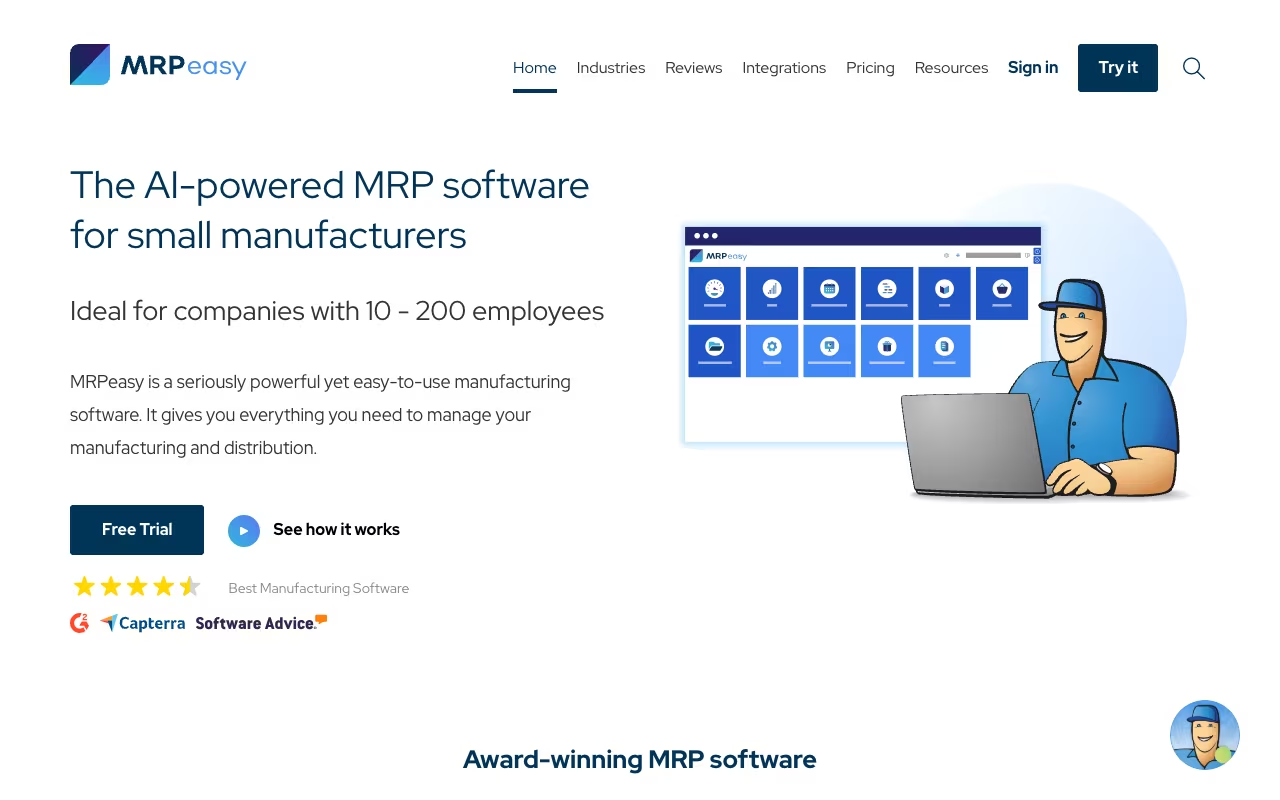
Most ERP systems are built for large enterprises and priced accordingly. SAP, Oracle, and Microsoft Dynamics are powerful, but implementing them takes months, costs six figures, and requires dedicated IT staff to maintain. MRPeasy was built for the other end of the market: small and mid-sized manufacturers with up to 200 employees who need production planning, inventory management, and basic accounting without the overhead of enterprise software.
The name says it all. MRP (Material Requirements Planning) made easy. It is a cloud-based ERP that covers production planning, inventory, procurement, CRM, and basic financials in a single platform. The interface is clean, the learning curve is manageable, and the pricing starts at a level that makes it accessible to shops that previously ran everything on spreadsheets.
MRPeasy now supports 30 languages and serves manufacturers across industries including food production, electronics, furniture, metalworking, and more. For small manufacturers ready to graduate from Excel but not ready for SAP, this is exactly the category of tool worth evaluating.
Try MRPeasy Free for 30 DaysKey Features
Production Planning and Scheduling
At its core, MRPeasy provides material requirements planning that calculates what you need to produce, when you need to produce it, and what materials are required. The production scheduling module uses a drag-and-drop Gantt chart that lets you visualize your entire production timeline, reschedule jobs by dragging them, and see capacity utilization at a glance.
You can manage bills of materials (BOMs) at multiple levels, including configurable BOMs for products with customer-selectable options. The system supports routing (defining the sequence of operations for each product), work center management, and automatic capacity planning. When you enter a sales order, MRPeasy can generate production orders automatically and check material availability before scheduling.
Inventory Management
The inventory module tracks raw materials, work-in-progress, and finished goods across multiple warehouses and locations. Stock levels update in real-time as production orders consume materials and finished products are received. The system supports lot traceability, serial number tracking (on Professional and above), and automatic reorder points that trigger purchase orders when stock drops below your defined thresholds.
For manufacturers dealing with perishable materials or regulated industries, the lot traceability feature provides full forward and backward traceability. You can trace any finished product back to the specific material lots used in its production.
Procurement
MRPeasy generates purchase orders based on production requirements and inventory levels. You can manage multiple suppliers per item, compare pricing, and track lead times. The system creates purchase suggestions based on your MRP calculations, so you know exactly what to order and when to order it. Receiving against purchase orders updates inventory automatically.
CRM and Sales
The built-in CRM is basic but functional. You can manage customer records, track sales opportunities, create quotes, and convert accepted quotes into sales orders that feed directly into production planning. It is not a replacement for Salesforce, but for small manufacturers whose sales process is straightforward, it covers the essentials without needing a separate CRM subscription.
B2B Customer Portal
Available on Professional plans and above, the customer portal gives your B2B clients self-service access to view their order history, check order status, and see your company branding. This reduces the number of "where's my order?" emails and gives customers the transparency they increasingly expect.
MRPeasy Pricing in 2026
MRPeasy offers four plans, all with a 30-day free trial, no contracts, and no hidden fees. Pricing is listed in euros:
Starter (EUR 39/user/month): Covers the essentials. Production planning, BOM management, basic inventory, procurement, CRM, and basic accounting. Includes 10 integrations. This plan handles core MRP functions for small shops with straightforward production processes.
Professional (EUR 59/user/month): Adds the B2B customer portal, quality control modules, serial number tracking, and additional reporting. Totals around 24 features across base and professional tiers. This is where MRPeasy becomes genuinely useful for shops that need traceability and quality management.
Enterprise (EUR 79/user/month): Adds Master Production Schedule (MPS), multi-site production, barcode scanning, maintenance management, and advanced scheduling. This plan is designed for manufacturers operating across multiple facilities or needing more sophisticated planning tools.
Unlimited (EUR 125/user/month, minimum 2 users): Everything in Enterprise, plus API access, webhooks, and no usage limits. This is for manufacturers who need integration with other systems or want to build custom workflows on top of MRPeasy's data.
For all plans, users beyond 10 are charged at a flat rate of EUR 69 per 10-user increment. Annual billing saves one month (roughly 8% discount). No module-based pricing or hidden fees.
What I Like
- Genuinely intuitive for manufacturing software. The interface is clean and well-organized. The drag-and-drop Gantt chart for production scheduling is visually intuitive. New users can navigate the system with minimal training, which is rare for ERP software.
- All-in-one without the complexity. Having production, inventory, procurement, CRM, and accounting in a single platform eliminates the need to stitch together multiple tools. For small manufacturers, this integration is the whole point.
- Transparent, affordable pricing. Starting at EUR 39/user/month with no long-term contracts or implementation fees makes MRPeasy accessible to shops that cannot afford five-figure ERP deployments. The 30-day free trial gives you real time to evaluate with your actual production data.
- Cloud-based with nothing to install. No on-premise servers, no IT infrastructure, no maintenance. Your team can access the system from any browser, which is particularly valuable for manufacturers with staff split between the office and the shop floor.
- 30 languages supported. For manufacturers operating in non-English markets or with multilingual teams, the language support is thorough and well-implemented.
What I Don't Like
- Limited for large or complex operations. Once you grow past 200 employees or need advanced production planning (multi-constraint scheduling, AI-based demand forecasting, complex subcontracting), MRPeasy will start to feel constraining. This is a tool for small manufacturers, and it does not pretend otherwise.
- Customization is basic. You can configure fields and workflows to a point, but MRPeasy does not offer the deep customization that larger ERPs provide. If your manufacturing process has unique requirements that do not fit MRPeasy's standard modules, you may hit walls.
- No native mobile app. The platform is browser-based and responsive, but there is no dedicated mobile app for shop floor workers. Accessing MRPeasy on a phone browser works but is not optimized for scanning barcodes on the move or quick data entry in a production environment.
- API access limited to Unlimited plan. If you need MRPeasy to integrate with other systems via API or webhooks, you are required to be on the most expensive tier at EUR 125/user/month. This feels restrictive for growing companies that need integrations before they need every other Unlimited feature.
- Reporting could be deeper. The built-in reports cover the basics, but power users who want custom dashboards, advanced analytics, or KPI tracking beyond standard manufacturing metrics will find the reporting module lacking.
Who Should Use MRPeasy
Small and mid-sized manufacturers (10 to 200 employees) running production on spreadsheets and ready to upgrade to a real system. Job shops, make-to-order manufacturers, and batch production environments where bills of materials and production scheduling are core to the business. Manufacturers who need inventory and procurement management tightly integrated with production planning. Companies that want an ERP they can implement in weeks, not months, without hiring consultants or dedicated IT staff.
Who Should Skip It
Manufacturers with 200+ employees or complex multi-plant operations should look at larger ERPs like Odoo, SAP Business One, or NetSuite. Companies needing deep customization or industry-specific modules (pharmaceutical compliance, aerospace traceability) will likely find MRPeasy too rigid. Service businesses, software companies, or any non-manufacturing operation will find the production-focused features irrelevant. If you need solid API integrations on a budget, the Unlimited-tier requirement for API access may be a dealbreaker.
Frequently Asked Questions
How long does it take to implement MRPeasy?
Most small manufacturers are up and running within 1 to 4 weeks, depending on data complexity. The process involves importing your items, bills of materials, and customer/supplier data (CSV import is supported), configuring your production workflows, and training your team. Unlike enterprise ERPs that require consultants and months of implementation, MRPeasy is designed for self-service setup. The free trial gives you 30 days to test with your real production data before committing.
Can MRPeasy handle make-to-order and make-to-stock production?
Yes. MRPeasy supports both production models. For make-to-order, sales orders trigger production orders automatically. For make-to-stock, you can use the Master Production Schedule (Enterprise plan and above) to plan production based on demand forecasts and inventory targets. Many manufacturers use a hybrid approach, and MRPeasy accommodates this without requiring complex configuration.
How does MRPeasy compare to Odoo Manufacturing?
Odoo is more customizable and scales to larger operations, but it also comes with significantly more complexity. Odoo's modular pricing can add up quickly as you add apps, and implementation often requires developer assistance. MRPeasy is simpler, faster to implement, and more affordable for small operations. If you have under 200 employees and want to be running within weeks, MRPeasy is the better choice. If you need an ERP that will scale to 500+ employees with deep customization, Odoo or a similar platform is worth the extra investment.
Does MRPeasy integrate with accounting software?
MRPeasy includes built-in basic accounting, but it also integrates with external accounting platforms. Integrations with QuickBooks Online, Xero, and other accounting tools are available depending on your plan tier. The built-in accounting covers invoicing, purchase orders, and basic financial reporting. For companies with complex accounting needs, the external integrations let you use MRPeasy for production and inventory while keeping your financial data in a dedicated accounting system.
Final Verdict
MRPeasy delivers exactly what its name promises: material requirements planning made easy. For small and mid-sized manufacturers, it fills a critical gap between spreadsheets and enterprise ERP systems. The production planning, inventory management, and procurement features are solid and well-integrated. The interface is clean enough that non-technical users can learn it quickly. The pricing is transparent and affordable. The limitations are real but predictable. This is not a tool for large, complex manufacturing operations. The customization is basic, there is no mobile app, and API access is locked to the most expensive tier. But for a 20-person shop that is currently running production on Excel, MRPeasy is a massive upgrade. The 30-day free trial with full functionality gives you enough time to import your data and see whether the system fits your workflow before spending a cent.
Try MRPeasy Free for 30 Days