Last updated: April 2026
Academic research is broken for most people. You type a question into Google Scholar, get 50,000 results, and spend hours reading abstracts to figure out whether the evidence actually supports your hypothesis. Consensus fixes this by searching 200 million+ peer-reviewed papers and giving you a direct, citation-backed answer in seconds.
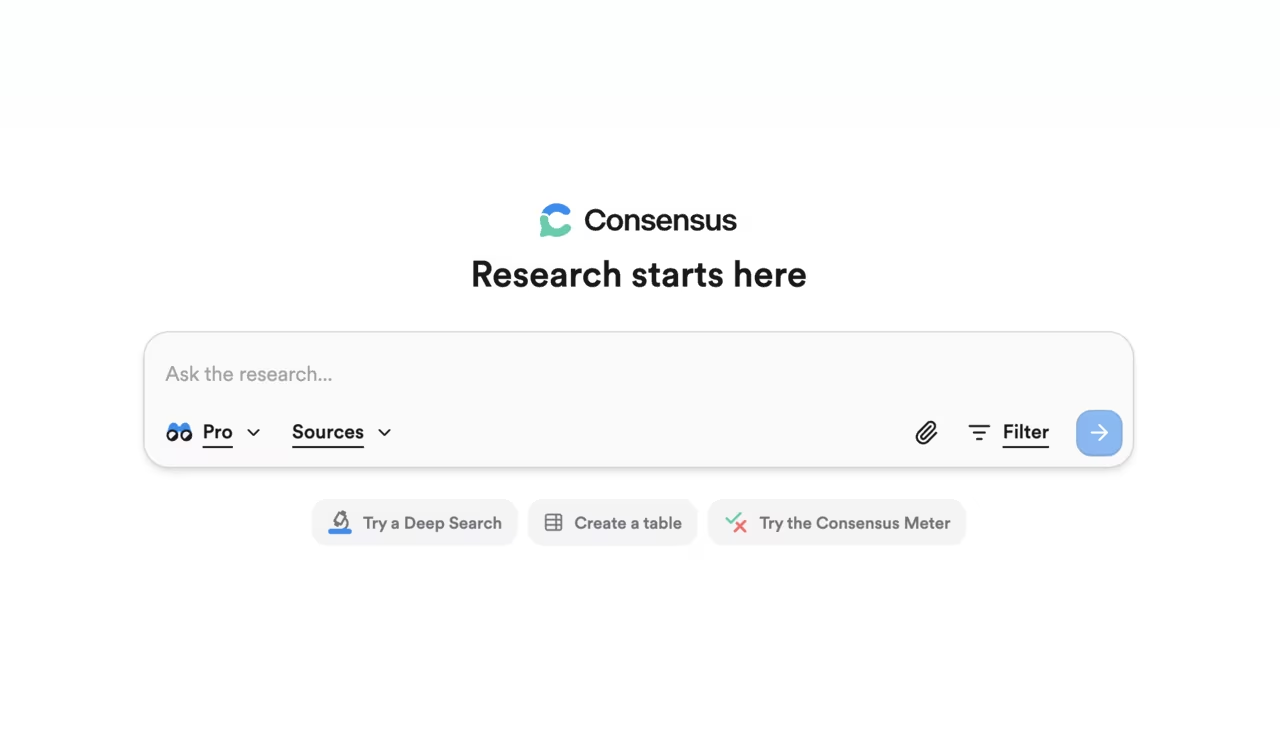
Ask "Does creatine improve cognitive performance?" and Consensus returns a synthesized answer with a visual meter showing what percentage of studies agree, disagree, or are inconclusive. Every claim links to the source paper. No hallucinated references, no paywalled dead ends. Used by students, researchers, and medical professionals at universities and hospitals worldwide.
Try Consensus Free Get started →How the Search Engine Works
Type a research question in plain English. Consensus uses a custom AI model trained specifically on scientific literature to find relevant papers from its index of 200 million+ studies across medicine, psychology, economics, biology, computer science, and more. Results aren't just links. Each paper gets a one-line finding extraction ("This study found that X increased Y by Z%") so you can scan dozens of results without opening a single PDF.
The Consensus Meter sits at the top of results. It's a visual breakdown showing how many studies support, oppose, or are mixed on your query. If 85% of studies say creatine helps cognition and 10% are mixed, you see that immediately. For evidence-based decision making, this feature alone sets Consensus apart from every other research tool.
Study Snapshots and Pro Analysis
Study Snapshots (Premium feature) generate AI summaries of individual papers: methodology, sample size, key findings, and limitations in a structured card format. Instead of reading an 8,000-word paper to find the three sentences that matter, you get them in 15 seconds.
Pro Analysis uses GPT-5 to synthesize findings across multiple papers into a single narrative answer with inline citations. Ask a complex question and get a paragraph-length answer that references 5-10 studies, each citation clickable. This is where Consensus pulls ahead of ChatGPT or Perplexity for research: every claim is grounded in actual peer-reviewed evidence, not web scraping.
Smart Filters and Citation Export
Filter results by study type (randomized controlled trials, meta-analyses, systematic reviews, case studies), publication date, sample size, and journal quality. If you only want meta-analyses from the last 5 years with 500+ participants, you get exactly that. Most general search engines can't filter at this granularity.
Export paper details directly into Zotero, Mendeley, or Endnote. Consensus also generates formatted citations (APA, MLA, Chicago) you can copy with one click. For students writing literature reviews, this cuts hours off the bibliography process.
Search 200M+ Papers Free Get started →Consensus vs. the Alternatives
Educational tools, published pricing
| Tool | Pricing | Model |
|---|---|---|
| Consensus | Free (20 searches/mo), $8.99/mo (Premium) | Freemium |
| Thinkific | $49/mo (lowest published recurring price) | Subscription |
| CodeFast | One-time purchase, lifetime access | One-time |
| Anara AI | AI assistant, custom pricing | Subscription |
| LearnWorlds | $29/mo (Starter), $79/mo (Pro Trainer), $249/mo (Learning Center) | Subscription |
| Gauth AI | Free tier with premium upgrades | Freemium |
Consensus vs. Google Scholar: Google Scholar gives you links and raw abstracts. Consensus gives you synthesized answers with evidence scoring. Scholar wins for exhaustive literature searches where you need every paper. Consensus wins for "what does the research say about X?" questions where you need an answer, not a reading list.
Consensus vs. Elicit: Both are AI research tools built for academics. Elicit lets you build structured extraction tables across papers, which is better for formal systematic reviews. Consensus is faster for quick evidence checks and has a more intuitive search-engine interface. Different tools for different workflows. Many researchers use both.
Consensus vs. ChatGPT/Perplexity: General AI chatbots can discuss research topics, but they hallucinate citations and can't filter by study type or sample size. For anything where citation accuracy matters (clinical decisions, policy briefs, published papers), Consensus is the safer choice. The trade-off: Consensus only covers peer-reviewed literature, so general knowledge questions are better handled by a chatbot.
Pricing
Consensus uses a freemium model with genuinely useful free access:
- Free: 20 AI-powered searches/month, Consensus Meter, basic paper results. Enough to evaluate the tool on real queries before paying anything.
- Premium: $8.99/month ($7.99/month billed annually). Unlimited searches, Study Snapshots, Pro Analysis with GPT-5 synthesis, advanced filters. Best for individual researchers and students.
- Teams: $9.99/seat/month ($120/seat/year). Everything in Premium plus shared libraries, admin controls, and volume discounts up to 200 seats. Built for research labs and academic departments.
For comparison, a Semantic Scholar subscription plus a ChatGPT Plus account ($20/month) costs more and gives you less research-specific functionality. At $8.99/month, Consensus is one of the better values in the AI research tools space.
Where It Excels
- Evidence synthesis speed: What takes 2-3 hours of manual literature review takes 30 seconds. The Consensus Meter alone answers "what does the science say?" faster than any alternative.
- No hallucinations: Every answer is grounded in actual papers. Unlike ChatGPT or Perplexity, Consensus doesn't fabricate citations or misattribute findings.
- Genuinely useful free tier: 20 searches/month is enough for casual research needs. You can evaluate the tool thoroughly before paying.
- Cross-discipline coverage: 200M+ papers spanning all major scientific fields. Not limited to biomedicine like some specialized engines.
- Structured output: Finding extractions, Study Snapshots, and Pro Analysis give you information in usable formats, not walls of raw abstracts.
Where It Falls Short
- Peer-reviewed only: Consensus only indexes academic papers. Industry reports, white papers, patents, and grey literature require a different tool.
- Free tier limits: 20 searches/month runs out fast during heavy research periods. Students writing a thesis will hit the cap in a day or two.
- No full-text access: Consensus finds and summarizes papers but doesn't provide full PDFs. You still need institutional access for the complete articles.
- Humanities gap: The AI works best with empirical studies (medicine, psychology, economics). Qualitative or theoretical fields like philosophy get weaker results.
- Limited integrations: Beyond citation managers (Zotero, Mendeley, Endnote), there's no API access or integrations with note-taking tools like Notion or Obsidian.
Who Gets the Most Value
Graduate students writing literature reviews. Medical professionals checking clinical evidence. Policy analysts who need evidence-backed recommendations. Content writers who want to cite real studies instead of blog posts. If your work involves questions that science has studied, Consensus turns hours of research into minutes.
If you need full-text access to papers, a tool for managing your research library, or coverage beyond peer-reviewed literature, pair Consensus with Google Scholar and a reference manager like Zotero. The combination covers nearly every research workflow.
Start Searching for Free Get started →