Last updated: May 2026
Solvely holds 4.7/5 on the iOS App Store from 31,000+ reviews. Its Trustpilot reviews are 100% one-star. Both numbers are real. The App Store cohort loves the multi-model cross-check and the lecture-recording features. The Trustpilot cohort got stuck in the cancellation flow. This 2026 review covers what Solvely does well, where the billing gets users into trouble, and where it stacks against Gauth, Photomath, and the free alternatives.
Solvely was founded in 2023 in San Francisco by Du Zhang and Enpeng Yuan, bootstrapped, and reportedly hit $6M ARR by April 2025 with a team of nine. The product is broader than the typical math-solver crowd. It covers algebra through advanced calculus, physics, chemistry, biology, statistics, economics, and history, plus a set of study features (lecture-to-flashcards, exam prediction) that the competition does not match.
Try Solvely Free Get started →What Solvely Actually Does
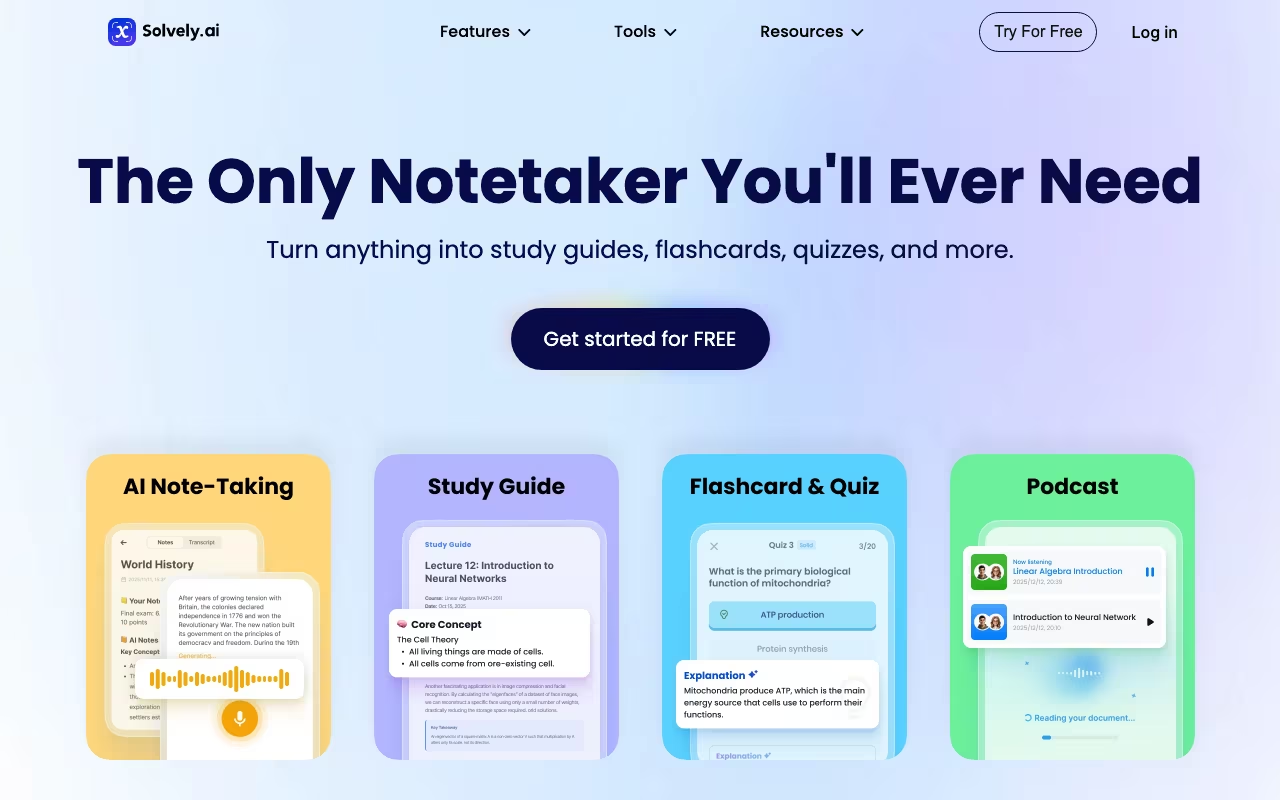
Solvely is three products bundled into one subscription. First, a homework solver: snap a photo of a problem, paste text, or type it in, and Solvely returns a step-by-step solution within 3-8 seconds. Second, a study toolkit: record a lecture, get an auto-transcribed and timestamp-searchable version, then convert it into flashcards, a quiz, or a podcast-style audio summary. Third, an exam predictor: feed it your study material and it generates mock exam questions in the format your class uses.
The homework solver is the most-used path. OCR handles printed mathematical notation reliably. Handwritten problems work for clean handwriting and struggle with messy scrawl. If the OCR misreads, you can edit the extracted text manually before submitting. Solutions include numbered steps with reasoning at each step, not just the final answer. For a quadratic, you see the factoring decision, why the discriminant matters, and what each algebraic move accomplishes.
The Free Tier Is Stingier Than You Think
Most homework apps offer a few free questions per day. Solvely's free tier is two solutions total across the lifetime of your account, then the paywall. This is the single most common surprise for new users and the source of a meaningful chunk of the negative reviews. The home page says "Start Free with Unlimited" which most readers interpret as a generous free tier; the unlimited refers to the duration of the paid plan, not the free one.
If you want to test Solvely without paying, do it deliberately. Snap your two hardest problems, evaluate the solution quality, and decide before you tap subscribe. Do not start the free trial on a low-stakes question and waste the cap.
Pricing in 2026
Solvely's pricing has four tiers plus pay-as-you-go credits:
- Weekly: ~$3.92/week. Best for cramming the week of a midterm or final.
- Monthly: $12.99/month.
- Annual: ~$46.99/year (effective $3.92/month). The cheapest per-month rate by far.
- Gems (pay-as-you-go): starts ~$0.99 for small packs. Useful if you only need a handful of solutions and do not want a subscription at all.
The published free-trial duration is not stated on the site. Some users report being charged within hours of signing up, which suggests either a very short trial window or no trial at all. If you are testing Solvely, assume you will be charged the moment you tap subscribe and plan accordingly.
See Solvely Pricing See plans →The Cancellation Problem
Trustpilot's reviews are 100% one-star, and they describe the same pattern: users could not find the cancel button on solvely.ai, were charged again the next billing cycle, and resolved it through a bank chargeback or App Store/Play Store refund request. The pattern matches the broader "subscription dark patterns" complaint trend that hits a lot of edtech apps in this category.
Practical advice for cancellation: if you subscribed through the iOS App Store, cancel via Settings → [Your Name] → Subscriptions → Solvely → Cancel. On Android, Play Store → Profile → Payments & subscriptions → Solvely. If you subscribed through solvely.ai directly, log into your account and look for the subscription page; if you cannot find the cancel option, email support directly with a screenshot of the missing button. Apple and Google honor cancellation immediately regardless of what the third-party app's UI does, so prefer those paths.
Solvely has not published a refund policy on the site as of this writing. Treat any annual purchase as final.
The Multi-Model Cross-Check Differentiator
This is the feature that separates Solvely from Gauth, Photomath, and the rest: it runs the same problem through multiple LLMs in parallel and surfaces the cases where the models disagree. When all models converge on the same answer, Solvely presents one solution with high confidence. When they diverge, you see the divergence and can compare the reasoning paths. For competitive exam prep where one wrong intermediate step propagates, this is a genuinely useful design.
The trade-off is generation cost. Multi-model cross-check is more expensive to run than a single-model call, which is part of why the free tier is so stingy. The math on Solvely's unit economics likely depends on free users not consuming many tokens.
Lecture-to-Flashcards Mode
If you record a 50-minute lecture in the Solvely app, the AI transcribes it, indexes it by timestamp, and lets you ask questions about specific moments. You can then auto-generate flashcards from the lecture content, a quiz to test your retention, or a podcast-style audio summary you can listen to during a commute or workout. None of Gauth, Photomath, Mathway, or Symbolab does this. The closest comparable is Notion AI or Otter.ai, but neither is built for academic study workflows.
The quality is uneven. The transcription itself is solid for clear classroom audio. Flashcard generation tends to over-include trivia and under-include the conceptual hierarchy you actually need to learn. You will get useful cards, but you will also need to prune. The exam predictor is similarly imperfect: it generates plausible-looking questions but cannot guess what your specific instructor will emphasize.
Accuracy by Subject
Solvely advertises ~95% accuracy on basic algebra, which third-party reviewers have confirmed within an order of magnitude. Subject-level breakdown based on aggregated reviews:
- Algebra and arithmetic: very strong. OCR + symbolic engine reliable.
- Calculus (single-variable): solid on textbook derivatives and integrals. Weaker on improper integrals, series convergence, and proof-based problems.
- Statistics and probability: good on standard distributions and hypothesis tests. Less reliable on multi-variate problems.
- Physics: strong on formula-driven problems with proper unit tracking. Weaker on conceptual questions and ambiguous diagrams.
- Chemistry: solid on stoichiometry, equilibrium, and acid-base. Weaker on organic mechanism drawing.
- Geometry: weakest STEM area because OCR struggles with figures. Multi-step proofs frequently misinterpreted.
- History and humanities: surface-level summaries, generic essay structure. Use Claude or ChatGPT instead for these subjects.
The most useful Solvely-specific tip: when you get a solution, tap any individual step for the "explain this step" drill-down. This forces the AI to defend its reasoning at that point, which often surfaces errors that the multi-model check missed.
Solvely vs Gauth vs Photomath vs Mathway vs Microsoft Math Solver
Educational tools, published pricing
| Tool | Pricing | Model |
|---|---|---|
| Solvely | Free (limited), premium plans available | Freemium |
| Thinkific | $49/mo (lowest published recurring price) | Subscription |
| CodeFast | One-time purchase, lifetime access | One-time |
| Anara AI | AI assistant, custom pricing | Subscription |
| LearnWorlds | $29/mo (Starter), $79/mo (Pro Trainer), $249/mo (Learning Center) | Subscription |
| Gauth AI | Free tier with premium upgrades | Freemium |
The homework-AI space is crowded. Here is how Solvely stacks against the four most-cited alternatives:
| Tool | Free tier | Paid (USD) | Best for |
|---|---|---|---|
| Solvely | 2 lifetime solutions | $12.99/mo or $46.99/yr; weekly $3.92 | Multi-subject + lecture-to-flashcards + exam prediction |
| Gauth | Limited daily questions, ad-free | $11.99/mo or $99.99/yr; Tutor +$19.99/mo | Multi-subject + optional live human tutor |
| Photomath | Basic answers, ads | $9.99/mo or $69.99/yr | Pure math; strongest symbolic engine; Google-owned |
| Mathway | Final answers, no steps | $9.99/mo or $39.99/yr | Cheapest annual; weakest free tier |
| Microsoft Math Solver | Fully free | $0 | Budget-only; math only |
Quick decision framework: if you need multi-subject homework help PLUS lecture recording PLUS exam prediction in one app, Solvely is the only product that does all three. If you only need math and want the most reliable symbolic engine, Photomath. If you want a more generous free tier with daily questions instead of a 2-lifetime cap, Gauth. If you want fully free with no risk, Microsoft Math Solver.
What Students Like
- Multi-model cross-check: catches errors that single-model competitors miss. Genuinely unique.
- Lecture recording with searchable transcript: not just transcription; you can ask questions about specific moments.
- Auto-generated flashcards and quizzes from lecture content: speeds up exam prep dramatically.
- Exam prediction: imperfect but useful for surfacing topics you might have under-studied.
- Multi-subject reach: math, science, history, economics, language arts all in one app.
- Annual plan price: $46.99/year is competitive with the cheapest annual plans in the category.
- 4.7/5 iOS rating from 31K+ reviewers: the product itself works for most users.
Where Solvely Falls Short
- 2-lifetime free solutions: extremely stingy compared to Gauth's daily quota or Photomath's free basics.
- Cancellation reliability: Trustpilot reviews describe dark patterns. Cancel through Apple or Google, not the app's own UI.
- No published refund policy: any annual purchase should be treated as final.
- Trial-to-paid trap: trial duration not transparent. Some users report being charged within hours.
- Geometry weakness: OCR struggles with figures; multi-step proofs frequently misinterpreted.
- Humanities accuracy: surface-level summaries; use a dedicated LLM (Claude, ChatGPT) for essays and analysis.
- Flashcard pruning required: auto-generated cards over-include trivia. Plan to edit them.
Who Should Use Solvely (and Who Shouldn't)
Good fit: high school and college STEM students who want one app for both homework solving AND active study (recording lectures, generating practice exams). Especially useful for students with multiple subjects to juggle who do not want separate apps for math, science, and study materials. The annual plan at $46.99 is reasonable if you will use the lecture-recording feature 2-3 times per week.
Skip Solvely if: you only need math (Photomath is more accurate and Google-owned). Skip it if you cannot trust yourself to remember to cancel before a renewal (cancellation has friction). Skip it if you do not record lectures or do active studying with flashcards (the differentiating features go unused, and Gauth's daily-quota free tier is a better fit at $11.99/mo). Skip it if Trustpilot's billing complaints are a dealbreaker; the dark-pattern criticism is documented.
Frequently Asked Questions
How many free solutions does Solvely give you? Two total across the lifetime of your account, then you hit the paywall. This is far stingier than competitors. Plan accordingly.
How much does Solvely Premium cost? $3.92/week, $12.99/month, or $46.99/year. The annual plan works out to roughly $3.92/month, which is the cheapest per-month rate. Pay-as-you-go "Gems" start at $0.99.
How do I cancel Solvely? If you subscribed through iOS, go to Settings → [Your Name] → Subscriptions → Solvely. On Android, Play Store → Payments & subscriptions → Solvely. If you subscribed via solvely.ai, log in and look for the subscription page; if you cannot find the cancel option, email support immediately and use a bank chargeback as last resort.
Is Solvely a scam? No, the product works for most users (4.7/5 on iOS from 31K+ reviewers). The criticism is the billing UX, not the homework-solving accuracy.
Solvely vs Gauth: which is better? Gauth has a more generous free tier (daily questions vs Solvely's 2 lifetime) and offers live human tutors as a paid add-on. Solvely has multi-model cross-check, lecture recording, and exam prediction. If you record lectures, Solvely. If you want generous free or live tutors, Gauth.
Solvely vs Photomath? Photomath has the stronger symbolic math engine and is owned by Google. Solvely covers more subjects and includes the study features (lectures, flashcards) that Photomath does not.
Does Solvely work offline? No, the AI runs server-side. Internet connection required.
Is Solvely safe for kids? The app itself is age-appropriate (no chat with strangers, no in-app purchases beyond the subscription). The privacy story is unremarkable; Solvely is a US-headquartered company without the China-ownership concerns that follow ByteDance products like Gauth.
Our Verdict
Solvely is the strongest homework helper for students who want both a solver AND a study toolkit in one app. The multi-model cross-check catches errors that single-model competitors miss, and the lecture-to-flashcards feature is genuinely unique in the category. The $46.99 annual plan is competitive on price. The iOS app earns its 4.7/5 rating.
The billing experience is where Solvely loses points. The 2-lifetime free-solution cap is stingier than competitors, the trial-to-paid window is not transparent, and Trustpilot complaints describe friction in the cancellation flow. Cancel through Apple or Google rather than the app's own UI, and treat any annual purchase as final.
Skip Solvely if you only need math (Photomath is more reliable and cheaper). Skip it if the billing complaints are a dealbreaker. Otherwise, Solvely is the most feature-complete homework + study app on the market in 2026.
Start with Solvely Free Get started →