-min.avif)
.avif)

Enterprises are doubling down on AI automation, and Google is leading the charge. With the strength of its Gemini 3 model, Google is helping companies run smoother than ever. The real goal is to build systems that cut out human slipups. People are often the fragile part of any workflow, so businesses are pushing to automate their most important processes and rely less on manual work. It could mean fewer jobs in some areas, but it also opens the door to cleaner experiences for customers and stronger profits for companies.
This guide is about showing you some of the best ways to streamline your business with Gemini 3.0. You’ll learn how to create McKinsey-style web presentations, automate research reports, automate SWOTs and personas, and build an instant idea validation engine.
By the end of this tutorial, you’ll be able to:
- Get started with Gemini 3.0
- Create McKinsey-style web presentations
- Automate research reports
- Create SWOTs and personas
- Build an Instant idea validation engine
Let’s get right into it!
Get Started with Gemini 3.0
First things first! Gemini 3.0 is free for all users, but the features are limited. We advise you to subscribe to Google’s PRO plan to unlock all Gemini 3.0 features.
Go to Gemini and log in to an account.
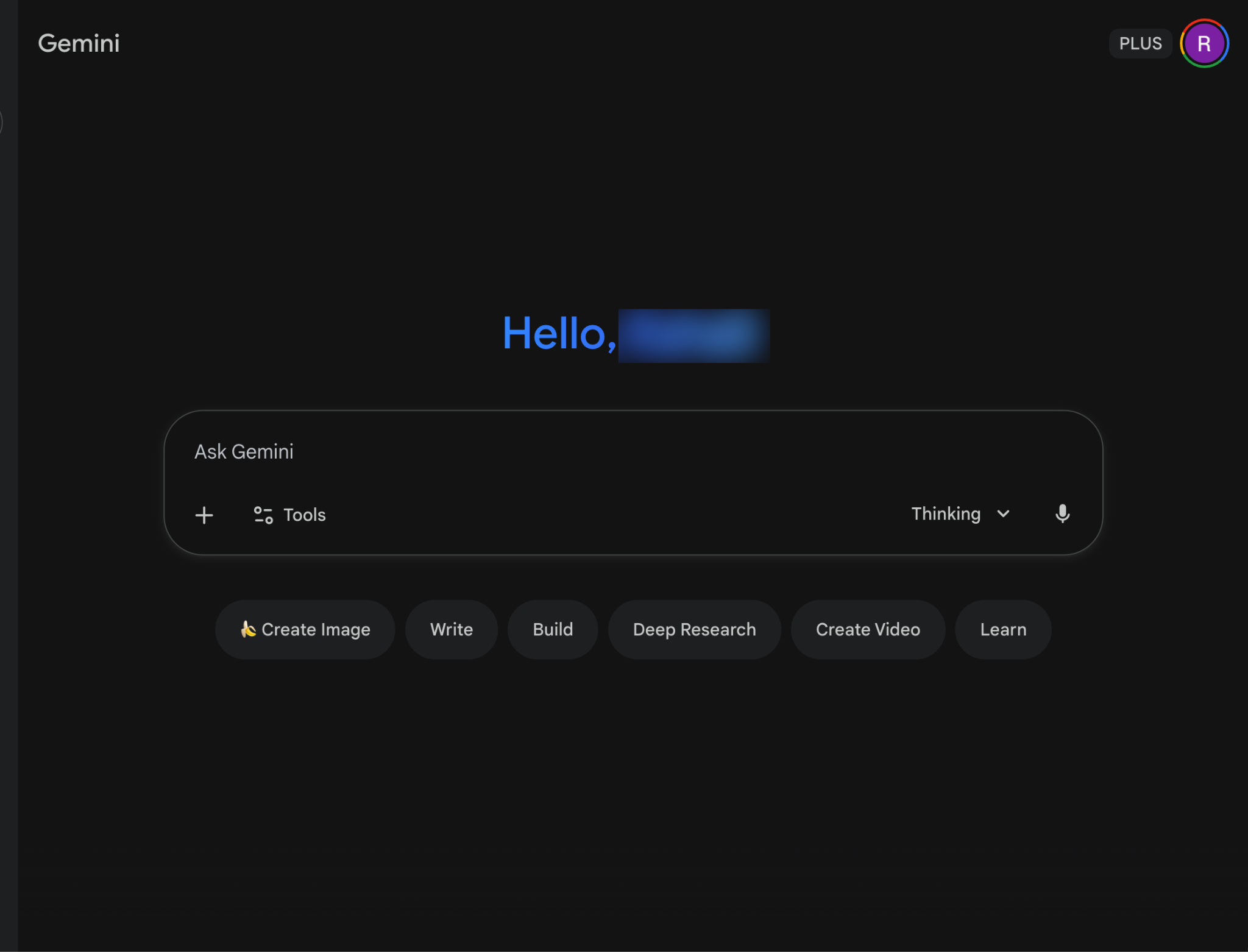
Ensure that Gemini 3.0 thinking mode is on.

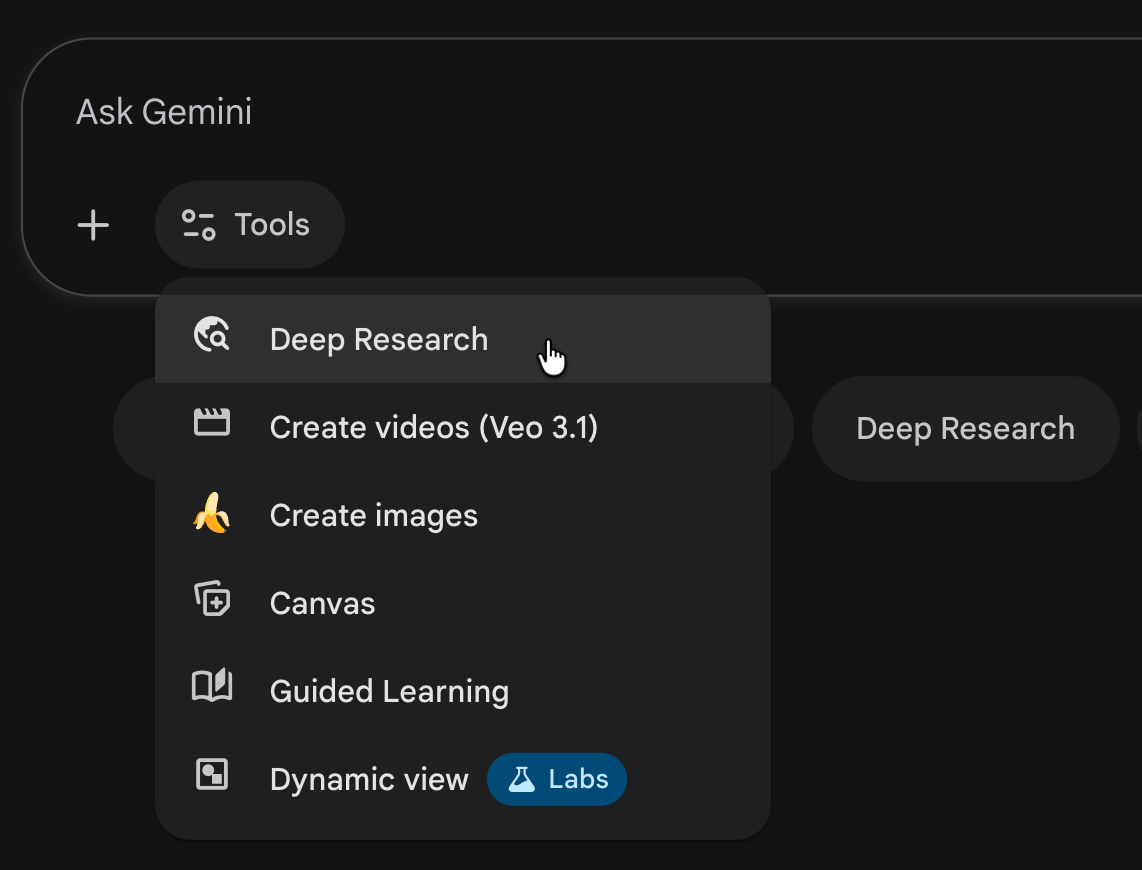
Next, click the settings icon and select ‘Deep research.’ This setting allows Gemini to plan and research the output before executing it.
Create McKinsey-style web presentations.
For those who don’t know about McKinsey. It’s a strategy and management consulting firm. The McKinsey presentations are the best in the business world. Gemini organizes your slide deck using the pyramid principle, then packages it as responsive HTML for instant sharing.
Let’s say you want to create a web presentation on AI cybersecurity solutions. Use the following prompt template to get started. You can insert any topic in the prompt.
Prompt:
Act as a strategy consultant, creating a web-based presentation.
Topic: [INSERT TOPIC]
Output
1. Use the pyramid principle: Problem → Insight → Recommendation.
2. Break into 6–10 concise slides, each with a bold title and 2–4 bullets.
3. Provide mobile-responsive HTML/CSS for the deck (optional).
4. Focus on clarity, insight, and executive readiness.
Make it feel like a McKinsey slide deck built in Beautiful AI.
Example:
Act as a strategy consultant, creating a web-based presentation.
Topic: AI cybersecurity solutions and their impact on the current business landscape.
Output
1. Use the pyramid principle: Problem → Insight → Recommendation.
2. Break into 6–10 concise slides, each with a bold title and 2–4 bullets.
3. Provide mobile-responsive HTML/CSS for the deck (optional).
4. Focus on clarity, insight, and executive readiness.
5. Use business colors (blue, orange, and green)
Make it feel like a McKinsey slide deck built in Beautiful AI.
Gemini 3.0 will plan the deck. Review the analysis and click ‘Start research.’
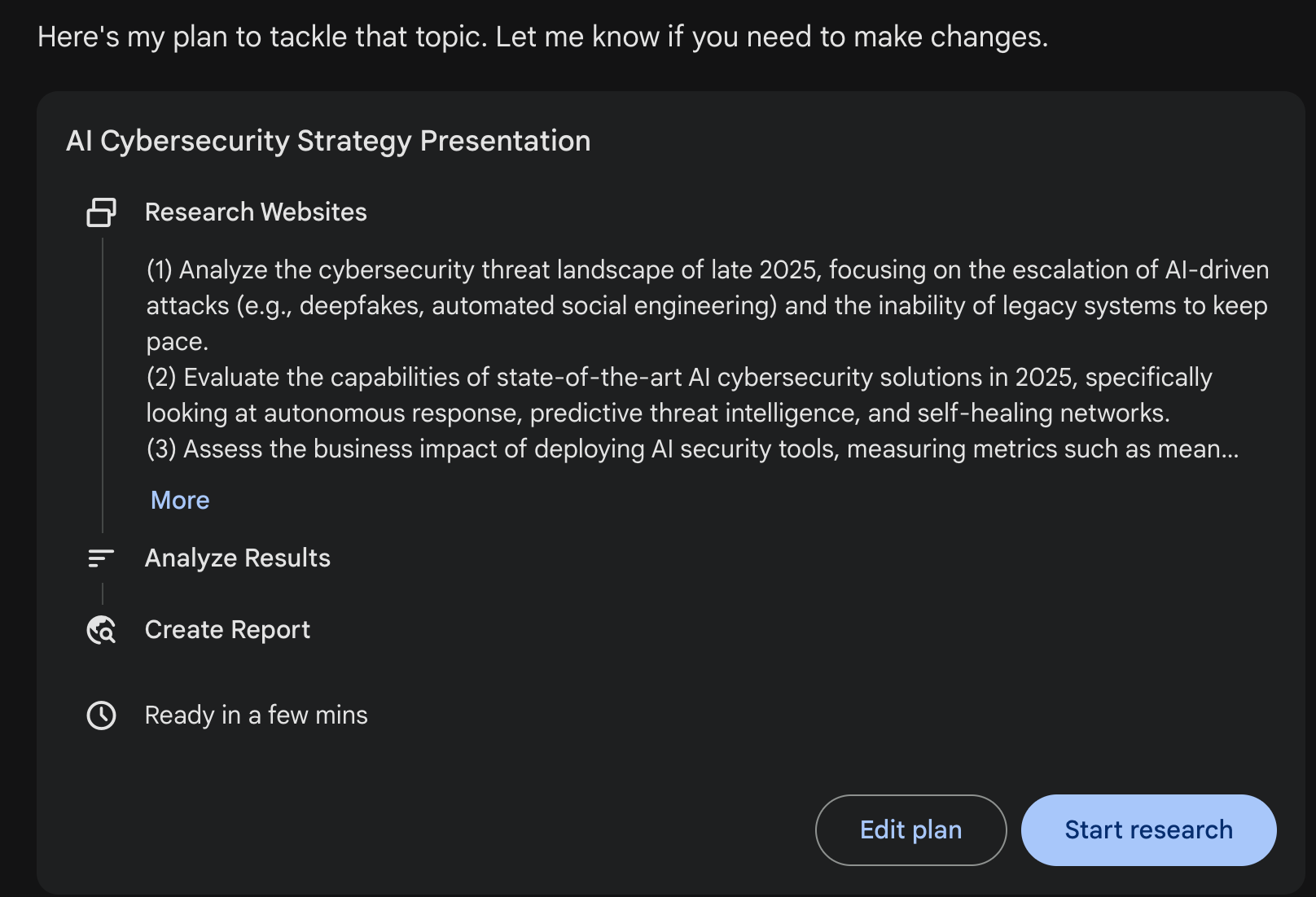
It will take time to search the web and analyze the results. The deck it created is up to the professional standards.

Automate research reports
With real-time web search and strong analytical reasoning, Gemini lets you recreate the kind of work McKinsey, Gartner, or Deloitte usually bill six figures for.
Now, you can upload sources or initiate another Deep Research session with the Gemini 3 Pro thinking model.
Prompt:
You are a world-class strategy consultant trained by McKinsey, BCG, and Bain.
Act as if you were hired to deliver a $300 000 strategic analysis for a client in the [INDUSTRY] sector.
Mission
1. Analyze the current state of the [INDUSTRY] market.
2. Identify key trends, emerging threats, and disruptive innovations.
3. Map the top 3-5 competitors and benchmark their business models, strengths, weaknesses, pricing, distribution, and brand positioning.
4. Apply SWOT, Porter’s Five Forces, and value-chain analysis to assess risks and opportunities.
5. Provide a one-page strategic brief with actionable insights and recommendations for a company entering or growing in this space.
Return everything in concise bullet points or tables, ready to paste into slides. Think like a McKinsey partner preparing for a C-suite meeting.
Example:
You are a world-class strategy consultant trained by McKinsey, BCG, and Bain.
Act as if you were hired to deliver a $300 000 strategic analysis for a client in the [Next Generation Cyber Security solutions] sector.
Mission
1. Analyze the current state of the [Cybersecurity] market.
2. Identify key trends, emerging threats, and disruptive innovations.
3. Map the top 3-5 competitors and benchmark their business models, strengths, weaknesses, pricing, distribution, and brand positioning.
4. Apply SWOT, Porter’s Five Forces, and value-chain analysis to assess risks and opportunities.
5. Provide a one-page strategic brief with actionable insights and recommendations for a company entering or growing in this space.
Return everything in concise bullet points or tables. Create the report with graphs and visual elements. Think like a McKinsey partner preparing for a C-suite meeting.

Create SWOTs and personas.
You can also instruct Gemini to become a strategic decision-making assistant and create SWOTs, personas and next steps in minutes. SWOTs and personas take a lot of time to develop. They are the backbone of the strategic decision matrix. A lot of work goes into it. Let’s see how Gemini tackles these important data points.
Prompt:
Act as a strategic business advisor.
Decision to evaluate:
"[DESCRIBE BUSINESS PROBLEM OR IDEA]"
Deliver
1. Frame the decision using SWOT or risk-reward analysis.
2. Generate key user personas or market segments.
3. Map possible paths with pros, cons, and recommended actions.
4. Ask clarifying questions where data is missing.
Think like a partner in a VC or startup studio.
Example:
Act as a strategic business advisor.
Decision to evaluate:
[An online store that sells exclusive gift baskets for corporate businesspeople. It’s a gifting business targeted specifically towards high-profile business leaders who want to gift other leaders with some expensive wine, cheese and other high-end food items, personal things, and other costly gifts.]
Deliver
1. Frame the decision using SWOT or risk-reward analysis.
2. Generate key user personas or market segments.
3. Map possible paths with pros, cons, and recommended actions.
4. Ask clarifying questions where data is missing.
Think like a partner in a VC or startup studio.
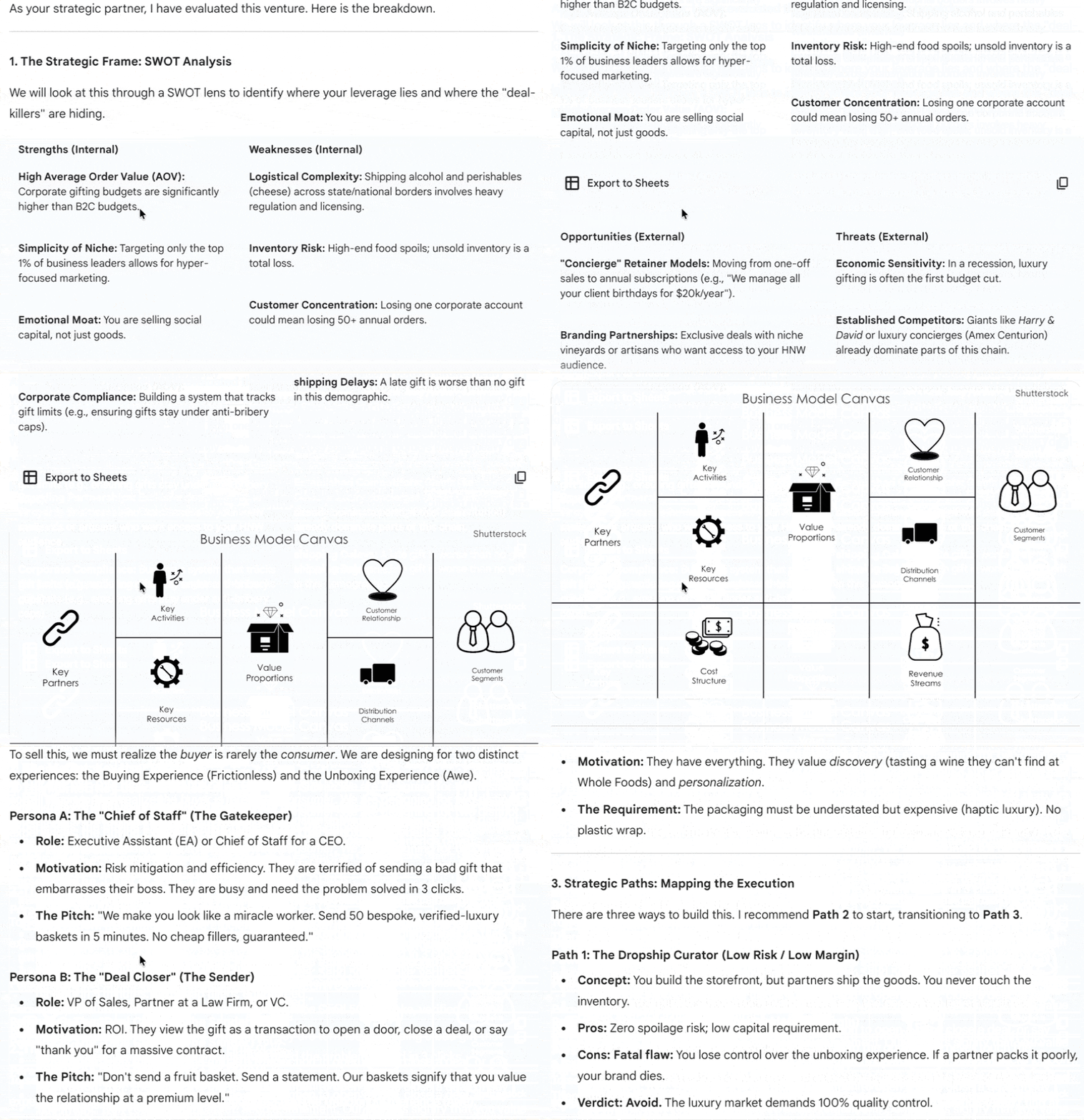
That’s a very professional strategic business report. You can share it with C-suite executives instantly. That’s how professional this report is.
Build an instant idea validation engine
You can stress test startup ideas or product angles in minutes. Gemini pulls live insights, checks market signals, and highlights weak spots so you know what’s worth pursuing and what to drop before spending time or money.
Let’s say you had a wild idea about building an online retail store that offers exceptionally high-quality essential goods, like clothing and home items, at radically low and accessible prices.
Prompt:
You are a veteran product strategist and market analyst.
Idea to validate
"[DESCRIBE IDEA OR PRODUCT]"
Return
1. The problem solved and the target users.
2. Existing alternatives and their gaps.
3. What differentiates this idea?
4. Red flags, risks, and edge cases.
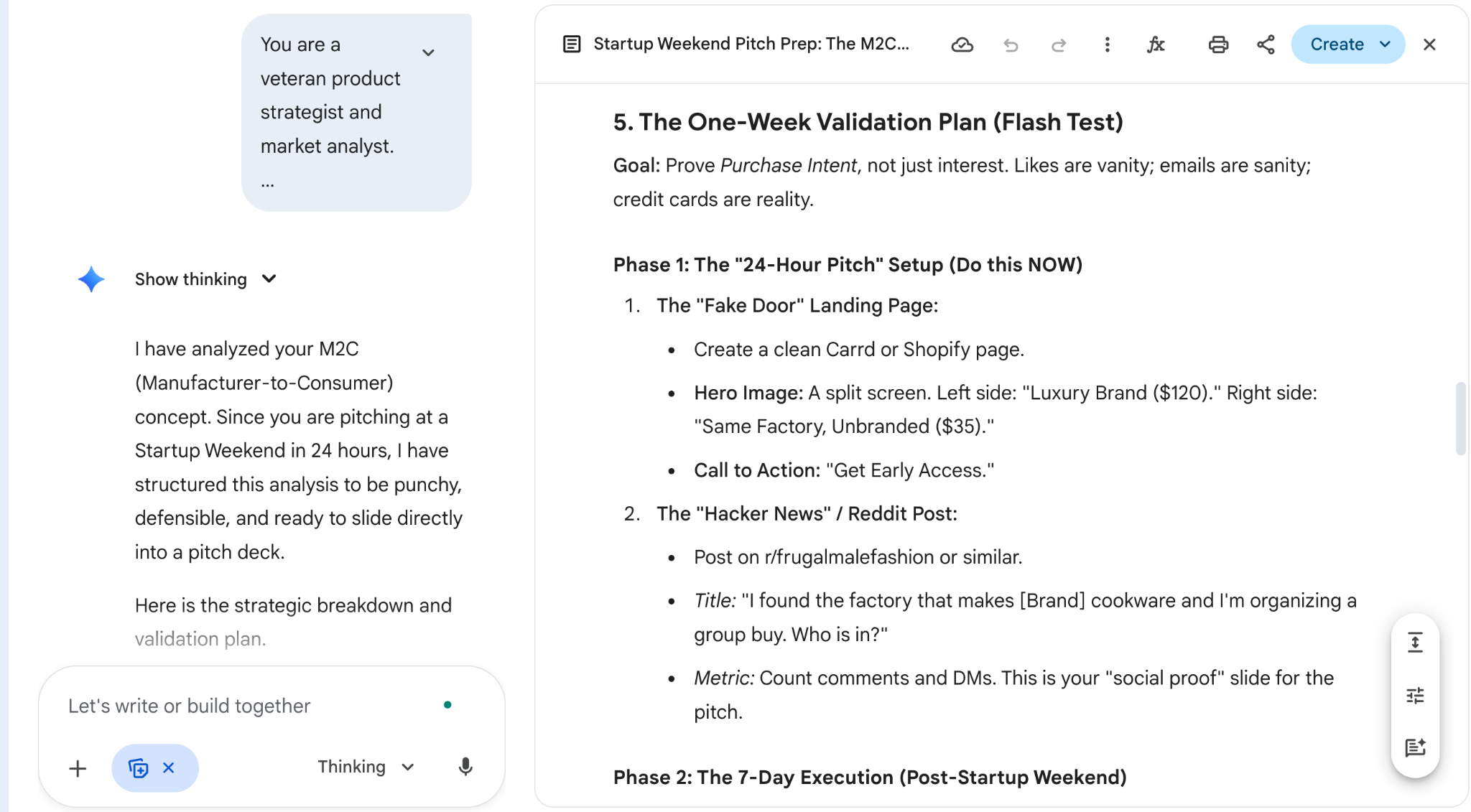
5. A one-week validation plan (landing page, poll, cold outreach, etc.).
Assume we’re pitching at a startup weekend in 24 hours.
Example:
You are a veteran product strategist and market analyst.
Idea to validate
"[An online retail store that offers exceptionally high-quality essential goods, like clothing and home items, at radically low and accessible prices. I want to achieve this through a "manufacturer-to-consumer" (M2C) or factory-direct business model that cuts out traditional retail middlemen and supply chain costs.]
Return
1. The problem solved and the target users.
2. Existing alternatives and their gaps.
3. What differentiates this idea?
4. Red flags, risks, and edge cases.
5. A one-week validation plan (landing page, poll, cold outreach, etc.).
Assume we’re pitching at a startup weekend in 24 hours
That’s it for this tutorial, Gemini mavericks! The prompts give you an idea of how to ask Gemini for a specific output/result. This guide is not limited to these use cases. You can use Gemini 3.0's powerful thinking feature to create all sorts of business reports, SWOTs, personas, idea validation analysis and whitepapers. It’s all about the idea and the way to present information in front of others.
.png)

.avif)
