
Last updated: May 2026
What Is Tenable?
Tenable is the vulnerability management and cyber exposure platform used by 60% of the Fortune 500. Founded in 2002, Tenable went public in 2018 and operates the largest vulnerability database in the industry through its Nessus scanner technology. The product family covers traditional IT vulnerability scanning, cloud security, operational technology (OT), identity, attack surface management, and unified exposure visibility.
The pitch is unsexy but critical. Every organization has thousands of vulnerabilities across infrastructure, cloud, applications, and identity. Knowing which ones actually matter (exploitable, exposed, high-value assets) and fixing them in priority order is the difference between security programs that work and those that drown in noise. Tenable specializes in this prioritization at scale.
The product targets enterprise security teams. Mid-market organizations may use Tenable.io as their primary vulnerability management tool; very large enterprises run Tenable.sc on-premise. SMBs typically need simpler tools like Intruder or Detectify.
Request Tenable DemoHow Tenable Works
The Nessus scanner engine underlies the platform. Nessus is the industry standard for vulnerability scanning, having shipped over 200,000 plugin signatures covering CVEs, misconfigurations, and compliance checks. Tenable.io and Tenable.sc add management, prioritization, and reporting on top.
Tenable.io is the cloud platform: SaaS-delivered vulnerability management with continuous scanning, asset discovery, and threat intelligence integration. Tenable.sc is the on-premise version for organizations needing data residency or running in air-gapped networks.
Tenable One unifies data across IT, cloud, OT, identity, and web apps into a single exposure management platform. Risk-based prioritization combines CVSS scores with exploit prediction (likelihood the CVE will be exploited), asset criticality (does this vulnerability sit on a high-value system?), and exposure context (is the system internet-facing?).
Tenable.cs covers cloud workload protection: AWS, Azure, GCP infrastructure misconfigurations and vulnerabilities. Cloud-native scanning identifies risks in container images, Kubernetes deployments, and serverless functions.
Tenable.ot extends visibility to operational technology: SCADA, industrial control systems, manufacturing equipment. Critical for organizations in energy, manufacturing, healthcare, and other OT-heavy industries.
Integrations with SIEM (Splunk, QRadar, Sentinel), SOAR (Phantom, Demisto), and ITSM (ServiceNow, Jira) push findings into existing security workflows.
Tenable Pricing in 2026
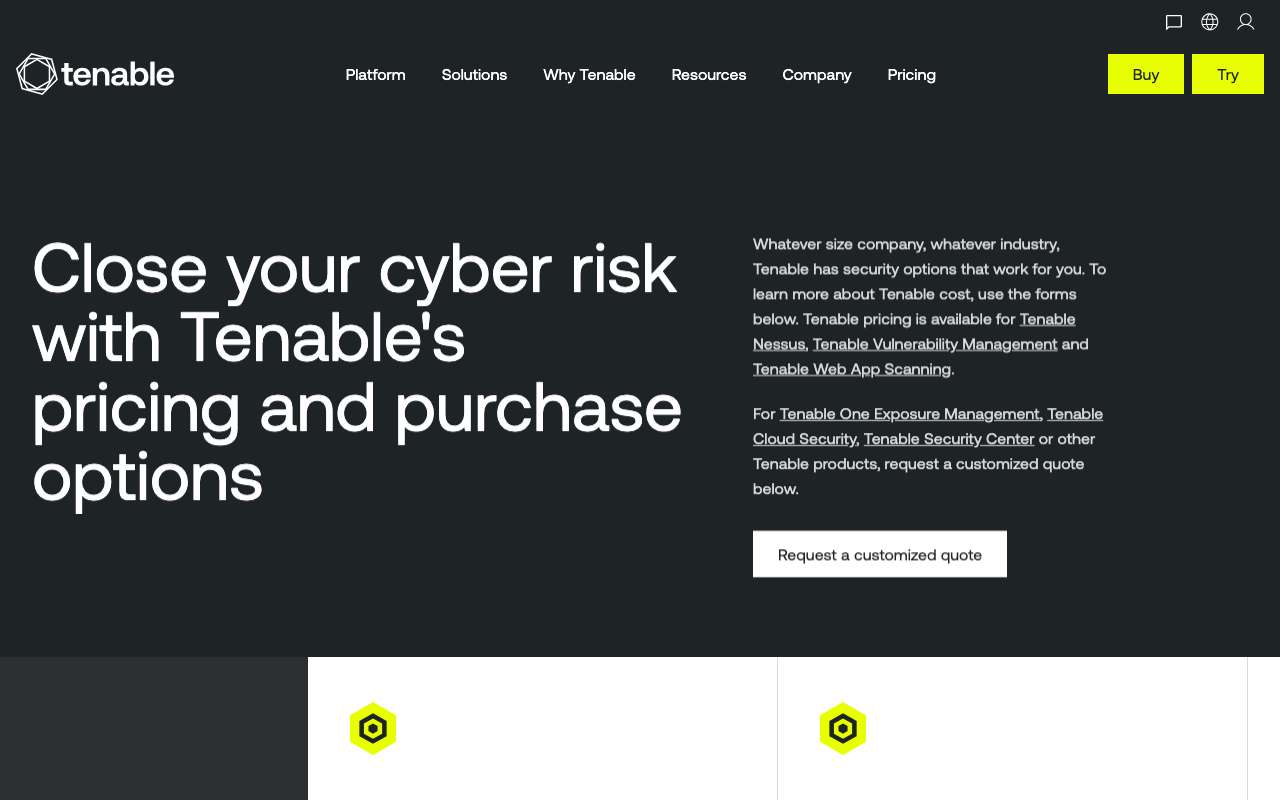
Tenable does not publish pricing. Annual contracts typically based on number of assets scanned. Industry estimates:
- Small business (1-100 assets): $5,000-$15,000/year
- Mid-market (500-5,000 assets): $30,000-$150,000/year
- Enterprise (10,000+ assets): $300,000-$3M+/year
Procurement involves sales calls, scoping exercises, and proof-of-concept deployments. Implementation typically takes 8-16 weeks for enterprise deployments.
Get Tenable PricingWhere Tenable Wins
- Vulnerability database depth: most thorough in the industry through Nessus.
- Risk-based prioritization: cuts the patch backlog into actionable items.
- Multi-layer coverage: IT, cloud, OT, identity, web apps in one platform.
- Industry standard: auditors and regulators recognize Tenable findings.
- Mature ecosystem: thousands of integrations and partner products.
Where It Falls Short
- Expensive: not for small businesses without dedicated security teams.
- Steep learning curve: most teams need formal training.
- UI is dense: feature-rich, not friendly.
- Implementation effort: weeks to months for proper deployment.
Tenable vs Qualys vs Rapid7 vs CrowdStrike
Qualys is the closest direct competitor with similar scope and pricing. Similar enterprise focus.
Rapid7 InsightVM bundles vulnerability management with SIEM and IR. Better unified workflow if you also need security operations.
CrowdStrike focuses on endpoint detection and response. Different category; use both together rather than as substitutes.
Wiz targets cloud-native security with strong CSPM and CIEM capabilities.
Who Should Use Tenable
Enterprises with mature security programs: this is the standard.
Companies under compliance regimes (HIPAA, PCI, SOC 2, FedRAMP): Tenable findings map to audit requirements.
Industrial and energy companies: OT visibility through Tenable.ot.
Skip it if: you are a small business without a security team (use simpler tools like Intruder or Detectify), your security budget is under $50K/year, or your environment is too small to need enterprise vulnerability management.
Frequently Asked Questions
Is Nessus the same as Tenable.io?
Nessus is the scanner engine. Tenable.io is the cloud platform that uses Nessus plus management, prioritization, and reporting features.
Does Tenable cover cloud?
Yes. Tenable.cs covers AWS, Azure, GCP misconfigurations and vulnerabilities including container security.
What about web applications?
Tenable.io WAS handles web application security testing including OWASP Top 10 coverage.
Does it integrate with SIEM?
Yes. Native integrations with Splunk, QRadar, Microsoft Sentinel, and others.
What is risk-based vulnerability management?
Prioritizing vulnerabilities by combining CVSS, exploit prediction, asset criticality, and exposure context rather than just CVSS scores.