
Last updated: March 2026
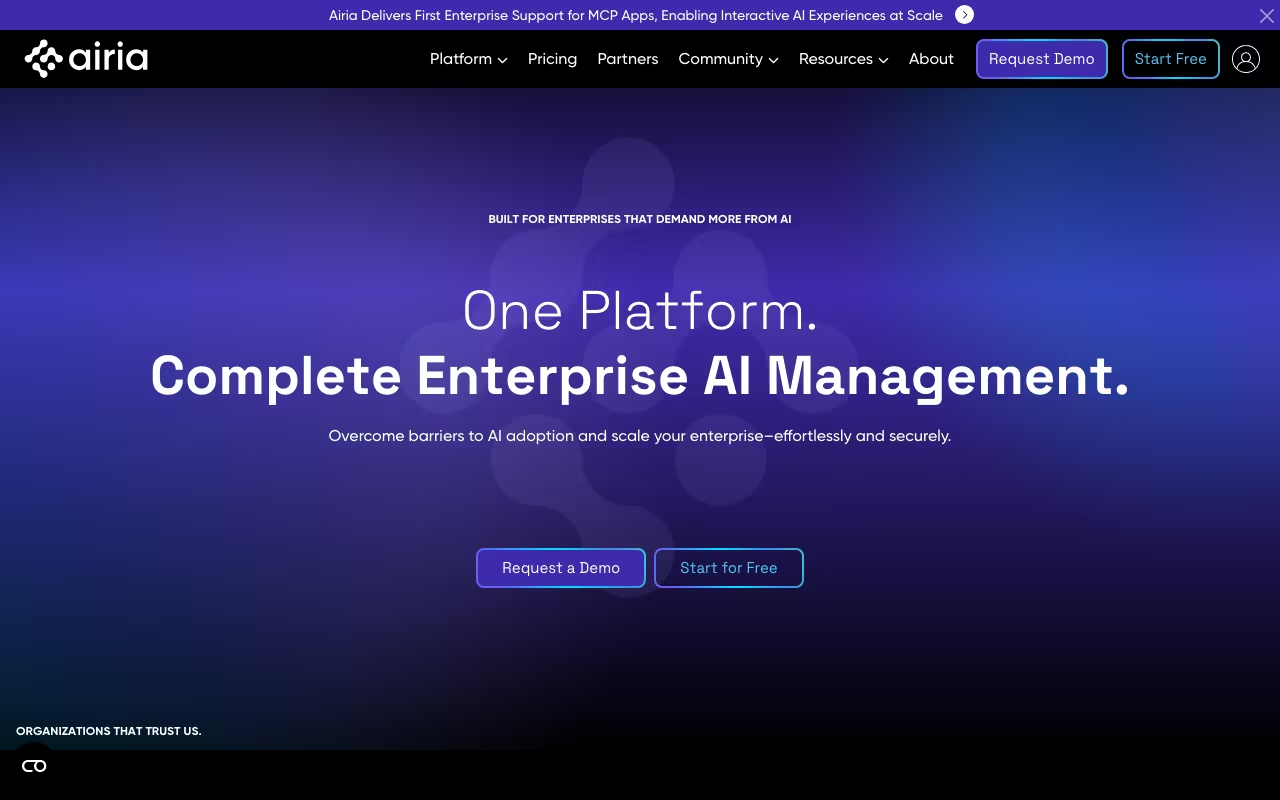
Every large company has the same AI problem right now: marketing is using ChatGPT, engineering is on Claude, the data team has a custom model, and nobody knows what anyone is spending. Airia is middleware that sits between your teams and all those AI models, giving you one interface, one set of governance rules, and one cost dashboard.
Think of it as an API gateway for AI. Instead of every team managing their own AI vendor relationships, Airia routes requests to the right model (OpenAI, Anthropic, Google, or others) based on the task, cost constraints, and your company's policies. Backed by $100M in funding and serving 300+ enterprise customers (including BuzzFeed, ArcelorMittal, and Northwestern University), they've got real traction.
Explore Airia for Your Enterprise Get started →The Core Value Proposition
Multi-model routing: Send requests to different models based on task type. A simple summarization task can go to a cheaper model; a complex analysis goes to the best available. This alone can cut AI costs 30-40% without anyone noticing a quality difference.
Governance and compliance: Define who can use which models, what data can be sent to external AI, and how outputs are audited. If you're in a regulated industry, this is the piece that makes AI adoption possible at all.
Cost tracking: See exactly what each team, project, and use case is spending on AI. No more surprise invoices from OpenAI.
Enterprise integrations: Connect AI capabilities to your existing systems (Salesforce, SAP, internal databases) without each team building custom integrations.
Pricing
Airia actually publishes prices, which is refreshing for an enterprise AI platform:
- Free: $0 forever. 1 user, 100 monthly agent executions, 10 agents.
- Individual: $50/month. 1 user, 1,000 monthly executions.
- Team: $250/month. Unlimited users, 10,000 monthly executions.
- Enterprise: Custom. SSO/SAML, audit logs, dedicated support.
14-day free trial on all plans. The free tier is genuinely useful for testing.
Request Airia Pricing See plans →Where Airia Shines
- AI cost control: Smart routing between models can significantly reduce spend without degrading quality
- Compliance-first design: Data handling policies, audit trails, and access controls that regulated industries require
- Vendor flexibility: No lock-in to a single AI provider. Switch models or add new ones without changing anything downstream.
- Visibility: Finally know who is using AI for what across your organization
Where It Falls Short
- Enterprise-only: If you have 20 employees, you don't need an AI orchestration layer. Just pick a model and use it.
- New category: AI orchestration is an emerging space. Airia is building the market alongside the product.
- Implementation complexity: Getting full value means integrating with existing enterprise systems. Budget for implementation time.
- Opaque pricing: No public pricing makes it hard to budget before talking to sales.
Airia vs. Alternatives
Dev tools, published pricing
| Tool | Pricing | Model |
|---|---|---|
| Airia | AI orchestration platform, custom enterprise pricing | Subscription |
| Capacity | Free (5 credits), $25/mo (Starter), $69/mo (Growth), $129/mo (Professional), $299/mo (Business) | Credits |
| UENI | Free website, $9.99/mo (Boost), $14.99/mo (Grow) | Freemium |
| Pagecloud | $20/mo (Starter), $34/mo (Business), $69/mo (Agency) | Subscription |
| Proton | Free, $5.49/mo (Mail Plus), $10.99/mo (Unlimited) | Freemium |
| EasyDMARC | Free (up to 10K emails/mo), from $35/mo (Business) | Freemium |
LiteLLM is open-source and handles multi-model routing. Free, but no governance, compliance, or enterprise features.
Portkey offers similar AI gateway capabilities with a focus on observability.
Building it yourself: Many engineering teams try this first. It works until you need governance, cost tracking, and audit trails, at which point you've built 30% of what Airia does and spent six months doing it.
Is It Worth Evaluating?
If your company is spending $50K+/month on AI across multiple models and teams, and you have compliance requirements around AI usage, Airia solves a real problem. The cost savings from smart model routing alone might cover the subscription.
If you're a 50-person company with one ChatGPT Team plan, this is overkill. Save your money.
See How Airia Manages Enterprise AI Get started →How Airia works
Airia is an enterprise platform for building AI agents and, more to the point, for securing and governing every model, agent and tool already running inside a company. It pairs an agent builder and orchestration layer with a control plane that discovers shadow AI, enforces policy at execution time, and produces continuous compliance evidence. The homepage framing is governance-first: four pillars of Discover, Secure, Govern and Optimize sitting over a five-layer stack that runs from enterprise data up through runtime security. Named customers include ArcelorMittal, Mars, BuzzFeed, Northwestern University, KOA and Learning Care Group.
Agents follow a Build, Connect, Test, Deploy lifecycle, with a choice of drag-and-drop, no-code, low-code or pro-code, iterating on prompts and models in a sandbox before promotion. Models are bring-your-own-key and model-agnostic across 15+ providers: AWS Bedrock, Azure OpenAI and AI Foundry, Google, Anthropic, OpenAI, Mistral, Cohere, Perplexity, xAI, Together AI, AI21, Alibaba, Replicate and Ollama, plus any OpenAI-compliant endpoint. Adding one means supplying a display name, provider, endpoint URL, model ID and optionally per-token pricing so consumption can be tracked. Per agent you set temperature, system and additional prompts, optional live web search, and context settings covering date and time, timezone, user details, chat history and attachments.
Connectivity runs through an MCP gateway and an integration framework the vendor puts at 1,000+ tools and data sources, with 17+ named on the homepage including Slack, Jira, Salesforce, Snowflake, AWS, Google Cloud, Microsoft Teams, Notion, Linear and Claude Code. Governance layers over all of it: data masking and encryption, agent constraints and guardrails, red teaming, risk classification, AI inventory, model routing for cost optimization, audit trail reporting, and automatic mapping to the EU AI Act, NIST AI RMF, HIPAA, ISO 42001 and SOC 2.
Where Airia wins
- Real model portability. Bring-your-own-key across 15+ providers plus any OpenAI-compatible endpoint, local Ollama included, so switching models is not a re-platforming project.
- Governance is the product, not a checkbox. Policy is enforced at the execution layer before a tool call completes, backed by red teaming, agent constraints and an audit trail, which is what actually blocks enterprise agent rollouts.
- Named framework mapping. Automatic mapping to the EU AI Act, NIST AI RMF, HIPAA, ISO 42001 and SOC 2 turns compliance documentation from a project into a dashboard.
- Shadow-AI discovery and AI inventory address the honest starting problem in most large organizations, which is not knowing what models and agents are already in use.
- Cost control is first-class. Model routing to approved or cheaper models, plus per-model pricing entered at setup, so consumption is tracked rather than discovered on the bill.
- One skill ladder from no-code to pro-code lets business teams and engineers work in the same platform without forking standards.
Where it falls short
- Pricing is effectively private. The pricing page is a demo-booking form with no tiers, no numbers, no free tier and no self-serve signup. Tiers exist only as generic personas (individual evaluating, individual running regularly, team, organization).
- The deployment model is not disclosed. Nothing states whether it is SaaS-only or supports VPC or on-premises, which for a security and governance product aimed at regulated buyers is a conspicuous gap you have to raise in the demo.
- The FAQ answers almost none of the technical buying questions and routes you to sales, so there is no way to pre-qualify on architecture, certifications or limits.
- Azure ML integration has documented gaps: no support for body input or nested parameters, and model endpoint URLs with query strings are unsupported.
- The 1,000+ tools figure rests largely on MCP connectors rather than natively built and supported integrations, so depth per connector will vary and needs verifying for the systems you actually depend on.
- Setup burden matches the enterprise scope. Model keys, connectors, policies, guardrails and risk classifications all have to be configured before any value appears, which is not a weekend project for a small team.
Who should use Airia
Airia is aimed at enterprises and regulated organizations that already have AI sprawl and need a single control plane to inventory, secure and govern it while still shipping agents. If your blocker is legal and security sign-off rather than the building itself, the governance layer and the framework mapping are the reasons to look.
It is a poor fit for startups, individual builders, or anyone who wants to swipe a card and start today. There is no public price and no self-serve path, so evaluation begins with a sales call, and you should go into that call with your questions about deployment model, certifications and connector depth written down, because the site will not answer them.