
Why ChatGPT Is Recommending Your Competitors (and How to Fix It)

You asked ChatGPT for the best product in your category. It named three competitors. Your brand didn't make the list. Now multiply that by millions of users asking the same question every day.
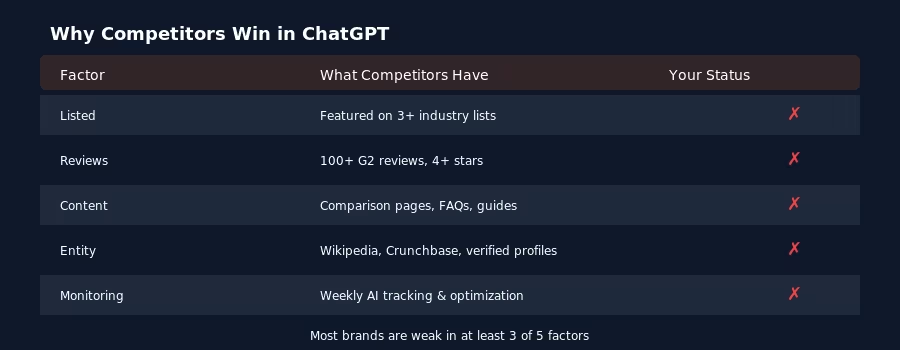
ChatGPT recommends your competitors because they have stronger signals in the five areas the model evaluates: authoritative list mentions, review volume, third-party citations, structured content, and entity recognition. The fix starts with understanding your current visibility gap using HubSpot AEO.
This isn't a theoretical problem. ChatGPT has 883 million monthly users. When someone asks "what's the best CRM for small businesses?" and your CRM isn't in the answer, you've lost a potential customer before they ever visited your site.
Curious where you stand? Run a free 28-day audit.
Check if ChatGPT recommends your brand →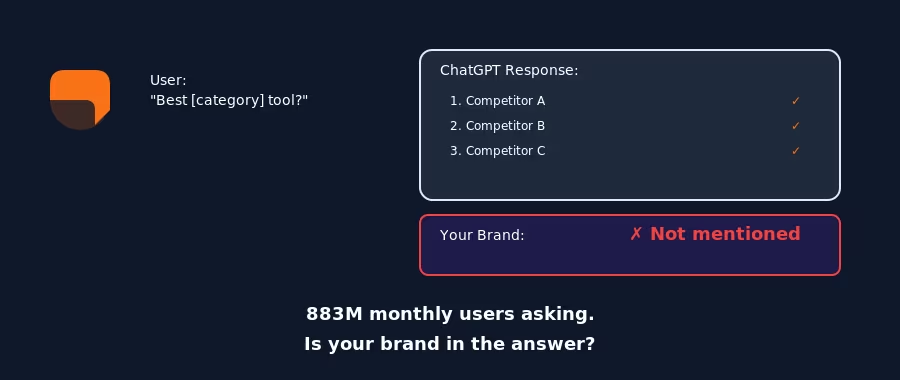
How ChatGPT Decides Which Brands to Recommend
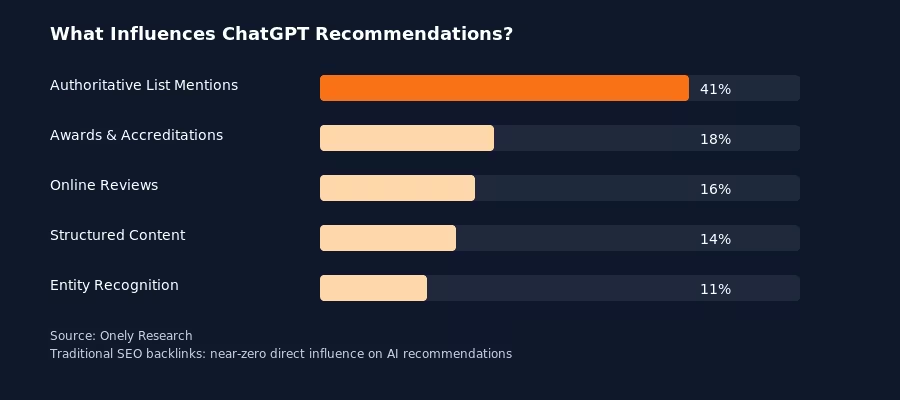
Onely's research analyzed hundreds of commercial recommendations and found three dominant factors: authoritative list mentions account for 41%, awards and accreditations for 18%, and online reviews for 16%. Neil Patel's analysis of 82 ranking factors confirmed that relevancy (0.91) and brand mentions (0.87) are the top two factors.
ChatGPT is more likely to recommend a brand that appears on "best of" lists from trusted publications, has strong review profiles on G2 or Capterra, and is mentioned frequently in contextually rich content across the web.
It's also worth noting what doesn't transfer. Keyword density, meta descriptions, and page speed have little direct influence on ChatGPT recommendations. Domain authority helps indirectly, but a strong backlink profile alone won't get you cited if you lack reviews, editorial mentions, and a clear brand entity. These are signals most SEO campaigns never build, which is why brands are often surprised to find smaller competitors outranking them in AI responses.
The Five Reasons ChatGPT Picks Competitors Over You
1. They appear on more authoritative lists
This is the single biggest factor. If competitors are featured on lists from Forbes, G2, or industry publications and you're not, ChatGPT will recommend them. The model treats curated lists as strong credibility signals.
The fix: pursue editorial mentions on industry publications. Create your own comparison content. Getting featured on two to three high-quality lists can shift your visibility significantly.
2. They have more and better reviews
Brands with 100+ reviews on G2 or Capterra appear in AI recommendations 3x more often than those with fewer than 20. Per Brand24's research, recency matters too. Reviews from the past 12 months carry more weight.
The fix: build a systematic review collection program. Ask customers after positive support interactions. The volume and freshness of your review profile directly affects AI visibility.
3. Your content doesn't answer the questions ChatGPT needs
If your site lacks clear, structured answers to common questions, ChatGPT has nothing to pull from. HubSpot AEO identifies which prompts mention competitors but not you, giving you a specific content roadmap.
The fix: create content that directly answers buyer prompts. Comparison pages, detailed FAQ guides, and "how to" articles give ChatGPT the raw material it needs.
4. Your brand entity isn't well-defined
ChatGPT recognizes brands as entities. If your brand name is generic or not clearly associated with your category, the model might not connect the dots.
The fix: strengthen your brand entity by consistently using your full brand name alongside your category. Wikipedia pages, Crunchbase profiles, and schema markup all help define your entity for AI models.
5. You don't know where you stand
You can't fix what you can't see. Without a tracking tool, you're flying blind. Start with HubSpot AEO for free with a 28-day trial period (or for $50/month). Get your visibility score and prioritized recommendations tailored to your business via CRM integration.
See exactly where you're losing to competitors.
Check your AI visibility gap with HubSpot AEO →A Step-by-Step Plan to Get ChatGPT to Recommend Your Brand
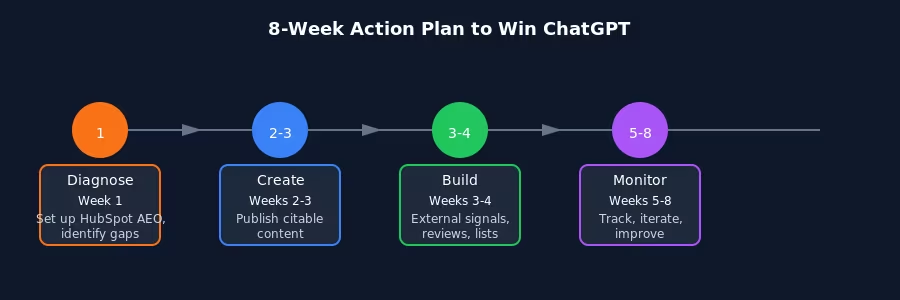
Week 1: Diagnose the gap
Sign up for HubSpot AEO. Enter your domain and competitors. Identify the top 5 prompts where competitors appear and you don't.
Weeks 2-3: Create citable content
For each priority prompt, create one content piece. Clear answers in the first paragraph, structured data, specific numbers, and your brand name + category mentioned naturally.
Weeks 3-4: Build external signals
Pitch for industry "best of" lists (the 41% factor). Launch a review collection campaign on G2 and Capterra. Update Crunchbase and social profiles.
Weeks 5-8: Monitor and iterate
Check HubSpot AEO weekly. Track which prompts now include your brand. Double down on content types that work. Most brands see measurable improvement within 4-8 weeks.
What Early Adopters Are Seeing with AEO
HubSpot's own marketing team put AEO to the test. After optimizing a single page using their AEO framework, they earned 159 AI citations and over 1,000 page views from AI referral traffic within four weeks. The key ingredients: structured answers to common prompts, clear entity association, and consistent brand-category pairing across the page (source: Contrast Blog).
Per HubSpot's 2026 State of Marketing report, 58% of marketers say AI-referred visitors convert at higher rates than traditional organic traffic. As brands build their AI visibility profiles, early movers are capturing demand that competitors haven't even started tracking yet.
The pattern across early adopters is consistent: diagnose your gap, create citable content targeting specific prompts, build external signals (reviews, list mentions, entity profiles), and monitor weekly. Brands that follow this sequence typically see measurable improvement within 4-8 weeks.
The brands seeing the fastest results share a common starting point: they used a tracking tool to identify the specific prompts where competitors appeared and they didn't, rather than guessing at what to fix. That specificity, knowing it's the "best CRM for agencies" prompt rather than CRM prompts in general, allows content and PR efforts to be targeted rather than broad. Without that visibility, optimization becomes guesswork. With it, each action has a measurable outcome to track against.
FAQ
Why doesn't ChatGPT recommend my brand even though I rank #1 on Google?
Google rankings and ChatGPT recommendations use different signals. Only 38% of top-10 Google pages get cited in AI answers. Use HubSpot AEO to see your actual AI visibility score.
The disconnect happens because Google uses link authority and on-page optimization signals, while AI models prioritize how often and in what context a brand is mentioned across third-party sources. A brand that ranks #1 on Google for a keyword may have zero reviews on G2, no mentions on Forbes or industry lists, and a thin brand entity profile, all of which matter far more to AI recommendation systems. Fixing your AI visibility often requires a different set of actions than SEO, which is why tracking both separately is important.
How long does it take to get ChatGPT to recommend my brand?
Most brands see initial results in 4-8 weeks. Getting to parity with established competitors typically takes 3-6 months of consistent optimization.
The brands that see results fastest tend to start with a narrow focus, picking two or three high-priority prompts rather than trying to improve visibility across dozens at once. If a competitor dominates a specific "best for [use case]" prompt, creating one well-structured piece of content targeting that exact query will move the needle faster than broad optimization efforts. Tracking weekly through HubSpot AEO makes it easier to spot which actions are working and where to concentrate effort next.
Can I pay to get recommended by ChatGPT?
No. ChatGPT has no paid placement mechanism. Visibility is earned through authoritative mentions, reviews, and quality content. Tools like HubSpot AEO help identify and close gaps faster.
What content should I create to get ChatGPT to recommend me?
Comparison pages, detailed FAQ guides, and "how to" articles. HubSpot AEO shows which prompts to target based on competitor analysis and your CRM data.
For comparison pages, write a dedicated page that directly addresses queries like "HubSpot vs [competitor]" or "best [category] for [use case]." Open with a clear recommendation in the first sentence, AI models pull from the most direct answers. For FAQ guides, structure each question as an H2 and answer it in two to three sentences before expanding. For how-to articles, include numbered steps with your brand name mentioned naturally alongside the action. The more precisely your content mirrors the phrasing of real buyer prompts, the more likely it is to be cited.
Conclusion: Your Competitors Won't Wait for You to Catch Up
Every day you're not in ChatGPT's recommendations, competitors capture demand you'll never see in your analytics. Try HubSpot AEO with a 28-day free trial to diagnose your gap. Build citable content. Collect reviews. Get on lists. Monitor weekly.
Related reading
Some offers on this page may be paid placements or contain affiliate links.
